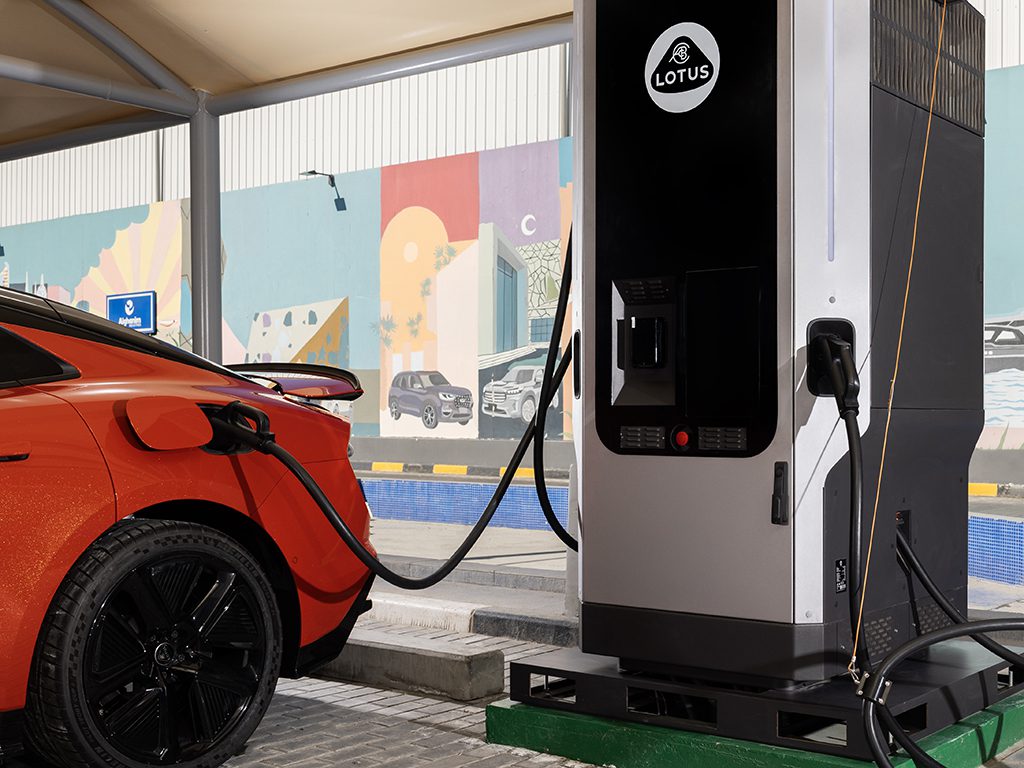
A sedan sat wired to a charger in Kuwait, its battery gauge climbing faster than almost any production car has climbed before.
Lotus described the session as happening under extensive heat conditions in the Gulf region, though the brand did not disclose the exact date or the precise reading at the charger.
Yet the cable stayed cool enough to keep feeding power at a blistering charging rate, and thirteen minutes and thirty five seconds later, the car had gone from nearly empty to nearly full. What let a battery pack swallow that much electricity without melting down is the real story.
How does a car take in that much power without overheating
The trick starts with voltage. Most mainstream EVs still run 400 volt electrical systems, which cap how much current can flow before cables and connectors get dangerously hot.
The Emeya runs an 800-volt charging system, which aims to deliver rapid charging and greater efficiency for drivers , letting the same amount of power move through thinner wiring at lower amperage. That is the foundation everything else builds on.
That alone would not be enough. So Lotus redesigned how the battery itself is built, using a cell to pack structure that allows for 20% more cells to be packaged in the same space compared to a standard module architecture .
More cells sharing the load means each one handles less current, which means less heat. That is the quiet part rarely mentioned on the spec sheet, but it is what keeps the pack from throttling itself during a hard charge.
A liquid thermal loop wraps around all of it, pulling heat away from the cells in real time. Which is precisely why the test worked in Gulf conditions instead of failing.
What the scene at the charger actually looked like
The test was completed independently by Lotus Al Ghanim, the official dealer of Lotus in Kuwait, and used Lotus’ ultra-fast 450kW DC charger . That is a far more powerful unit than the 150 to 250 kilowatt chargers still common across most of the American fast charging network, where fast chargers across America only recently crossed 80,000 total plugs.
Plugged in, the car was able to maximise nearly the full capacity of the charger, reaching a peak charging power of 443kW, enabling it to charge from 10% to 80% in 13 minutes and 35 seconds . Lotus reported the session as independently completed by its Kuwait dealer rather than conducted in a lab.
That beat the car’s own prior best, when testing showed that the four-door reached a peak charging power of 402kW and an average charging power of 331kW , set earlier in a separate test audited by the consultancy P3.
Doing it again, faster, in warmer conditions is the part engineers find more impressive than the raw number. None of this happened in a lab. It happened at a public dealership charger, in weather that can expose a weak cooling design within minutes.
Where the hard numbers come from and why they hold up
The figures trace back to the automaker’s own announcement, which described the session as independently completed by its regional dealer rather than a lab estimate pulled from a brochure. That distinction matters in an industry full of optimistic charging claims.
Lotus says the Emeya 2026 model year features a WTLP range of up to 379 miles (610 km), and that with a WLTC energy consumption down to 18.7kWh/100km, Emeya delivers up to 310km of range in 10 minutes .
So the headline number is paired with a usable range figure, which is what actually matters to a driver standing at a plug. Other automakers publish similarly fast 800 volt numbers.
A Lucid sedan recently drove 749 miles on one charge in a separate test, a different kind of record built on the same high voltage foundation.
Where this record runs into real limits
That 450 kilowatt charger is not common outside select Lotus dealerships and parts of Europe, where Lotus has already begun installing its 450kW chargers in Germany, with more European markets to follow soon . Most American drivers plugging into a public network today will not find a charger capable of pushing anywhere near that output.
Even on the right hardware, the numbers assume a mostly empty battery and ideal starting conditions.
Charging curves taper sharply past 80 percent, which is why every fast charging claim gets measured in that same 10 to 80 percent window rather than zero to full. And the car remains a low volume hyper GT, not a mainstream sedan.
Technology like this tends to filter down over years, the same path 800 volt systems took from early Korean EVs into today’s broader market, the way EV sticker prices have shifted as the segment matures.
What this means for drivers watching the charging race
The number that matters most to an ordinary driver is not 443 kilowatts. It is the thirteen minutes that number bought, roughly the length of a gas station stop stretched slightly longer, for a battery that started nearly empty.
Because that gap between charging and fueling up remains a frequently cited psychological barrier for EV shoppers, every record like this one chips away at a specific complaint rather than a vague one.
Heat resistance matters just as much as the peak figure. Even so, the broader charging network has to catch up first.
Hardware capable of delivering 450 kilowatts remains rare, and the industry’s fastest cars are still faster than the infrastructure built to feed them. That gap is narrowing, slowly and unevenly, one dealership charger and one 800 volt platform at a time.
