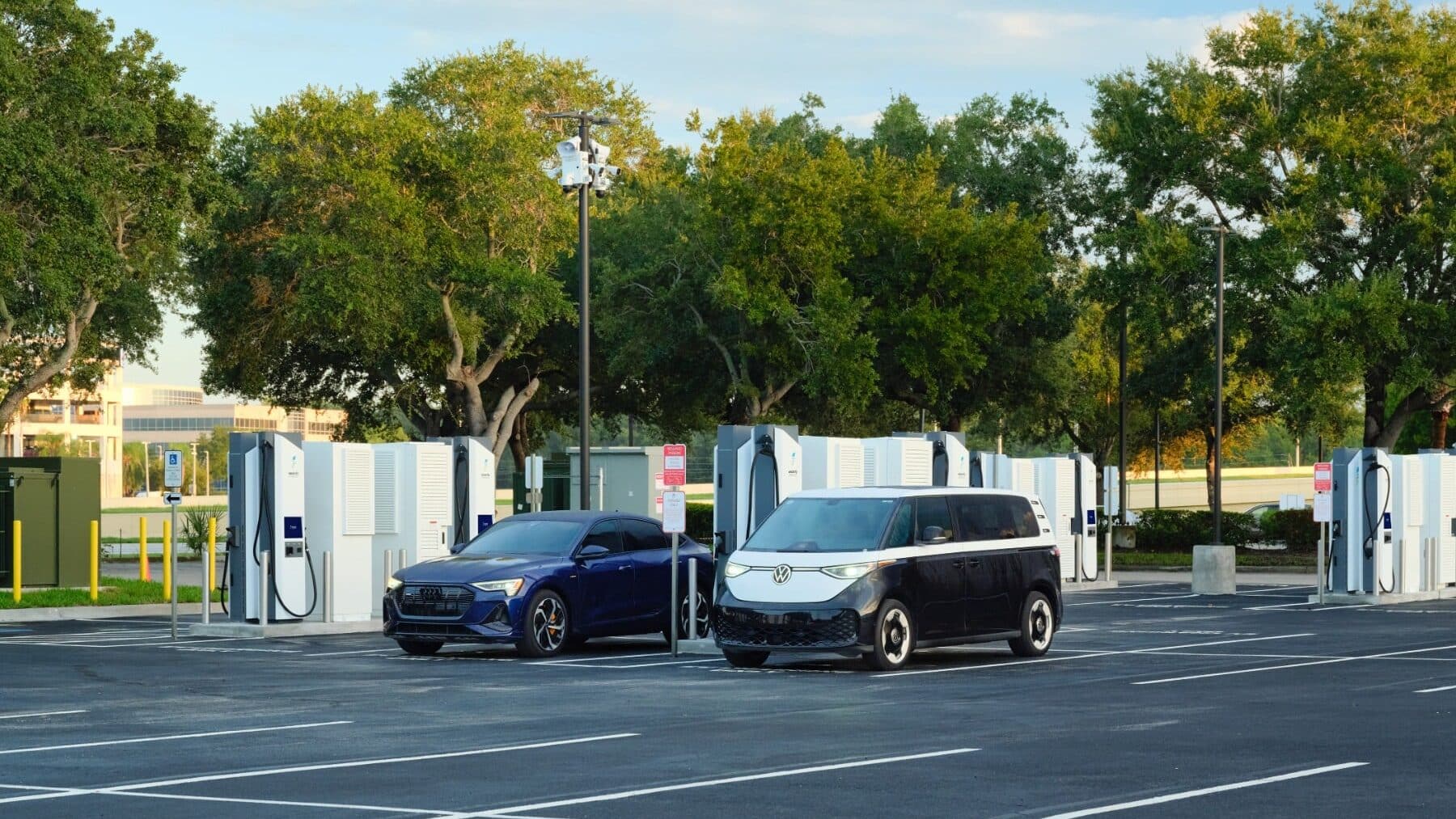
A row of charging pedestals hums beside a gas station off an interstate exit, cables dangling, screens glowing in the dusk.
A driver circles the lot once, looking for an open plug instead of a pump.
None of the machines wear the same badge anymore.
Some are white and sleek, others boxy and industrial, built by companies that did not exist in this business a few years ago.
That crowded, mismatched scene is now the normal American charging stop.
So how did the country suddenly end up with so many more plugs, built by so many more brands?
Why so many new chargers appeared so fast
The jump comes down to simple economics of scale. Building a charging site with twenty or more stalls costs less per plug than building the same number across several small two or four stall locations, because the land, the permits, the transformer and the construction crew get spread across more hardware.
That math pushed operators toward fewer but much bigger stations this year. New stations averaged 6.2 ports apiece in the third quarter, up from 5.6 a year earlier.
Each new site is simply doing more work, even as the overall pace of new groundbreakings cools nationwide.
Automakers also changed the incentive structure. A consortium of rival brands building stations together, plus big box retailers wiring up their own lots, means more companies are now chasing the same driver who once had only one practical option at a rest stop. And because higher powered hardware now costs little more to install than older, slower units, most new stalls arrive capable of charging far faster than the fleet average from just a few years back.
What the charging stop actually looks like now
Picture that same highway exit two years ago. A driver often had one small bank of four plugs, usually run by a single familiar network, and a real chance at least one charger was broken or occupied.
Now the same exit might host a twenty four stall bank from one operator, a newer rival’s site across the street, and a retailer’s own chargers in a store parking lot. That is not hypothetical; a station just opened in Orlando with 24 DC fast chargers capable of delivering up to 350 kW each.
Meanwhile, a joint venture backed by several automakers has been striking deals with convenience store chains to put its chargers where people already stop for gas and snacks.
That kind of partnership driven expansion, rather than one company building alone, is what let the national count climb even as overall construction slowed. The result finally resembles gas stations more than the sparse, single brand charging deserts drivers complained about for years.
The numbers behind the milestone
According to a charging data platform’s quarterly report, public DC fast-charging ports totaled 80,964, installed at 14,614 locations as of the end of the third quarter. That is the first time the national count has ever crossed eighty thousand plugs.
Even so, growth actually slowed from a year earlier. Operators added 4,106 new ports and 664 new stations, bringing the network to 80,964 ports across 14,614 stations. That’s down from 4,618 ports in Q2 , and 12% fewer than in Q3 2025 , while operators opened 2,158 stations, about 20% fewer than in Q3 2025 , according to figures reported by InsideEVs.
What makes this quarter notable is who is building the new plugs. Tesla’s share of US DC fast-charging ports dropped to 49.3% at the end of September, down from 54.3% a year earlier , the first time it has fallen under half the national total.
Rivals are closing that gap fast. Ionna more than doubled its Q2 rollout to 378 ports and jumped from seventh to second, ahead of Walmart at 344. Americans logged a record 17 point 6 million charging sessions in July, which set a monthly record with 17.6 million sessions.
Where the growth is uneven and the limits that remain
None of this means every driver’s experience improved equally. Usage data shows a sharp split between cities and everywhere else: ports in the top 30 metros ran at 21.1% utilization, about twice the 11.0% everywhere else, with Los Angeles leading all metros at 31.8%.
That gap shapes where companies keep building next. Dense urban corridors justify the cost of a twenty four stall site; a lonely rural exit often does not.
That is why ninety percent of new sites built in the third quarter sit in urban areas, according to Paren’s own count of 90% of the new sites in Q3 2026 being in urban areas.
Smaller networks are also lagging the trend toward bigger stations. The report found 71% of ChargePoint’s and 74% of Blink’s sites consisted of just two ports or fewer , a reminder the headline milestone hides real variation beneath it. Pricing tells a similar story, since non-Tesla Supercharging now averages $0.569 per kWh in the U.S., and it pulled the national fast-charging average up for the first time in over a year, as Tesla’s Supercharger prices have climbed up to 15% over the past year , meaning more choice has not automatically meant cheaper charging for every driver.
What it means for drivers heading into next year
For an ordinary road tripper, the practical upshot is straightforward: the odds of finding an open, fast, working plug at a familiar highway exit are meaningfully better than a year ago. That shift has been building gradually, including efforts like the rollout of compatible connectors blending once separate charging standards into a single plug drivers can count on.
Analysts expect the fourth quarter to look stronger than the third, since this year has so far followed the same pattern as 2025, Paren said, noting that although both years saw a dip in Q3, this preceded a peak in Q4 2025, which it expects to see again in Q4 2026. If that holds, the country could add thousands more ports before the year closes out.
Even the growing pains point to a market maturing, not stalling.
