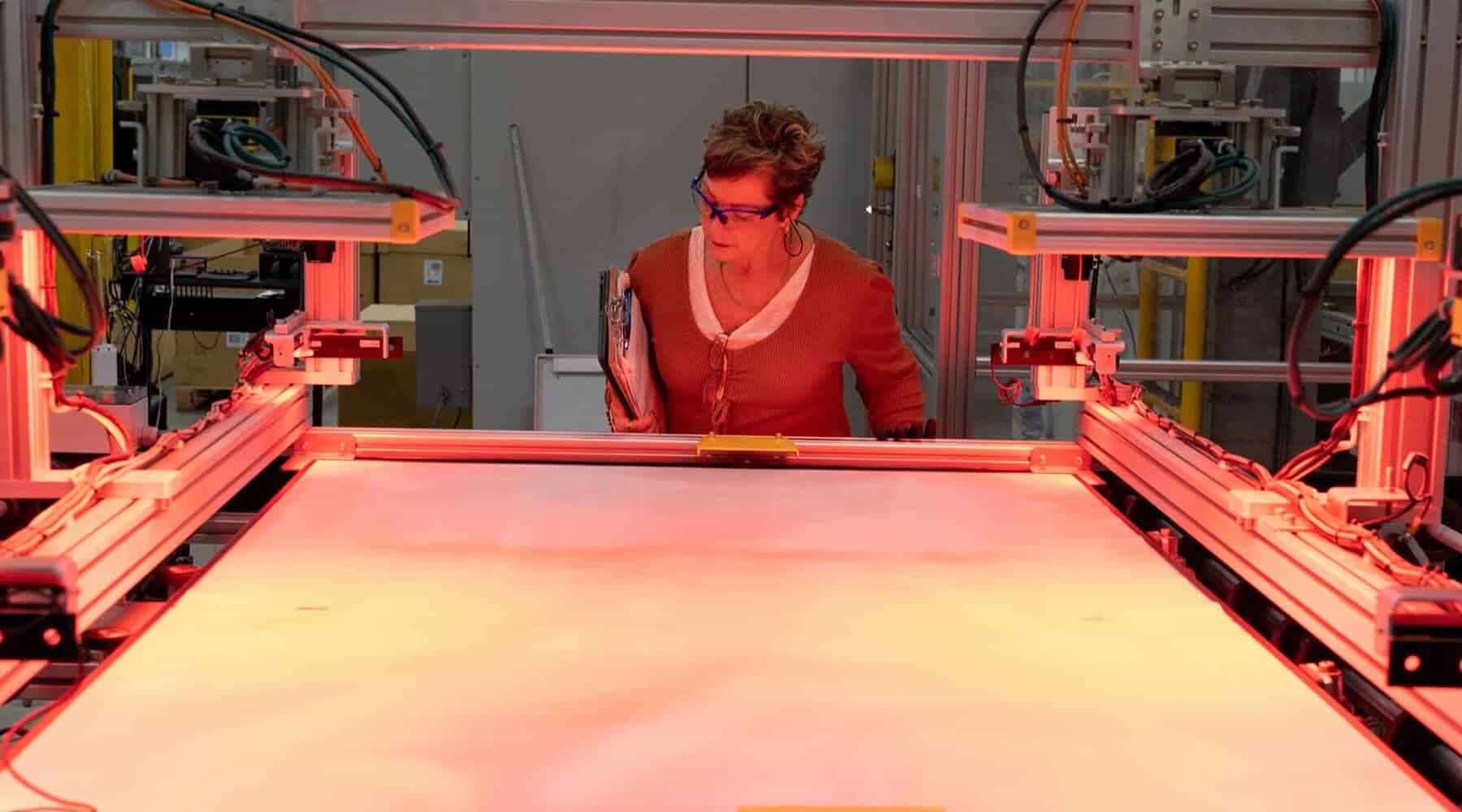
Heliene and Caelux have started commercial-scale production of a solar panel the companies say can convert more than 27 percent of sunlight into electricity, above the roughly 22 percent ceiling of today’s best mass-produced silicon panels.
The companies announced that Heliene and perovskite solar company Caelux have started commercial-scale production of a hybrid-tandem solar module for the US market , with the silicon-perovskite hybrid-tandem modules able to offer a conversion efficiency of up to 27%+ and targeting module efficiencies exceeding 29% by 2028 , incorporating two power-generation layers, one using Caelux’s perovskite glass and the other using regular n-type silicon solar cells .
How the panel works
The design stacks a perovskite power-generating layer directly into the glass that normally just protects a solar panel. The module combines Caelux’s Energy Producing Glass, which builds a perovskite layer into the module’s top glass, with Heliene’s N-type silicon cells.
The companies claim that, when combined with compatible silicon solar cells, the technology enables modules to generate up to 20% more energy than conventional N-type silicon solar modules.
Unlike some next-generation cell technologies that require manufacturers to rebuild their factories, Heliene CEO and founder Martin Pochtaruk said a key advantage of the Caelux technology is that the glass drops into existing manufacturing lines without requiring a separate production setup.
Where the modules are made and when they ship
Industrial-scale deliveries of the modules will begin in 2027 and will be manufactured by Heliene at its Minnesota module assembly plant, according to the companies.
Heliene is producing the modules at its plant in Mountain Iron, Minnesota. The two firms have locked in a long-term supply arrangement to scale the technology.
Both companies have entered into a multi-year, multi-gigawatt agreement to commercialise the hybrid-tandem module , and an initial industrial-scale commercial order is underway, with deliveries scheduled to begin next year.
Heliene operates two U.S.-based solar module manufacturing facilities with a combined annual module output capacity of 1.3GW , a fraction of the gigawatt-scale lines that larger domestic manufacturers have been building, including multi-gigawatt cell plants announced elsewhere in the sector this year.
A bet on efficiency over scale
The companies are framing the launch as a first step rather than a finished product. The companies aim to achieve module conversion efficiencies exceeding 29% by 2028 , which would place the panels well beyond the efficiency ceiling that conventional single-junction silicon technology is approaching.
Analysts tracking the perovskite-silicon tandem race note that the glass-overlay approach sidesteps a costly retooling problem that has slowed rival tandem technologies.
The glass-overlay route avoids cell redesign and could allow US manufacturers to lift output per square meter without heavy new capital spending, though the 29% target and delivery timing still depend on mass-production data that has yet to be published.
Caelux, which has pursued similar partnerships with other manufacturers in recent years, said the Heliene deal marks a step forward for its technology. The partnership with Heliene is a new step for Caelux, which started shipping its first order of perovskite glass technology in July 2025 and has since partnered with several manufacturers to implement its technology.
The announcement marks the first of Caelux’s commercial agreements to reach production , moving the company from pilot-scale demonstrations into an actual factory supply chain for the first time.
Why it matters for the broader industry
The push for higher-efficiency panels comes as US manufacturers face continued pressure over the cost and performance of domestic solar hardware, including tariff-driven cost floors on imported materials like those behind the current polysilicon price floor.
A panel that squeezes more electricity out of the same rooftop or field footprint could ease some of that cost pressure for developers, particularly as utilities and grid operators grapple with rising demand tied to data centers and electrification.
Caelux has said the technology’s higher output per panel could extend benefits across residential, commercial, and utility-scale solar installations, though widescale deployment will depend on how the panels perform once the first commercial shipments reach customers in 2027.
