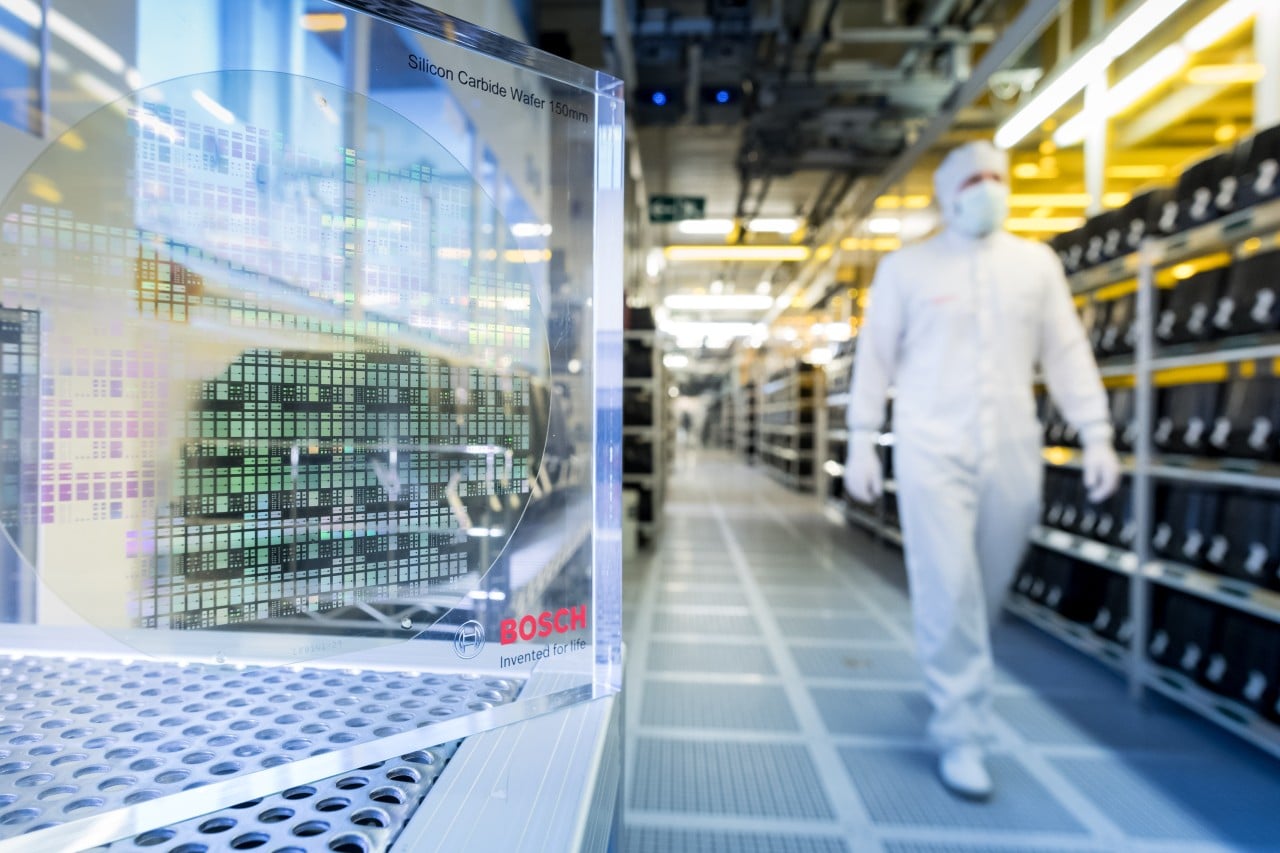
Bosch said it will spin its semiconductor business into a standalone division starting January 1, 2028, as the German supplier races to capture new demand from robotics and artificial intelligence while automakers continue to struggle with chip bottlenecks.
The move was announced as rival suppliers Nexperia and STMicroelectronics warned this week that AI data center demand is actively diverting chip-making capacity away from cars.
A new division built for growth
Bosch plans to establish a standalone semiconductor division from January 2028 as part of a wider corporate reorganisation designed to strengthen its position in the growing global chip market. The German technology group said it expects rising demand from sectors including artificial intelligence (AI), robotics and industrial automation to create significant opportunities for its semiconductor business.
Bosch plans to generate five billion Euros in revenue from semiconductors by 2030. To achieve this goal the semiconductor activities will be bundled in a dedicated Semiconductors business as of January 1, 2028.
Under the restructuring, Bosch’s semiconductor operations will be transferred from the Mobility Electronics division into a new business unit called Semiconductors, which will remain within the company’s Mobility business sector.
In the official announcement, Bosch said the restructuring is meant to better align its organization with the specific and highly dynamic requirements of the semiconductor industry. “By establishing our own unit, we’re opening a new chapter in our more than 60-year history in the semiconductor industry,” said Erik Rein, who is responsible for Bosch’s semiconductor business.
Opening fabs to outside customers
Bosch is also widening access to its manufacturing capacity beyond its own vehicles.
Bosch intends to make more of its existing production capacity available to external partners in the future, enabling it to deliberately expand its contract manufacturing business.
Additional investment is planned for Bosch’s semiconductor test centre in Penang, Malaysia, while the company also holds a 10% stake in the European Semiconductor Manufacturing Company (ESMC) joint venture in Dresden.
Bosch’s existing chip lineup centers on components built for durability and precision, the kind of parts that also underpin fast-charging electronics in vehicles like the hyper GT that hit 443 kilowatts on a Gulf charger earlier this year.
Bosch’s semiconductor portfolio includes silicon carbide (SiC) semiconductors, automotive integrated circuits (ICs) and foundry services.
AI demand squeezes automotive chips
The restructuring lands just as other chipmakers say car production is being crowded out by the data center boom.
Speaking at the Electronica trade fair in Munich, Nexperia interim CEO Stefan Tilger told Reuters the company is “totally oversubscribed” as suppliers divert manufacturing capacity toward fast-growing AI data centers and away from the mature chips used in cars and industrial equipment.
“The automotive industry is suffering at the moment quite heavily,” Tilger said.
STMicroelectronics chief executive Jean-Marc Chery echoed the concern around the same time.
Chery warned that the AI investment boom is creating bottlenecks elsewhere in the semiconductor supply chain, as manufacturers prioritize higher-margin products linked to data centers and artificial intelligence, saying some foundries and assembly and packaging firms that previously served a broad range of customers “are disengaging from mainstream technology.”
Claus Bauer, interim head of finance at automotive supplier Aumovio, said on a call with analysts on November 5 that the impact from the squeeze on supplies to the auto industry, barely noticeable so far, is set to “explode” in 2027, underscoring how the capacity fight is already showing up in supplier costs.
Why it matters for automakers
The comments follow a separate crunch tied to Nexperia’s China operations that began in late 2025, after the Dutch government took control of Nexperia from its Chinese owner Wingtech Technology on September 30, also removing its Chinese CEO, citing concerns that its technology could be appropriated by Wingtech. China responded by cutting off exports of the company’s finished chips, which are mostly packaged in China, with some 70% of the European-produced chips packaged in China and sold mostly to distributors, a dispute that prompted Honda to slash its annual profit forecast after halting production at several plants and prompted Stellantis to set up a “war room” to explore alternative purchasing methods to mitigate disruptions.
That episode exposed how a single supplier disruption can ripple through assembly lines that depend on steady chip flow, the same kind of precision timing that lets plants retool dies in minutes rather than hours, as seen at a Michigan stamping plant built for speed.
By building its own expanded chip capacity and opening fabs to outside customers, Bosch is positioning itself to profit from the same AI-driven demand that is squeezing its automotive customers, rather than compete only within the car industry’s traditionally thin margins.
The demand for semiconductors is forecast to increase in future years, with PwC’s 2026 Global Semiconductor Industry Outlook projecting market growth from 627 billion dollars in 2024 to 1.03 trillion dollars in 2030.
How much of that growth automakers can still access, rather than data center operators, remains the open question hanging over suppliers and carmakers alike heading into 2027 and 2028.
