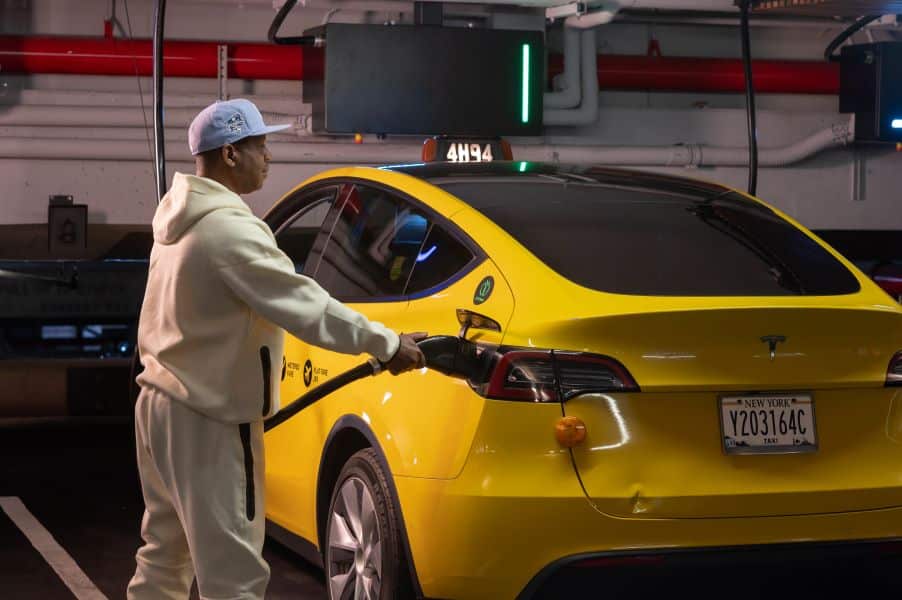
A driver pulls into a highway charging plaza at six in the evening, plugs in, and watches the price readout climb higher than it would have at midnight.
That gap used to be a rounding error.
Now it stretches across almost twenty cents on every kilowatt hour delivered.
Most stations still charge one flat number no matter the hour.
But the ones that do not are starting to reshape who profits at the plug, and the mechanism behind that gap starts with how power itself gets priced.
Why the price gap at the charger keeps widening
The mechanism is simple grid economics, not a mystery at all. Electricity itself gets more expensive to generate and deliver during the hours when everyone wants it most, typically late afternoon into early evening, and cheaper overnight when demand sags.
Charging networks that adopt time-of-use pricing simply pass that swing straight through to the driver instead of smoothing it into one flat rate. A station that pays a steep wholesale price at 6 p.m. and a cheap one at 2 a.m. can either eat that difference itself, which most fixed-rate operators still choose to do, or charge drivers more to match the real cost of power in that hour.
Over the past year, that second group grew large enough to move the national numbers. Peak time-of-use prices rose 4.3% to $0.637 per kilowatt hour while off-peak prices held at $0.438 , according to quarterly tracking of the market.
That is a nearly 20 cent spread for anyone willing to plan around the clock.
What that spread looks like at a real charging plaza today
Picture two drivers at the same charging station on the same day. One arrives at rush hour on a road trip, plugs in because the battery is low and there is no choice, and pays whatever the screen says.
The other charges overnight at a depot, a hotel lot, or a truck stop while sleeping, and walks away having paid meaningfully less for the identical electrons. That gap now has real teeth.
Non-Tesla networks outside that peak-pricing split maintained an average price near 53.3 cents per kWh for the fifth consecutive quarter , so drivers who can shift to off-peak now save roughly a dime per kilowatt hour against that broader average. Timing a charge has become a bigger lever than shopping between brands of charger.
Even so, most of the country has not caught up. Only 27.1% of per-kWh stations use time-of-use pricing, and 72.9% use a fixed rate. The pricing split exists mainly where operators have decided it is worth the complexity.
The hard numbers behind the shift, and where they come from
The figures come from Paren’s Q3 2026 State of the US Fast EV Charging Industry report , a data firm whose platform monitors more than 98% of US DC fast-charging infrastructure in real time . Its researchers pull live pricing from charger networks across the country every quarter rather than relying on press releases from any single company.
The broader national average price also moved, though far more gently than the peak versus off-peak split. In Q3, the national average fast-charging price reached 54 cents per kilowatt-hour, up 2.7% year over year.
State by state, prices remain far from uniform. Hawaii has long sat far above every other state, with New Jersey a distant second, followed by states like Maine , a pattern Paren’s reporting has tracked for several quarters running. Delaware and Montana have also appeared among the pricier and more fixed-rate-heavy markets in recent reports, though the exact quarter-over-quarter percentage moves for those individual states were not independently verifiable against the public report summary.
Hawaii’s position as the most expensive state by a wide margin has held steady report after report, an island grid outlier even among already pricey states. One dominant automaker’s charging brand drove most of the quarterly national increase, with the national average fast-charging price reaching 54 cents per kilowatt-hour, a 2.7% increase year over year , tied to Tesla raising its non-member price 15% to $0.569 per kWh , while non-Tesla networks maintained an average price near 53.3 cents per kWh for the fifth consecutive quarter , a split connected to the off-peak shifting underway in home charging programs.
Where the pattern breaks down and who still pays flat rates
None of this plays out evenly everywhere. Even inside states that have leaned hardest into variable pricing, adoption is partial rather than universal.
Some states have shown notably higher time-of-use adoption than the national norm, though the precise ranking of leading states shifts from one quarterly report to the next. Meanwhile other states show far less movement: Wyoming pairs a high fixed-pricing share with a low time-of-use share but a comparatively high per-minute billing share, with Montana close behind .
A small slice of stations nationwide skip per-kilowatt-hour billing altogether in favor of per minute charges instead.
And demand itself has not slowed enough to force a faster shift, with usage looking largely inelastic at current levels, meaning drivers keep plugging in regardless of the hour on the clock.
What the widening gap means for drivers and the networks ahead
For an ordinary driver, the practical lesson is straightforward. Charging overnight at a station offering time-of-use billing can now save real money compared with the same plug at rush hour, a gap wide enough to notice on a monthly budget rather than a rounding error on a receipt.
For the industry, this looks like an early test of a bigger question playing out alongside automated charging programs scaling up nationwide, since whether networks eventually compete on when power costs less, not just on where a plug sits, remains unsettled.
So far, that competition remains small. Only 27.1% of per-kWh stations use time-of-use pricing, and 72.9% use a fixed rate , leaving nearly three in four stations charging the same rate around the clock.
That leaves room to run. As more drivers notice the savings sitting on the other side of midnight, the spread between peak and off-peak charging looks likely to keep shaping which stations draw repeat business.
