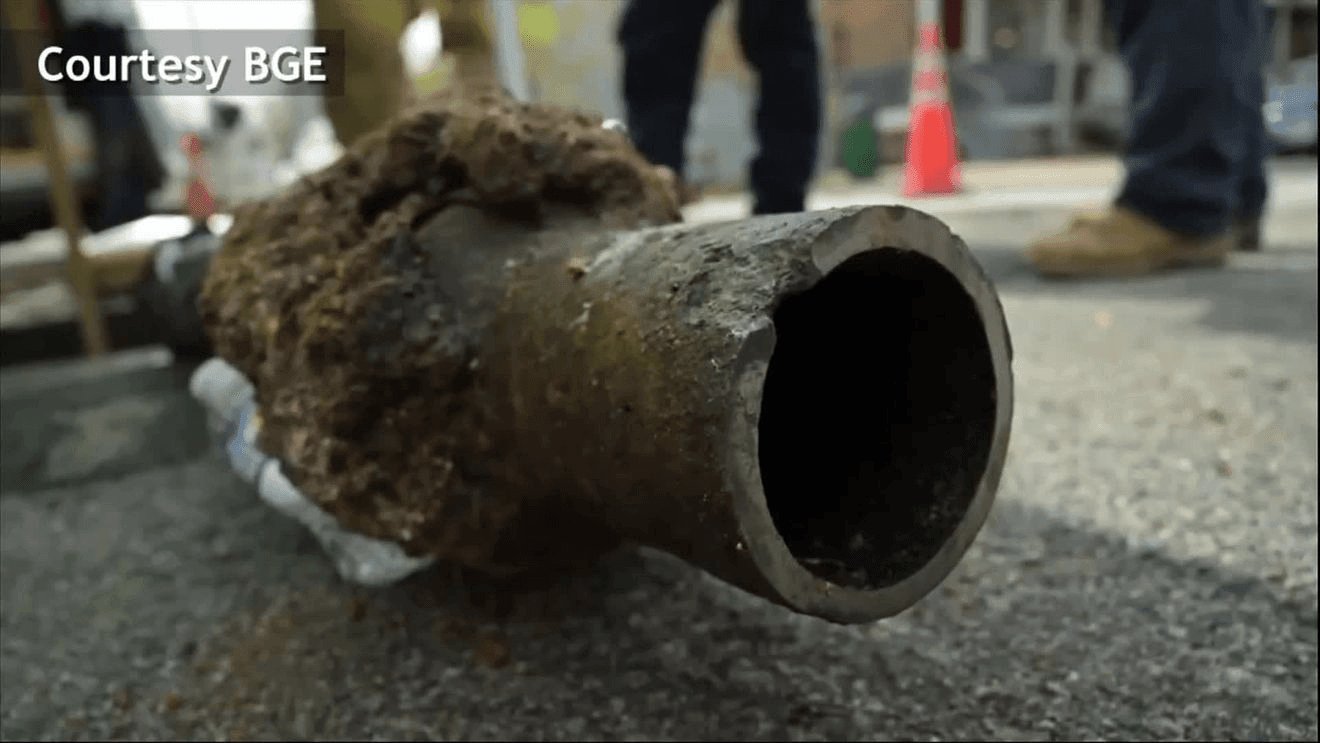
A trench runs down a quiet Baltimore block, and inside it sits a pipe older than almost everyone living on the street.
It is cast iron, laid decades before anyone worried about leaks.
Crews are pulling thousands of these sections out of the ground.
Every foot they replace gets added to a bill nobody in that house has seen yet.
So how does a buried pipe turn into a number nearly five times larger than what it will cost to install?
The financing trick hiding inside every monthly bill
The answer sits in how utilities pay for construction long before a single customer sees the finished pipe. Baltimore Gas and Electric does not simply spend money and bill customers for the cost.
It borrows and raises capital, then collects that spending back over decades, with interest charges added and a built in margin layered on top of the original price.
That structure is normal across the utility industry, and regulators allow it because pipe networks last a long time and need steady funding. But consumer advocates calculated what the math actually produces once financing costs compound over the life of a multi decade build out, and the gap between what gets spent and what gets repaid turned out to be enormous.
Maryland’s Office of People’s Counsel, the state’s official ratepayer advocate, says BGE will spend about $3 billion more over the next 20 years, at a total customer cost of about $19 billion over time, once the financing is fully worked through. The company itself has only committed a fraction of that so far.
A pipe program that started small and kept growing
The underlying project is called Operation Pipeline, and it was never secret. BGE’s work to replace Maryland’s aging legacy gas system ramped up in 2013 when lawmakers enacted the Strategic Infrastructure Development and Enhancement Plan (STRIDE), a law meant to speed the retirement of risky old mains.
Even so, the scale has crept upward year after year. BGE has spent $1.4 billion on “Operation Pipeline,” its gas pipeline replacement program, since 2013, and that spending has not slowed down. In 2025, BGE spent over $130 million on Operation Pipeline and in 2026, they plan to spend over $142 million.
That annual pace points toward a much bigger total. BGE has already spent approximately $1.5 billion on gas system replacements and plans to spend nearly $3 billion more by 2043.
Which means the company is still only partway through a build out that stretches almost two more decades, similar in spirit to the rate hikes already working through regulators in Pennsylvania’s own gas delivery charges.
Where the $19.5 billion figure actually comes from
Maryland PIRG Foundation, a nonprofit consumer research group, built its own estimate by reviewing BGE’s own regulatory filings. The analysis reviewed selection criteria for the 34 active “Operation Pipeline” projects in 2025.
Its conclusion, published in the group’s Fast-Tracked and Flawed report, lines up closely with the state’s official estimate. If the company completes its proposed $4 billion in STRIDE-related spending, the Office of the People’s Counsel projects that customers will repay a total of $19.5 billion over time, including interest and utility profits.
That is not a worst case scenario. It is the baseline projection from the agency whose entire job is defending ratepayers.
Critics argue the spending priorities compound the problem. The analysis concludes that BGE’s Operation Pipeline program, which operates under Maryland’s STRIDE law, has emphasized costly pressure conversions which may be slowing the work to repair or replace the riskiest pipes. BGE disputes that framing and points to its own safety data as proof the work is targeted correctly.
The company’s pushback complicates the simple story
BGE has not stayed quiet. A spokesperson for the utility pointed to one figure the advocacy report left out of its headline number.
“In 2025, 85 percent of our planned operation pipeline work was abandoning cast iron main. That number was conveniently left out of the report they issued,” Alexopulos said.
That matters because cast iron and bare steel mains are the pipe types most prone to slow gas leaks and, in rare cases, explosions. The company argues it is retiring the riskiest material first, not simply building for profit.
BGE Spokesperson Nick Alexopulos said a focus on low-pressure gas infrastructure is necessary, and much of the company’s cast iron pipes are low-pressure, which has been recognized as a risk by the Pipeline and Hazardous Materials Safety Administration.
Yet the ratepayer advocate counters that safety and cost effectiveness are not the same question. David Lapp with the Maryland Office of People’s Counsel says BGE is a third of the way through the replacement program, but customers have only paid about 3 percent of the costs to complete Operation Pipeline. That gap between work finished and bills still owed is the heart of the dispute heading into the next rate filing, a fight that echoes similar battles playing out over fuel cost recovery in Virginia.
What happens next for Maryland ratepayers
None of this is settled yet. BGE is expected to file a new multi year rate case this year that will ask regulators to approve continued funding for the pipe replacement schedule.
That filing will be the next place the $19.5 billion estimate gets tested in public. Local officials are already pushing back hard.
Baltimore’s City Council has heard calls to stop the plan, with thousands of residents signing petitions calling for an end to the multi-year rate structure, arguing that locking in years of advance increases removes the normal checks a traditional rate case would apply.
Even so, the underlying pipes do need replacing somewhere on some timeline, and nobody disputes that old cast iron mains eventually have to come out of the ground. The real argument is about speed and sequencing, and who absorbs the financing cost while that work gets done.
For an ordinary household, the number that matters is simpler than any accounting detail: a bill that already climbed sharply in recent winters is tied to a program nowhere near finished, with the full repayment math only now becoming public enough for residents to weigh before the next rate hike lands.
