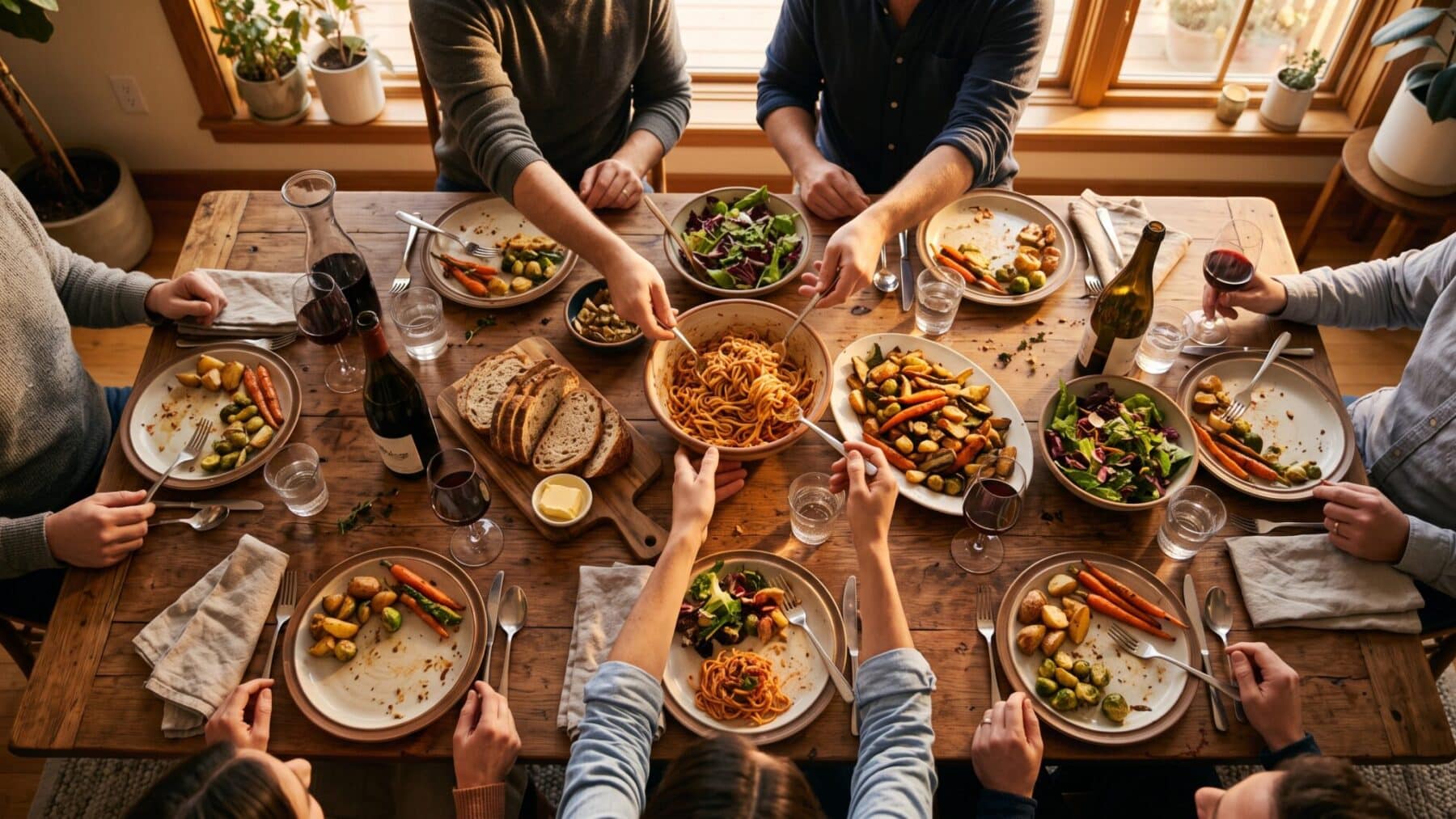
A table is set for two, and then one chair goes empty.
Across the United States, that scene is playing out meal after meal in ways researchers only recently began to measure at scale.
The number that emerged stopped them cold. And the fix, it turns out, is sitting right there on your calendar.
Why eating with someone else changes how your brain registers the meal
The act of sharing food does something a solo meal cannot. When people eat together, the social context activates reward pathways tied to trust and belonging, circuits associated with cooperative acts between people who know each other. Food becomes a vehicle for synchrony: two people reaching toward the same dish, pacing their bites together, pausing to talk.
Because the brain does not fully separate the taste of a meal from the emotional context around it, the bonding chemistry of communal eating is simply absent when you dine alone. Research shows that shared meals increase social bonding, feelings of wellbeing, and one’s sense of embeddedness in a community. That is not a small side effect. It is the main event.
Even cooking counts. Research has found evidence that the social bonding benefits of shared meals extend beyond the table, with shared cooking and dining linked to improved psychological flourishing and family wellbeing.
The real scale of a habit most Americans think is fine
Scroll a delivery app on a Tuesday night and it is easy to feel like everyone eats alone now. One in four Americans now eats every meal alone, a 53 percent increase since 2003. That is not a pandemic artifact: the highest levels were not confined to 2020 and 2021, rates of eating every meal alone were even higher in 2023 than during the pandemic years.
Younger adults are pushing the number hardest. The largest and most dramatic changes are for those under 35. The extent to which 18-to-24-year-olds report eating all of their meals alone the previous day has increased by about 90 percent in two decades. And it is not simply a matter of living alone: living alone explains part of that shift, but not all of it, dining alone also rose among people who lived with others.
Meanwhile, reservations for one spiked 22 percent in Q3 2025 compared to Q3 2024 at full-service restaurants, though single diners still accounted for less than 1 percent of total booked reservations. At quick-service restaurants, solo diners now account for nearly half, 47 percent, of quick-service restaurant orders, up from 31 percent in 2021. Americans are not just eating alone at home; they are booking solo tables at restaurants in growing numbers. If you are already spending that kind of money on a dinner out, the data on a single night out adds another layer worth knowing.
What 150,000 people across 142 countries revealed
Researchers combined global and national datasets to examine associations between eating with others and wellbeing. They analyzed data from the 2022, 2023 Gallup World Poll, covering over 150,000 respondents across 142 countries and territories. Participants reported the number of days they shared lunch or dinner with someone they knew in the previous week. The full analysis was published in Scientific Reports.
The headline finding was not what most people expected. There is a significant, positive relationship between shared meals and wellbeing in almost all world regions. The number of shared meals explains as much variation in wellbeing as some key socioeconomic indicators, such as income or unemployment. Happiness researchers spend careers hunting for levers that strong.
Those who share more meals report significantly higher levels of life satisfaction and positive affect, and lower levels of negative affect. This is true across ages, genders, countries, cultures, and regions. Even one shared meal a week was associated with meaningfully higher life satisfaction than eating every meal alone. Not a daily commitment. One meal.
The United States ranks 69th out of 142 countries for shared meals. Countries across Latin America and the Caribbean reported sharing the highest number of meals in a seven-day week, sharing nearly two thirds of lunches and dinners. The gap between what is normal in much of the world and what has become normal here is wide, and it is widening.
Where the shared-meal effect gets complicated
None of this means a reluctant, obligatory dinner with people you find draining counts the same as a genuine shared meal. Quality matters alongside frequency. Even so, when researchers controlled for factors like income and employment, the relationship between sharing meals and wellbeing held strong.
Solo dining is not straightforwardly bad. Many diners now view eating alone as intentional self-care, a deliberate chance for peace away from constant social demands. Choosing solitude for restoration is genuinely different from eating alone because no shared table is available.
The complication the data cannot fully resolve is the direction of the arrow: does loneliness cause solo dining, or does solo dining deepen loneliness? For parents already stretched between work and family time, this is one more place where the daily schedule quietly costs something invisible. There remain vast gaps in our understanding of the causal dynamics of meal sharing, subjective wellbeing, and social connections, future research needs to examine causal pathways directly.
How one meal a week becomes a real and usable reframe
The most useful thing the research produces is not a warning. It is a very low bar. Promoting shared meals could represent a low-cost, actionable strategy to strengthen social ties and improve population wellbeing. You do not need to restructure your week. You need to protect one meal in it.
The happiness jump was particularly high when comparing people who shared no meals to those who shared one meal a week. Each additional shared meal after that adds a smaller increment. The return on the first protected dinner is higher than any subsequent one.
18-to-24-year-olds in the US are 90 percent more likely to eat every meal alone on a given day than they were in 2003. Americans who eat at least one meal with others report higher levels of happiness and lower levels of stress, pain, and sadness on that same day. Not that week. That day.
The researchers put it plainly: restaurants are not just businesses selling food and drinks, they are venues that facilitate one of the strongest predictors of happiness we have. Whether that table is at a restaurant or your own kitchen, the mechanism is the same, and another person must be sitting across from you.
