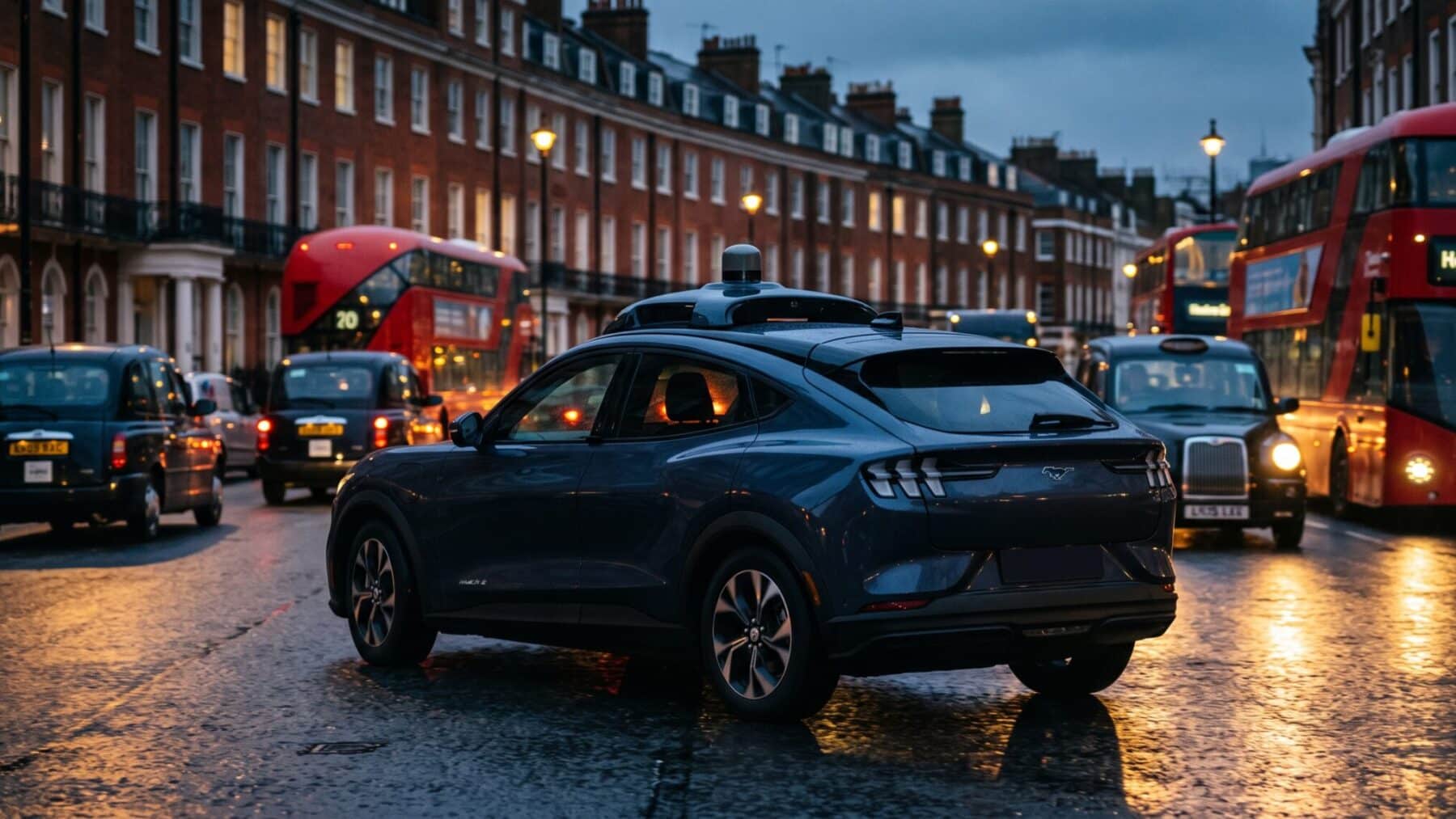
Transport for London has issued private hire vehicle licences to 15 of Wayve’s autonomous Ford Mustang Mach-E vehicles, completing the triple-lock regulatory requirement for supervised self-driving passenger trips in the UK capital through Uber. A trained, TfL-licensed driver will be present on every trip.
What the licensing approval means
Transport for London granted private hire vehicle licences to a number of Wayve’s autonomous all-electric Ford Mustang Mach-E vehicles on August 5, 2026. According to The Guardian, TfL licensed exactly 15 vehicles. The cars, equipped with the Wayve AI Driver and surround cameras and radar, were inspected to confirm they meet all of TfL’s policy and safety standards. The licensing completes the “triple-lock” requirement for private hire trips, under which the operator, the driver and the vehicle must all hold licences with the same licensing authority.
TfL confirmed that the vehicles have been licensed as private hire vehicles, not as automated vehicles. A PHV licence does not turn these cars into fully driverless taxis; the first rides will run with a licensed safety driver who can take over control. Other approvals remain pending before a fully driverless passenger service could operate.
The approval is a significant milestone for Wayve, a British autonomous vehicle startup that raised a $1.05 billion Series C round led by SoftBank Group, with contributions from Nvidia and existing investor Microsoft. Wayve has since reached an $8.6 billion valuation in a Series D round led by Eclipse, Balderton and SoftBank Vision Fund 2, which also featured Nvidia, Microsoft and Uber.
The “triple-lock” refers to the layered set of permissions required before a self-driving vehicle can legally carry fare-paying passengers in London: the operator, driver and vehicle must all hold licences with the same licensing authority.
Trips will take place under the Government’s AV Trialling Code of Practice and Uber’s TfL Private Hire Operator licence. Wayve’s vehicles are designed to operate autonomously and will do the driving, with a trained and TfL-licensed private hire driver onboard to oversee the trip and provide support or take over driving if needed.
Wayve’s technology and the Uber partnership
Wayve’s approach, known as AV2.0, moves beyond traditional autonomous vehicle systems reliant on HD maps or geofenced domains, learning instead from experience to adapt to new roads.
TfL issued private hire vehicle licences to a fleet of fully electric Ford Mustang Mach-E models modified by Wayve for autonomous driving. The vehicles are equipped with Wayve’s AI Driver, as well as surround-view cameras and radar, and underwent inspections by TfL to confirm compliance with the transport authority’s standards. TfL confirmed that Wayve had requested modifications to Ford Mustang Mach-E vehicles, which were independently assessed to ensure they met the requirements of the Private Hire Vehicles (London) Act 1998.
GCN has previously reported on the Ford SYNC recall affecting nearly 48,000 trucks, illustrating how closely intertwined in-vehicle software and safety oversight have become across Ford’s broader lineup.
The setup gives Wayve passenger and operating experience without removing the human fallback. It also lets Uber introduce autonomous trips through the same private-hire framework it already uses for human-driven rides.
The commercial model mirrors approaches being tested in the United States, where robotaxi operators have sought to slot autonomous vehicles into established mobility networks rather than build consumer-facing platforms from scratch.
A crowded but maturing regulatory landscape
The London approval arrives as regulators on both sides of the Atlantic are formalising their frameworks for autonomous vehicles.
In the United States, NHTSA has issued a Standing General Order requiring identified manufacturers and operators to report certain crashes involving vehicles equipped with automated driving systems or SAE Level 2 advanced driver assistance systems. The order allows NHTSA to obtain timely notification of real-world crashes associated with ADS and Level 2 ADAS vehicles, so the agency can respond to crashes that raise safety concerns through further investigation and enforcement.
NHTSA has also updated its New Car Assessment Program to include pass-or-fail ADAS evaluations, signalling that US regulators are building a more structured public rating system around driver-assist performance, not just passive crash safety.
What comes next for Wayve
During the eight weeks before the announcement, more than 100,000 Londoners signed up to join Uber’s Interest List. Select riders who joined the Interest List will soon be given access to Wayve rides to provide feedback on the experience ahead of the full public launch.
The companies say the vehicles have been designed for autonomous operation and the service will move towards fully driverless journeys in future phases. That phased approach is consistent with how most commercial autonomous deployments have proceeded globally, including Waymo’s expansion across US cities.
Wayve has been testing autonomous driving technology on London’s streets since 2018, in one of the most complex urban environments in the world. Its technology has been tested across more than 500 cities worldwide, allowing it to adapt to new environments without relying on pre-mapped data. The company argues that the challenge of London’s narrow Victorian-era streets, dense cyclist traffic and unpredictable weather gives its AI system a training advantage for global deployment.
The vehicle’s underlying electric platform also fits London’s expanding in-vehicle compute architecture trends, as autonomous systems increasingly demand centralised, high-performance processors rather than the distributed domain controllers that defined earlier automotive electronics.
London is described by Wayve as just the beginning, with autonomous rides powered by the Wayve AI Driver planned for more cities around the world. The parties have begun preparations for a pilot deployment in Tokyo by late 2026, introducing the Nissan LEAF powered by the Wayve AI Driver, available to riders through Uber, the next milestone in a global robotaxi rollout planned across more than ten cities worldwide. For Uber, the deal represents a foothold in autonomous mobility that its US peers, including Waymo, have spent years building stateside, now arriving in Europe’s largest ride-hail market.
