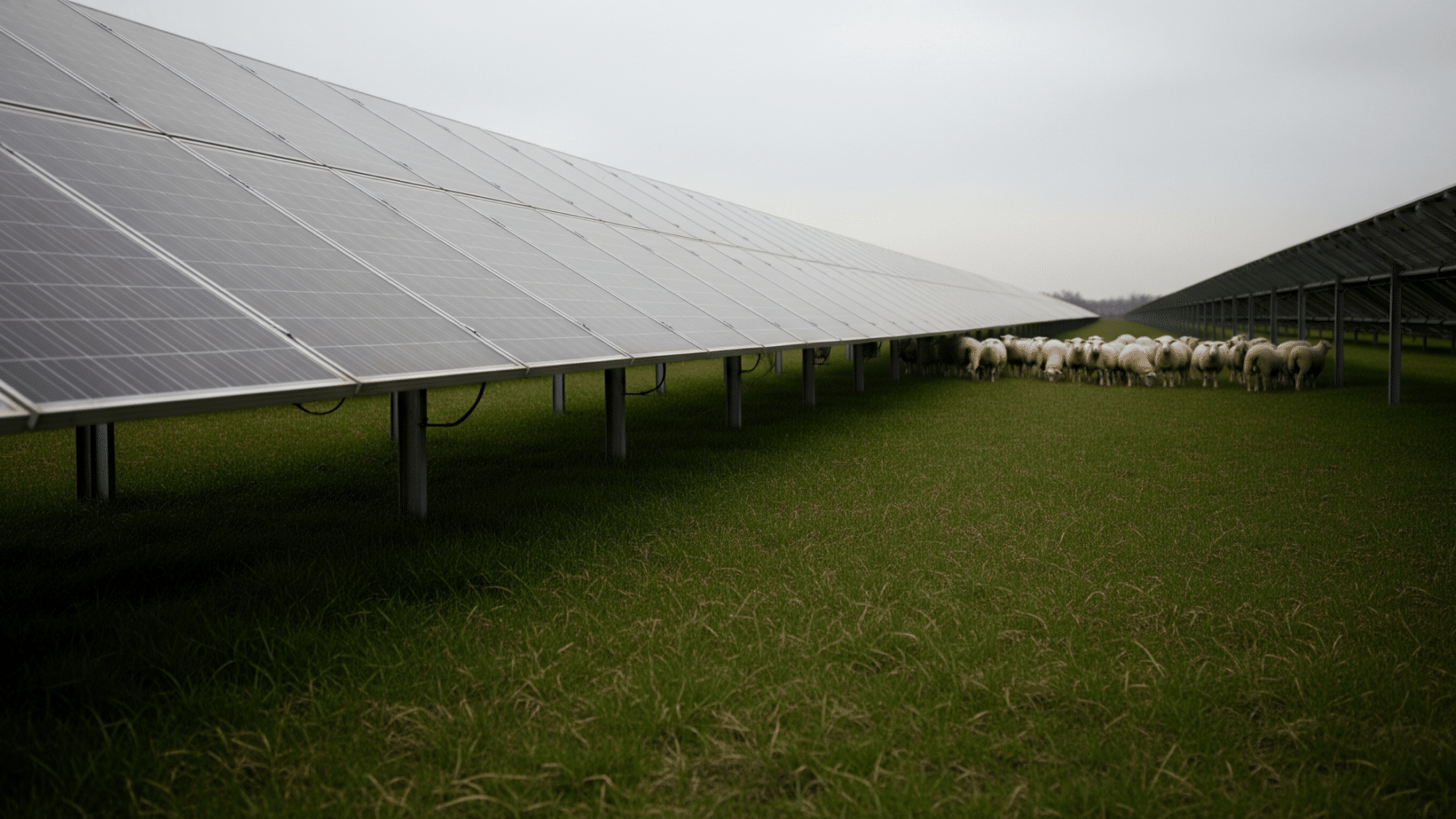
There is a strip of land in Pennsylvania, wedged between rows of solar panels, where a small flock of sheep shows up every spring and starts eating.
Nobody designed the field for them.
The panels were built to generate electricity. The grass was just a maintenance problem. And yet what happened next changed the math on both the farm and the power bill in ways the engineers had not drawn into their plans.
A grass-trimming job that quietly grew into something much larger
Solar farms need their vegetation managed constantly.
Grass and weeds that grow too tall can shade the panels, cut output, and drive up operating costs. The standard fix is a diesel mower, or a spray of herbicide, or both.
Sheep offered a cheaper, quieter alternative. Low enough to fit beneath a standard panel array, they will graze all day in the shade the panels provide, trimming the vegetation for free.
What started as a workaround has become an industry. The American Solar Grazing Association’s 2024 census reported approximately 113,050 sheep grazing 129,000 acres across more than 500 solar sites nationally, representing an estimated 18,000 to 26,000 megawatts of solar power plants.
Conducted in partnership with the National Renewable Energy Laboratory, the census described the scale of solar grazing in America as “much larger than previously understood and undergoing rapid growth.”
The Pennsylvania site where researchers decided to look more closely
Lightsource bp first welcomed the American Solar Grazing Association to its Nittany 1 solar site in Pennsylvania in 2022, as part of a study on the impacts of solar sheep grazing for soil health, forage, and pasture conditions. Nittany 1 is one of 28 northeastern US solar grazing sites included in the research.
The research was sponsored by the New York State Energy Research and Development Authority, and American Farmland Trust led the technical aspects of the research design.
It was, as the researchers noted, one of the first studies to publish soil testing methodology for operational solar farms anywhere in the country.
Just as solar energy met unexpected visitors at a Virginia farm, the Pennsylvania data would turn up something nobody had formally measured before.
What years of data from 28 grazed sites started to show
ASGA researchers collected data on soil carbon, soil compaction, species variety, plant nutrition, and other environmental factors before and after the 2022 and 2023 grazing seasons, with the full findings published in the journal Frontiers in Sustainable Food Systems on August 29, 2025.
Soil samples were analyzed through a Cornell University Soil Health Lab, and forage samples were tested by an independent laboratory.
The numbers for soil organic matter alone were striking.
Solar-grazed sites tended to have higher soil organic matter than non-grazed sites, at 4.14% compared to 3.70% respectively. Soil pH was also significantly higher in grazed sites, averaging 6.20 compared to 5.81 at non-grazed sites.
The soil was measurably healthier wherever the sheep had been. But the bigger surprise was still coming.
The finding that rewrote what a solar panel is actually doing to the ground beneath it
Researchers expected the shade under the panels to be a problem for forage quality. Less sunlight usually means less nutritious grass.
The data showed the opposite.
The ASGA reports that vegetation harvested from beneath solar panels had significantly higher crude protein content and better digestibility than vegetation from open spaces on the same sites.
The panels were accidentally making better sheep feed, not worse.
While forage biomass was lower under panels, crude protein concentrations were higher, and overall pasture condition scores rose between 2022 and 2023 across metrics including plant vigor, erosion control, and livestock concentration management, though researchers noted the increases were not statistically significant, describing them as suggesting the potential for improved pasture quality over time.
You can read the full ASGA study summary and the Lightsource bp site findings directly from the primary sources.
It is a dynamic that echoes what happened inside a fenced Ohio nuclear site, where land sealed off for one industrial purpose quietly turned into something ecologically richer than anyone planned.
What this means for the 500 sites and the land they sit on
As sheep graze, they trample manure, urine, seeds, and plant matter into the earth. The plant matter decomposes and, together with the animal waste, fertilizes and rejuvenates the soil. Healthier soil grows healthier vegetation for the sheep to eat, and the cycle continues.
The ASGA study was also the first to use a US Department of Agriculture pasture condition scorecard to assess pasture at solar farms, examining metrics of pasture health including plant diversity, soil compaction, and livestock concentration.
Pasture condition scores increased between 2022 and 2023, suggesting the potential for improved site conditions over time.
The story of American solar power is usually told in megawatts and panels.
Increasingly, it is also being told in organic matter percentages, protein readings, and the quiet sound of 113,000 animals doing a job that keeps getting more interesting the longer anyone looks at it.
