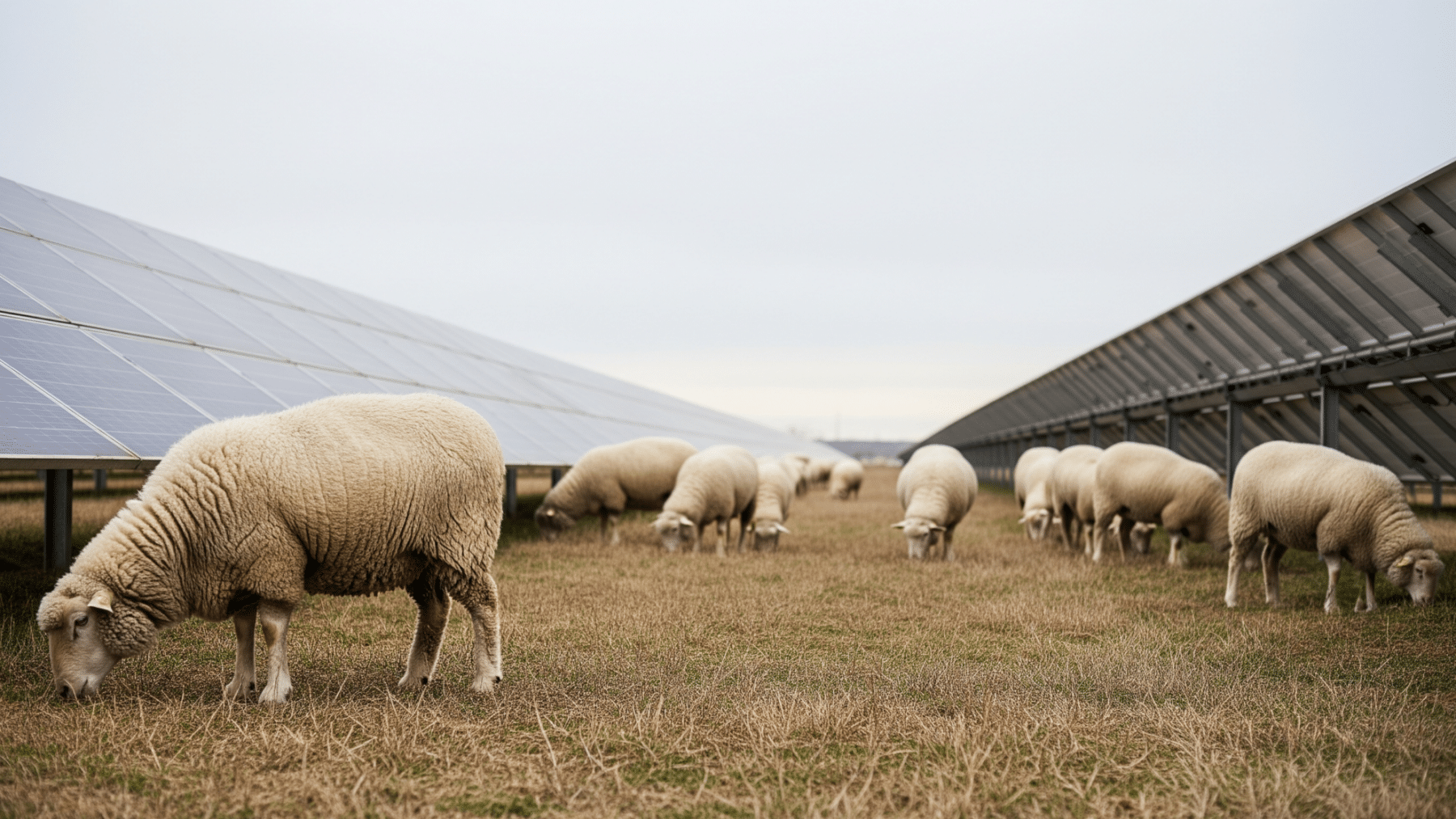
On a stretch of flat farmland outside the small town of Buckholts in Milam County, Texas, something unexpected has settled in among the rows of solar panels.
It is not a technician. It is not a lawnmower. And it was not exactly in the original engineering drawings.
It is about 3,000 sheep, stocky, unhurried, and completely committed to eating everything in reach.
A solar farm the size of a small Texas city
In Milam County, outside Austin, SB Energy operates the fifth-largest solar project in the country, capable of generating 900 megawatts of power across 4,000 acres.
To put that acreage in human terms: it is larger than many American downtowns combined, a vast expanse of flat former pasture that stretches well beyond what any single glance can take in.
The panels are arranged in row after row across what used to be ordinary rural pasture and cropland. Every single row needs the grass beneath it kept low so it does not shade the panels and drag down output.
That grass problem turns out to be one of the least glamorous challenges in the entire clean energy transition.
The maintenance problem nobody puts in the brochure
Mowing thousands of acres repeatedly, season after season, is expensive. It is also noisy, diesel-powered, and sometimes damaging to the panels themselves.
Unlike sheep, mowers are often too tall to get underneath the panels.
Steep or uneven ground makes the problem worse. Diesel exhaust is a strange companion for a site built entirely around clean electricity generation.
So operators began looking at a very old technology as a solution to a very modern problem.
On rural Texas farmland, beneath hundreds of rows of solar panels, a troop of stocky sheep rummage through pasture, casually bumping into one another as they remain committed to a single task: chewing grass. The booming solar industry has found an unlikely mascot in sheep as large-scale solar farms crop up across the U.S.
This is not one farm’s quirky experiment
The Texas site is actually part of a national shift that has grown far beyond what anyone predicted.
According to the first-ever U.S. Solar Grazing Census, conducted by NREL and the American Solar Grazing Association, approximately 113,050 sheep were grazing 129,000 acres across over 500 solar sites nationally, representing an estimated 18,000 to 26,000 megawatts of solar power plants, about 7 to 11 percent of existing installed solar capacity.
The census was the first time a broadly organized effort was dedicated to capturing the full scope and scale of solar grazing in the United States. That surprised even the researchers who ran it.
“The scale of solar grazing in the U.S. is much larger than previously understood and undergoing rapid growth,” NREL and ASGA stated in the report.
And this is also playing out on other solar farms, where different animals are showing up with their own unplanned benefits for the land around them.
What the sheep are steadily building beneath every panel
Here is the part that nobody put in the original site plan, and the part that is genuinely rewriting how energy developers think about land.
Research found that the soil at solar grazing sites tends to contain more organic matter than at non-grazed solar farms and has a more neutral pH to support healthier plants.
The mechanism is almost beautifully simple.
As sheep graze, they trample manure, urine, seeds and plant matter into the earth. The plant matter decomposes and, together with the animal waste, fertilizes and rejuvenates the soil. Healthier soil grows healthier vegetation for the sheep to eat, and the cycle continues.
The comparison with large energy sites is striking: a fenced-off power installation rebuilding its own land from the ground up is a pattern appearing across multiple generation technologies.
The study examined the impacts of solar sheep grazing on soil health, forage and pasture conditions, collecting in-field data at 28 grazed and three non-grazed commercial solar sites in the Northeastern United States from 2022 to 2024, the majority of which were previously cropland.
That is richer topsoil building up, year by year, under panels that will stand for 25 or 30 years, on land that was often depleted before the first panel was ever installed.
Why this small, woolly detail matters for the energy grid’s future
The numbers behind solar grazing are only going to grow. The U.S. solar buildout is accelerating, which means the total acreage under panels is expanding rapidly.
Studies have also shown sheep grazing encourages native plant growth, promotes biodiversity and improves pollinator habitat.
Research from Argonne National Laboratory, conducted over five years at two Minnesota solar farms intentionally designed with native plantings, found that total insect abundance tripled, while native bees showed a 20-fold increase in numbers. The study was published in 2024 in Environmental Research Letters and is the first empirical field evidence on the interannual, temporal changes in insect communities following the planting of pollinator habitat at solar energy facilities.
Dual use of the site generates additional revenue streams from the same property by producing meat, dairy or wool. Solar grazing also allows farmers to expand their flocks without purchasing more land and promotes soil fertility.
A 4,000-acre Texas solar farm set out to generate clean power at massive scale. Three thousand sheep showed up, kept the grass down, and started improving the ground beneath clean energy infrastructure in a way no engineer specified and no blueprint required.
Sometimes the most consequential thing on a power site is the one eating the weeds.
