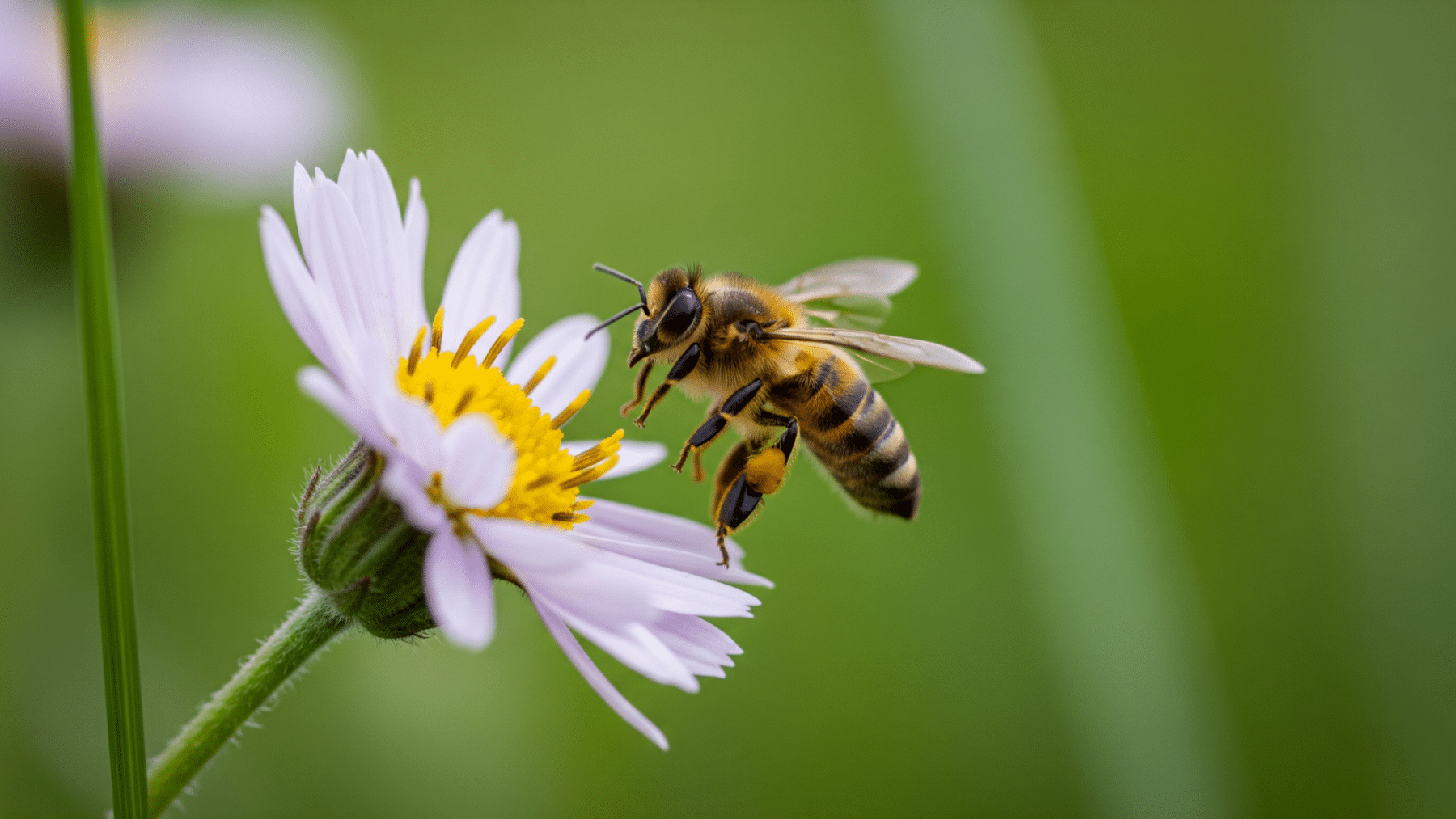
Every summer, bees drift through American backyards by the millions, landing on flowers, hovering, tilting, and darting away.
Most people barely register them.
But something is happening inside those tiny bodies that scientists have only just begun to fully map, and the implications reach far beyond gardens or honey or pollination.
It reaches into the data centers and chip labs quietly rewriting the rules of artificial intelligence.
A brain smaller than a sesame seed doing something no one expected
The honeybee’s brain contains roughly one million neurons, the honeybee brain of *Apis mellifera* has a volume of approximately 1 mm³ and contains around 960,000 neurons, compare that to the roughly 86 billion inside a human head.
For decades, researchers assumed that meant bees operated on instinct and simple pattern-matching, not anything we’d call real recognition.
The idea that a brain that small could do anything sophisticated with a complex visual scene seemed almost laughable.
It wasn’t.
The strange way a bee actually looks at something
When a bee approaches a flower, it doesn’t just stare.
It moves, bobbing, scanning, and tilting in a specific, deliberate way.
By building a computational model, or a digital version of a bee’s brain, researchers discovered how the way bees move their bodies during flight helps shape visual input and generates unique electrical messages in their brains.
Those movements generate neural signals that allow bees to easily and efficiently identify predictable features of the world around them, demonstrating remarkable accuracy in learning and recognizing complex visual patterns during flight.
That combination of body movement and brain signal is doing something that takes modern AI systems enormous computing power to replicate.
What the digital model revealed when researchers ran the tests
In one experiment, the model was tasked with differentiating between a ‘plus’ sign and a ‘multiplication’ sign, specifically, a plus pattern made up of a vertical and horizontal bar, and the same pattern rotated through 45°. Twenty simulated bees were trained to discriminate a positive target pattern from a negative distractor pattern, and the model showed significantly improved performance when it mimicked the real bees’ strategy of scanning only specific regions of the patterns.
That is a trained, deliberate visual strategy, not reflex.
The study highlights a core idea: intelligence comes from how brains, bodies and the environment work together.
That principle has long been a goal in AI research, and a very hard one to engineer efficiently.
It mirrors what researchers found when a pigeon in Iowa demonstrated that the learning principles inside small animal brains overlap directly with those powering advanced AI systems.
The payoff: a bee can recognize a human face using almost no neurons at all
Here is the part that genuinely surprised the research team at the University of Sheffield and Queen Mary University of London.
The sophisticated visual pattern learning abilities of bees, such as differentiating between human faces, have long been understood; however, the study’s findings shed new light on how pollinators navigate the world with such seemingly simple efficiency.
With a small network of artificial neurons, the model showed how bees can recognize human faces, underscoring the strength and flexibility of their visual processing.
Recognizing a human face is one of the hardest tasks in computer vision.
Current AI systems throw enormous hardware at the problem, the kind of GPU clusters described in recent animal brain and spatial AI work.
Professor Lars Chittka of Queen Mary University of London noted that scientists have long been fascinated by the question of whether brain size predicts intelligence in animals, but that such speculations make no sense unless one knows the neural computations that underpin a given task.
His conclusion from the model was direct: “Here we determine the minimum number of neurons required for difficult visual discrimination tasks and find that the numbers are staggeringly small, even for complex tasks such as human face recognition.”
The research demonstrates that future robots can be smarter and more efficient by using movement to gather information, rather than relying on huge computer networks.
Why AI engineers are now looking very closely at a backyard insect
A new discovery of how bees use their flight movements to facilitate remarkably accurate learning and recognition of complex visual patterns could mark a major change in how next-generation AI is developed, according to the University of Sheffield study.
By bringing together findings from how insects behave, how their brains work, and what computational models show, the study demonstrates how studying small insect brains can uncover basic rules of intelligence.
That is a significant turn in AI research philosophy.
For years, the dominant assumption was that more neurons, more data, and more hardware would always win.
As Professor James Marshall, Director of the Centre of Machine Intelligence at the University of Sheffield and senior author on the study, put it, the findings show that a small, efficient system can perform computations vastly more complex than previously thought possible, and that harnessing nature’s best designs for intelligence opens the door for the next generation of AI, driving advancements in robotics, self-driving vehicles, and real-world learning.
A bee hovering over a flower, it turns out, has been running one of nature’s most efficient vision algorithms all along, and researchers are only now learning how to copy it.
