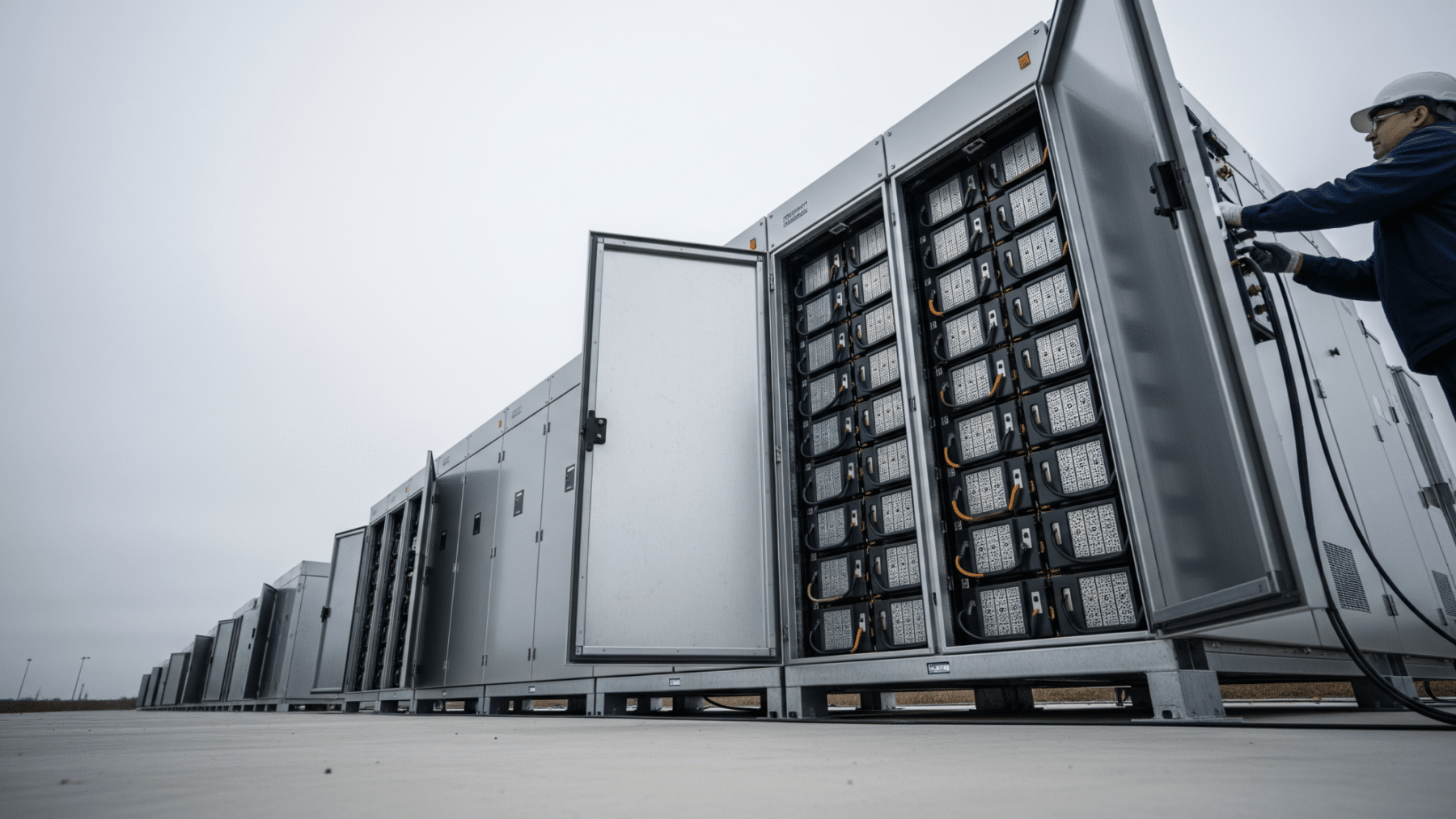
Something crossed a line in 2025 that nobody circled on a calendar.
The world added more battery storage capacity in a single year than it ever added of any other power technology in any prior year on record, including the kind of power plant that ran the twentieth century.
The number itself is striking.
But the benchmark it erased is the part that takes a moment to sink in.
A year that kept breaking its own records every quarter
The U.S. energy storage market hit a record 18.9 gigawatts of battery energy storage system installations in 2025, a 52% increase over 2024, according to the latest U.S. Energy Storage Monitor report released by the American Clean Power Association (ACP) and Wood Mackenzie.
The year did not slow down at the finish line either.
Q4 of 2025 closed with the strongest quarterly totals on record, with 5.8 GW installed.
New activity was spread across 13 different states, showing market diversification outside of leading states California and Texas, which have historically dominated utility-scale battery energy storage deployment.
Then 2026 arrived and kept going.
The U.S. energy storage market installed a record 3.3 gigawatts of battery energy storage systems in Q1 2026, surpassing the previous first-quarter record by 54%, with utility, commercial and residential installations all hitting new highs.
What the numbers look like when you add them up across all 50 states
The U.S. energy storage market installed 18.9 GW and 51 GWh of capacity in 2025, according to the quarterly Energy Storage Monitor report from Wood Mackenzie, a 52% increase in installations compared to 2024 levels. The final quarter of the year set a record for quarterly activity with 5.8 GW and 14.8 GWh deployed across all segments.
The residential market alone reached a record high of 2.7 GW installed in 2025, a 92% jump from 2024.
That geographic spread matters for the grid.
A technology once clustered in a handful of sunny states is now wiring itself into the country’s midsection.
The cost shift that made all of this possible almost overnight
None of this growth was accidental.
A price collapse of historic proportions changed the math for every project developer and utility in the country.
Battery costs fell by more than 90% between 2010 and 2025, according to the IEA.
Lithium-iron phosphate batteries now account for around 90% of deployments.
Just five years ago, the market share of LFP batteries in deployments was well below 50%.
Those falling prices are what turned battery storage from a niche grid accessory into something utilities now plan their entire capacity portfolios around.
And that is what set up the milestone most people missed entirely.
The record that battery storage just took from natural gas, and why it matters to your power bill
According to the IEA’s Global Energy Review 2026, total global battery storage capacity additions reached 108 gigawatts, up around 40% from 2024.
Annual growth of this scale exceeds the historical peak for gas-fired power capacity additions, which was around 107 GW in 2002.
That 2002 figure was the high-water mark of the gas-plant building boom, a year when developers raced to wire natural gas turbines into grids across the globe.
Nothing had touched it in 23 years.
Installed capacity is now eleven times higher than in 2021.
The United States contributed a record 18.9 GW of battery capacity in 2025, representing a 52% year-on-year increase, with utility-scale storage installations reaching 16 GW for the full year and behind-the-meter residential additions rising to 2.7 GW.
For the everyday power customer, the practical effect is that batteries are increasingly the technology that keeps the lights on during grid stress events, buying power when it is cheap overnight and releasing it during peak-demand hours when wholesale prices spike.
Where the grid goes from here, and what the next five years already look like on paper
The U.S. is projected to install around half a terawatt-hour of storage between 2026 and 2031, a 250% increase over the previous five-year period.
Annual utility-scale additions are projected to double between 2025 and 2030, supported by projects initiated to qualify for federal investment tax credits.
One key factor behind the continued U.S. battery boom is the preservation of the federal investment tax credit for qualifying energy storage systems. The Inflation Reduction Act first authorized those credits in 2022, and the One Big Beautiful Bill Act preserved the energy storage ITC even as it accelerated the expiration of corresponding credits for wind and solar. Allison Weis, Global Head of Storage at Wood Mackenzie, noted that developers now face the challenge of securing compliant supply chains: “Developers with mature pipelines and available capital rushed to safe harbor their pipelines in late 2025 and will now work to secure long-term supply agreements with domestic manufacturers for the rest of their pipeline. Lower tier developers either face acquisition or turn to low-cost Chinese OEMs. Battery energy storage cell manufacturers will work to secure limited FEOC-compliant cell components to qualify for the 45X tax credit, a key factor in maintaining cost competitiveness with China.”
The next constraint is not money or desire.
With Foreign Entity of Concern restrictions now in force, the challenge of securing FEOC-compliant equipment and safe-harbored capacity will be a critical developmental bottleneck over the next two to four years.
Still, the trajectory is clear. The record-setting pace of American energy infrastructure build-out is extending well beyond oil and gas.
Wood Mackenzie and ACP expect utility-scale storage to claim 85% of capacity additions through 2031 as policy, manufacturing capacity and market demand align. The EIA expects U.S. electricity consumption to rise by 76 billion kWh in 2026 and 126 billion kWh in 2027, driven largely by increased sales to commercial, industrial and transportation users, and energy storage will be critical to ensuring the grid can scale reliably and efficiently to meet that demand.
The benchmark that gas turbines held for two decades is gone.
What replaces it is still being built, one cabinet at a time, in fields from Texas to Michigan to Georgia.
