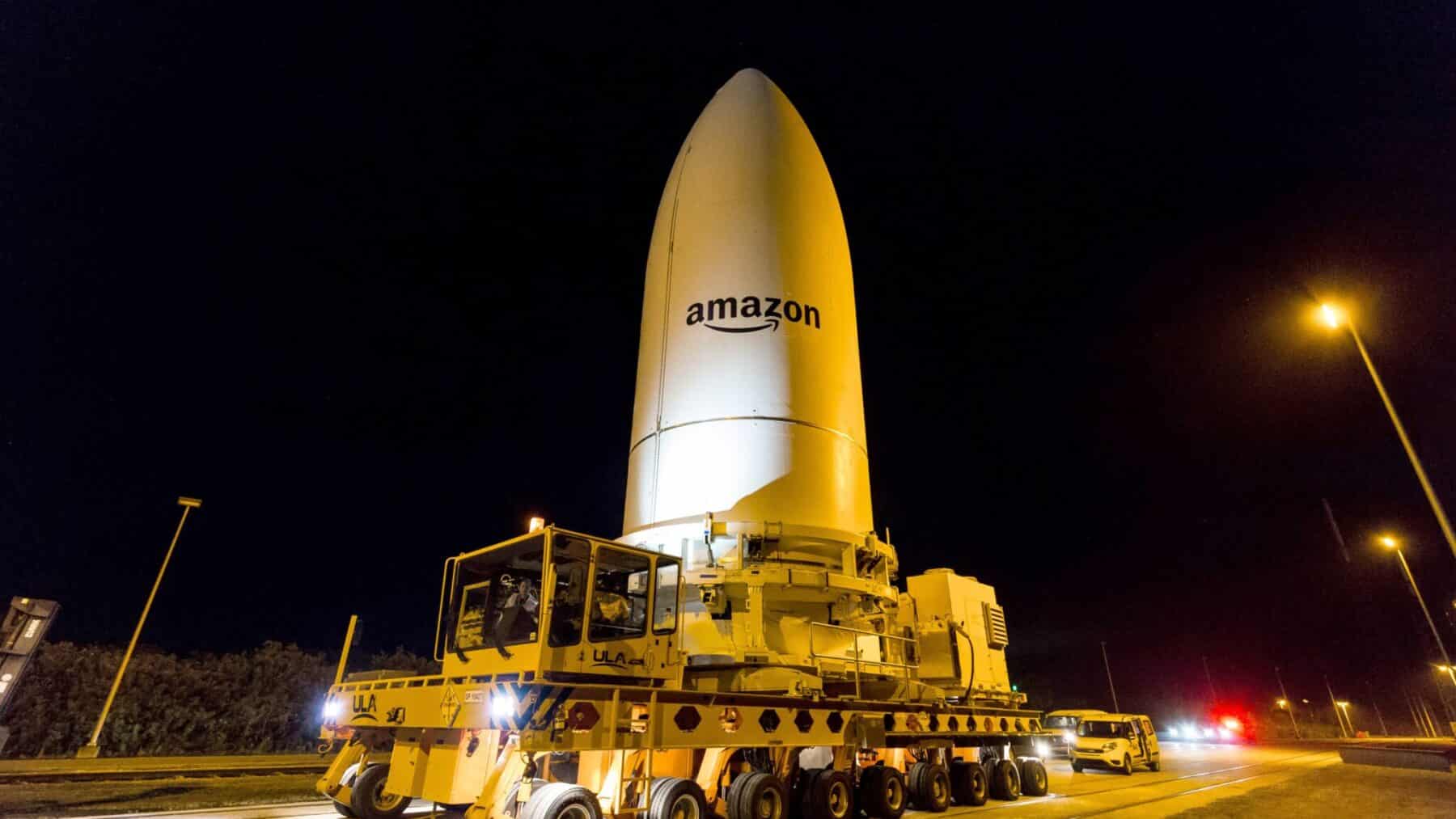
A rocket lifts off from a Florida coast at night, its fairing packed with two dozen flat satellites.
The constellation they join is still years from finished.
Back on the ground, a deadline has already passed.
The numbers tell two different stories depending on who is counting.
Only one of those stories ends with a company losing ground in orbit.
So why did regulators let the shortfall slide instead of pulling the license?
How a missed satellite count turned into a spectrum penalty
The mechanism here is simple and almost bureaucratic. Satellite licenses come with built in deployment milestones, and missing them is supposed to cost a company its authorization to keep launching. A requirement to deploy the first 1,616 satellites in its Amazon Leo broadband internet constellation by July 30 had been a condition of the FCC’s 2020 license for the network, when it was known as Project Kuiper.
So the company asked for relief. In January, Amazon asked for a two-year extension of that deadline, citing the limited availability of commercial launch opportunities. That alone signals how tight the global rocket market has become.
Instead of granting the full extension, regulators chose something narrower. The Federal Communications Commission has freed Amazon from a requirement to deploy the first 1,616 satellites in its Amazon Leo broadband internet constellation by July 30 , issuing a conditional waiver rather than the extension requested. A straight extension would have changed nothing else, while a conditional waiver lets regulators attach strings, and those strings turned out to tilt the playing field.
A launch pad scramble against a fleet still under 400 satellites
Picture the gap in plain numbers. Satellite trackers following the program this month put Amazon’s orbital fleet near 400 craft, far short of what the license demanded. 391 satellites sit in CelesTrak’s active catalogue, with 396 production satellites launched by Amazon on 14 missions from 28 April 2025 to 2 July 2026 , against a requirement for 1,618 in orbit by July 30, a shortfall of more than 1,200 satellites against the letter of its own license.
Amazon itself had warned regulators this was coming. On 30 January 2026 Amazon asked the FCC for a 24 month extension of the first deadline or a waiver, reporting 180 satellites in orbit and forecasting about 700 by 30 July 2026. Even that forecast proved optimistic.
Meanwhile the rival constellation kept compounding. Independent trackers following both fleets this fall put Starlink’s active count above ten thousand, dwarfing Amazon’s build out by an order of magnitude, a gap that shapes everything from coverage maps to launch cadence.
That imbalance is why the conditions landed the way they did. A regulator trying to protect a young challenger ended up writing rules that, in practice, still favor the company already furthest ahead.
What the waiver actually says, and where the numbers come from
Here is the mechanism the regulator chose, drawn from the order itself. Satellites launched after the July 30 deadline lose the priority status gained from the regulator’s 2020 Ka/Ku band and 2021 V band processing rounds, until the company catches up.
So what does spectrum priority actually control? Amazon bears the regulatory burden of ensuring its newer satellites do not interfere with rival constellations, including SpaceX’s Starlink. The waiver effectively reverses the usual order of protection for any satellite launched after that date.
Trade coverage following the filing noted the practical effect runs for roughly twenty months. Amazon Leo satellites deployed after July 30, 2026 will lose their priority access to the Ka/Ku spectrum until either 20 months have passed from that date, to March 30, 2028, or the date Amazon Leo manages to deploy and operate 50 percent of its constellation, whichever comes first. Even that penalty has an escape clause, since the company can shorten the wait for priority spectrum to October 2027 if it can prove that at least 50% of the sats are built with a launch secured.
Where the fix falls short and who still benefits
None of this erases the core complication. The final deployment deadline for the full constellation was left untouched, which means the company still answers to a hard date years away even as its near term penalty eases. Under the authorization for the first generation of satellites, Amazon was required to launch half of those satellites no later than July 30, 2026, with the remainder launched by July 30, 2029.
But the spectrum demotion is real, and rivals pushed for it. The FCC added the condition to address concerns from SpaceX, which opposed Amazon’s request for a deadline extension, describing it as special treatment, and raised concerns about a surge in interference issues stemming from Amazon launching and operating so many new satellites to meet the deadline.
That framing is contested, since the company avoided a worse outcome. Missing those deadlines typically comes with penalties, including fines and a reduction in the number of approved satellites. The waiver spared Amazon that fate, keeping its buildout alive with a weaker hand in frequency disputes for roughly a year and a half.
What this means for the race still playing out in orbit
Even so, the shift matters beyond paperwork. Satellite broadband increasingly competes with cable and fiber for ordinary households, a market this desk has tracked through projects like ground based infrastructure races that mirror the orbital one overhead.
A spectrum disadvantage, even temporary, can slow how quickly a newer network grows its coverage footprint relative to an incumbent already selling to millions of customers. Because the company still plans a Gen2 expansion on top of its original fleet, the stakes keep rising.
That expansion is sizable. Regulatory filings tracked this year show the Gen2 buildout adding thousands more satellites on top of the original Gen1 constellation, bringing the long term total into the thousands once both generations fly. What happens next depends largely on how fast those launch contracts actually fly, and whether the penalty clock runs out before the fleet catches up.
