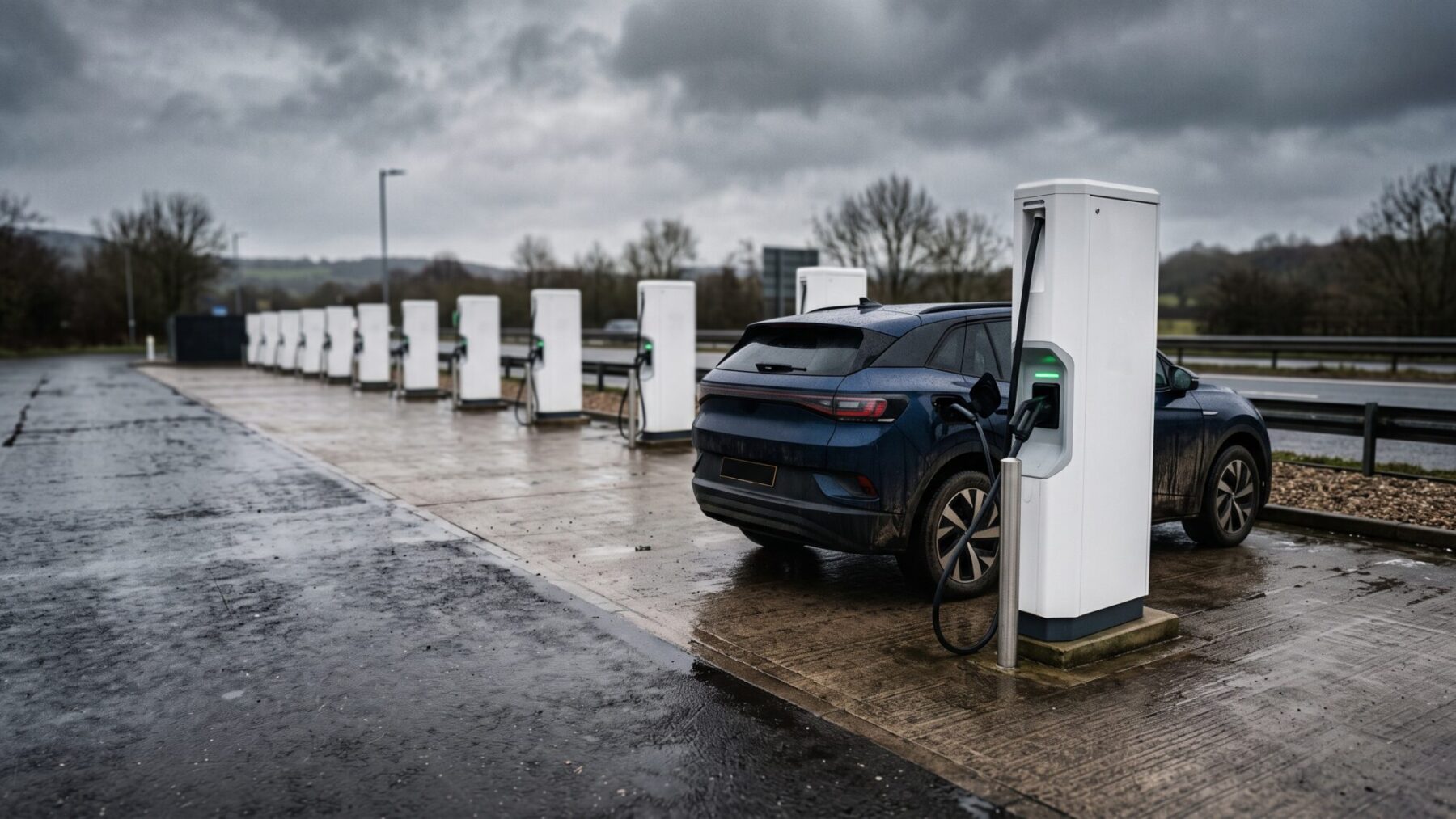
Pull into a highway charging plaza today and the landscape looks different than it did eighteen months ago.
New dispensers wear new colors. New apps ask for your payment. New names appear on the canopy above. The scoreboard has shifted, and the numbers behind it tell a story every EV driver and every automaker will feel at the plug.
How a dominant network loses share while still adding stalls faster than any single rival
The mechanism is straightforward: when a single operator controls more than half of every fast-charge port in a market, it can only lose share even while growing, because rivals are building faster. That is exactly what has happened to the Supercharger network over the past two years. Its total stall count keeps climbing, but the pool of all ports is climbing faster, and the math does the rest.
The shift is also structural. Tesla owns and operates every Supercharger stall directly, giving it tight control over reliability and customer experience. But the rivals now gaining ground are also building and owning every stall themselves, and doing so collectively at a pace that dilutes any single operator’s share. The pool of competitors has widened dramatically.
That difference in scale of competition matters enormously. More owned stalls mean more uptime data, more customer relationships and more pricing power across the market as a whole, not just at one network.
What the plaza looks like now: 76,000 ports, eight automakers and a retail giant in the race
As of September 1, 2026, there were 76,236 public DC fast-charging ports across the US, according to the Alternative Fuels Data Center, 23 percent more than a year ago. The industry added more than 1,100 new stalls in August alone, and has been deploying more than 1,000 stalls per month on average so far this year.
The Supercharger network remains the largest single DC fast-charging network, with roughly 38,000 stalls and a share that stood at 52.5 percent at the start of the year, down from 57 percent at the start of last year. It still deploys more new stalls than any other individual operator, but the combined effort of other networks is stronger. Its market share has been slowly decreasing and is approaching the 50 percent mark for the first time in the network’s history.
Ionna, a joint venture of eight automakers, BMW, General Motors, Honda, Hyundai, Kia, Mercedes-Benz, Stellantis and Toyota, was established in July 2023 and Toyota joined the venture in July 2024. As of the JD Power study’s publication, Ionna had 1,375 ports and 150 charging stations, with a commitment to 30,000 ports by 2030. Walmart, Red E Charge and Ionna all punched well above their installed base in new deployment share during the second quarter. The retail giant’s charging push alone signals how far the market has moved beyond specialist operators.
The JD Power flip: a network less than two years old beat the decade-old leader on satisfaction
The port-count shift would be striking enough on its own. The satisfaction reversal is the sharper surprise.
According to JD Power’s 2026 US Electric Vehicle Experience Public Charging Study, Ionna ranked highest among DC fast chargers with a score of 807 out of 1,000. Mercedes-Benz Charging Network placed second at 797 and Rivian Adventure Network third at 755. Tesla Superchargers received a score of 701, falling to fourth, noticeably behind the leaders. After five consecutive years atop the rankings, the Tesla Supercharger network is no longer number one.
Overall satisfaction with DC fast charging rose 12 points year over year to 666 , suggesting the whole category is improving even as the old hierarchy reshuffles. Ionna’s stall design puts both major connector types, NACS and CCS1, on every dispenser, meaning any EV on sale today can use one without an adapter.
Reliability also improved meaningfully. DC fast-charging satisfaction increased by 12 points compared to last year, and reported failures dropped to the lowest level ever recorded by JD Power, with only 12 percent of surveyed drivers experiencing a charging failure, down from 14 percent the previous year. NEVI compliance requirements mandating 97 percent uptime are pushing baseline standards higher across the industry, not just for federally funded stations, but as a competitive benchmark every network is now measured against.
Where the growth math gets complicated for the leading network
Holding the top position in total ports while losing share of new deployments is an unusual predicament. The leader’s share of all DC fast-charge ports has declined steadily, falling from 57 percent at the start of 2025 to 52.5 percent by January 2026, with projections suggesting it could slip below 50 percent within months as growth spreads across more companies.
The industry is also changing how it builds, not just where. In Q2 2026, newly installed DC fast-charging stations had an average of 5.4 ports per site. The average number of ports per DC fast-charging location has risen to more than 4.7, up from 4.1 a year earlier, reflecting a shift toward larger, multi-stall sites rather than single-charger installations. Fewer sites, more stalls per site is a strategy that boosts utilization and lowers the per-session cost of maintaining each location.
That is the same playbook that made the Supercharger network dominant. Now the rest of the industry has adopted it.
The NEVI federal program, which funds DC fast chargers along highway corridors, was paused in February 2025 after a January 2025 executive order. A federal court later ruled the freeze unlawful, and the program is restarting in 2026 with about 885 million dollars in funds flowing to states , money that will disproportionately benefit newer entrants competing for rural and highway-gap sites.
What the reshuffled leaderboard means for drivers filling up this year and next
For the EV driver, a more competitive charging market means real options. Networks are racing to improve uptime, amenities and pricing transparency rather than simply counting stalls. That is a markedly different picture from two years ago, when broken chargers were routine complaints at most non-Supercharger stops.
The eight-automaker alliance behind Ionna creates its own dynamic. The joint venture gives BMW, General Motors, Honda, Hyundai, Kia, Mercedes-Benz, Stellantis and Toyota a direct stake in making charging hardware work as smoothly as possible. Drivers buying from any of those eight brands now have a charging option whose owners have every financial reason to keep the stalls working.
For anyone tracking where the EV market is heading through a slow-sales year, the infrastructure shift may be the most telling signal of all. The leading network still operates more fast-charge stalls than the next several competitors combined, and its decade-long head start is a real moat. But when a network less than two years old claims the industry’s top satisfaction score and challengers from Walmart to Rivian crash the growth rankings inside a single year, the market has already shown you where it is going.
