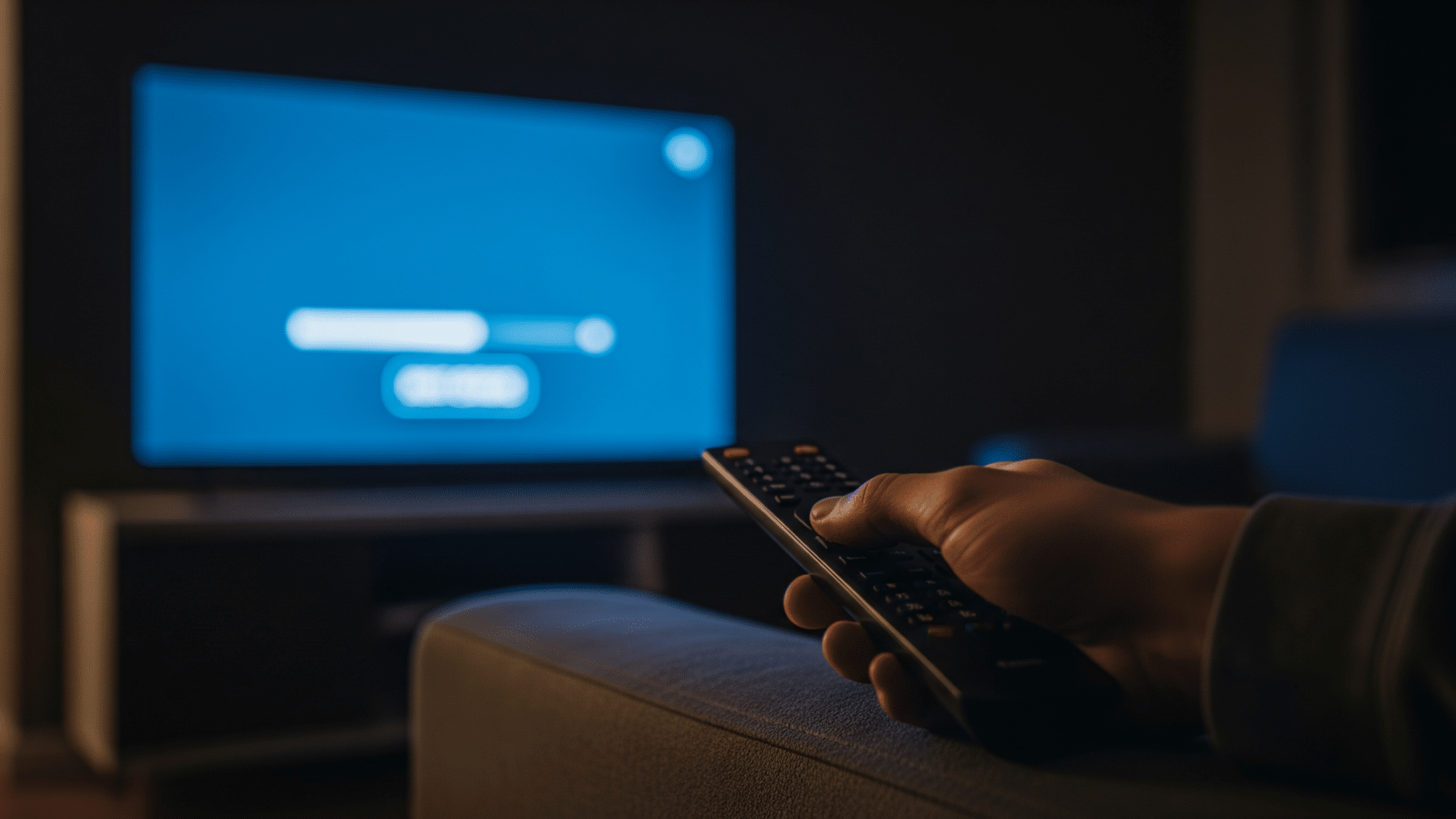
Every night, in living rooms across America, a small button appears in the corner of a television screen and a color slowly sweeps across it.
Nobody presses anything.
The next episode begins on its own, and the decision to keep watching was never actually made.
That moment, a few seconds long and easy to miss, turns out to be one of the most precisely engineered pieces of screen design ever built into a consumer product.
And researchers just measured exactly what it costs.
The feature hundreds of millions of people use every night without thinking about it
Autoplay, a feature that automatically begins the next episode or movie without user input, has become a staple of modern streaming platforms like Netflix.
Most people experience it as simple convenience. A show ends, another begins. No friction, no effort.
What very few viewers realize is that every frame of that transition is the product of a deliberate design choice, one that researchers classify in a specific and unflattering category.
Among the many types of existing design patterns, some are termed “attention capture damaging patterns,” a subset of dark patterns designed to capture and retain user attention. Employing such design elements to arrest user attention can contribute to stress, reduced productivity, and addiction-like behaviors, affecting users’ mental well-being by leading users to engage with content they might not have chosen willingly.
Autoplay sits squarely in that group.
And until now, no one had actually measured its real-world effect with a controlled experiment.
How 76 ordinary viewers agreed to flip one switch and change everything
The study followed 76 participants who already reported moderate to heavy Netflix use. Half the group turned off autoplay, while the control group left it on.
Researchers in the Department of Computer Science at the University of Chicago then did something clever: they didn’t just ask people how they felt.
They analyzed the participants’ submitted data to look for differences in watching behaviors between the study’s intervention period and the six-month duration leading up to the study, using the control group to account for confounding variables.
That comparison, real playback logs, real timestamps, gave them something surveys never could: a precise before-and-after picture of how one feature reshapes an evening.
The numbers were not subtle.
And the mechanism behind them turned out to be even more interesting than the outcome.
What actually happens in the room when credits start to roll
Here is the physical sequence, as the researchers documented it.
Users may return to the menu, opt to continue watching the credit sequence, opt to play the next episode right away, or do nothing, for which the next episode will automatically play after about 5 seconds. A color wipe across the Next Episode button operates as a visual countdown timer for when the next episode will automatically begin.
Five seconds is not much time. Enough to glance at your phone, shift on the couch, think vaguely about going to bed.
Lead author Brennan Schaffner said: “Platforms like Netflix try to minimize friction so that opportunities for consumers to deviate from the activity in which they are passively engaged are few and far between.” He added: “The 5-second autoplay countdown is hardly enough time for viewers to consider, or even just re-visit, their original intentions for visiting the platform.”
The design does not trick anyone. It simply removes the moment where a conscious choice would occur.
Think about how many times you’ve watched something you didn’t exactly choose to watch.
Now consider that the gap between episodes is measured in single-digit seconds.
The 24-second gap that explains 21 lost minutes every single day
Here is the payoff the numbers deliver, sourced directly from the University of Chicago AIR Lab study.
Disabling Netflix’s autoplay resulted in, on average, 21 fewer minutes watched per day and 17-minute shorter sessions.
Disabling autoplay also increased the time between content viewings within a session by about 24 seconds on average.
Twenty-four seconds.
That tiny gap, barely enough to set down a glass of water, is the entire mechanism.
Adding only about 24 seconds between episodes within a session, just enough to require a deliberate choice rather than passive continuation, turns out to have a meaningful effect on how long you stay.
The feature doesn’t need to trap anyone. It just needs to eliminate the pause where a person would naturally reconsider.
By removing natural stopping cues like loading pauses between episodes, the design eliminates the tiny moments that might remind us to stop.
Psychologists call these “decision points,” brief pauses where our brains can evaluate whether to continue.
Netflix enables autoplay by default, and previous work indicates that many Netflix users may not know that autoplay can be disabled at all. The same frictionless-continuation architecture runs across virtually every major streaming platform, and researchers note the pattern is growing more deliberate, not less.
For anyone already thinking about how teenagers are retreating from in-person social life and into screens, the engineering of that retreat turns out to have a precise mechanical address.
What researchers say the fix actually looks like
The University of Chicago team was direct about what the findings imply for platform design.
By offering more granular controls over autoplay settings, like turning this feature off by default or presenting users with a choice during account creation, platforms could give users the ability to balance convenience with autonomy.
Creating longer countdown options would let users simultaneously experience the benefits of autoplay’s convenience while providing themselves adequate time to make conscious decisions.
For now, the setting to disable autoplay exists on most platforms. It is simply buried deep enough that most people never find it.
The pattern looks familiar to anyone who has tried to locate an alternative option deliberately made hard to see.
The number that sticks is 21 minutes a day. Across a year, that is more than 128 hours of watching that no one ever consciously chose.
All of it driven by a color wipe and a five-second clock.
