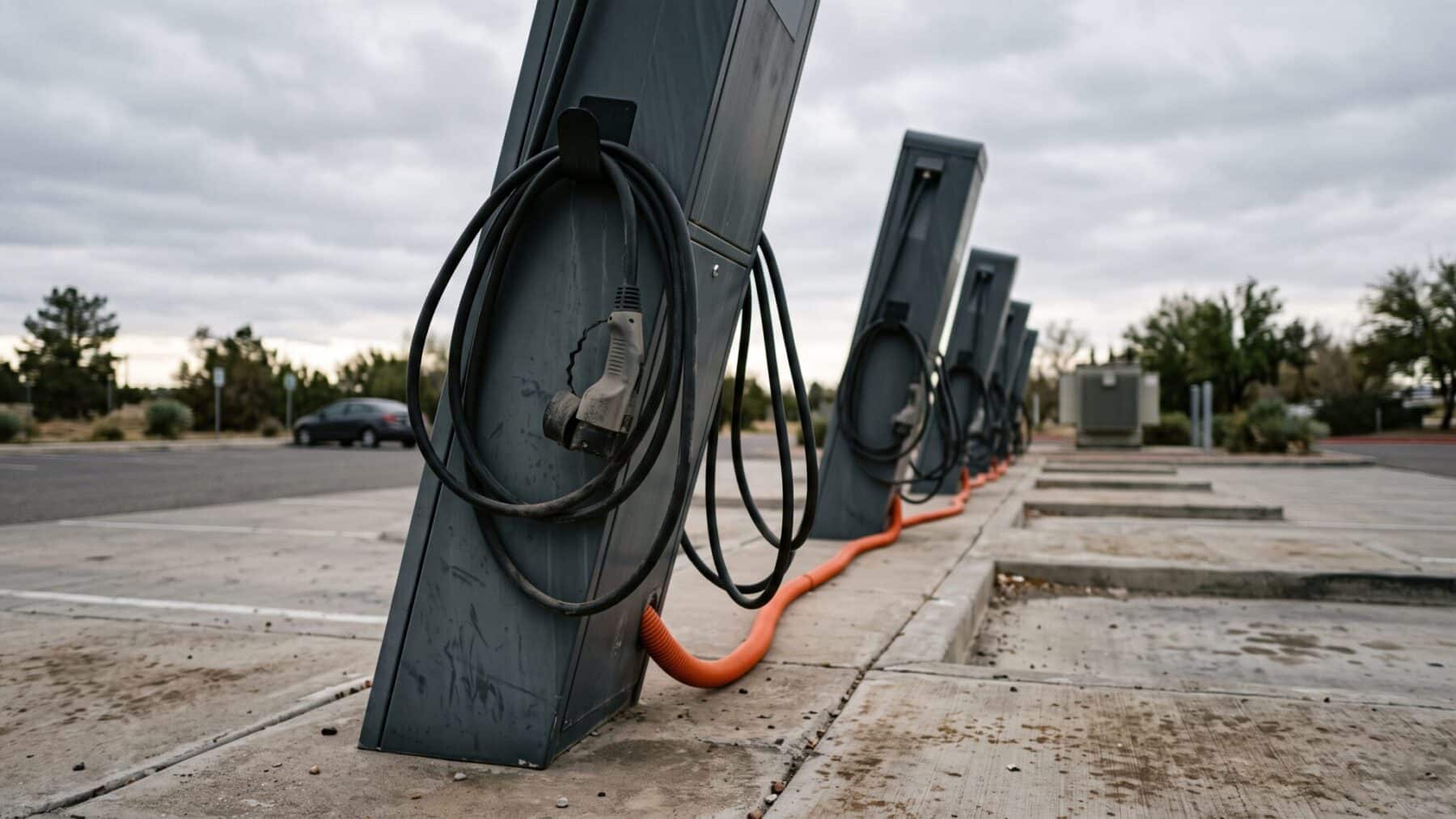
A commercial truck depot sits quiet just after midnight, every vehicle plugged in.
Within thirty minutes, dozens of chargers fire simultaneously. The site’s grid connection spikes hard. The utility registers the peak. And the demand charge that lands on next month’s bill can dwarf the cost of the electricity itself.
California’s three largest utilities are now each rewriting that structure, though not in the same direction. For any depot drawing serious power, the stakes are immediate. So what, exactly, changes?
How demand charges work and why the new rate designs change the math entirely
Traditional commercial electricity billing separates energy use from peak power draw. A customer pays per kilowatt-hour for everything consumed, but also pays a separate monthly charge based on the single highest kilowatt draw recorded at any fifteen-minute interval. One bad charging night sets a demand ceiling the operator pays for all month, whether or not it ever peaks again.
PG&E’s Business EV rate replaces the traditional demand charge with a subscription-based kilowatt allocation, in PG&E’s own words, “the kW subscription replaces a demand charge.” Its BEV2 tier covers installations of 100 kW and up, subscribed in 50 kW blocks, including public fast-charging sites. SDG&E’s Electric Vehicle High Power rate uses a similar subscription model, where customers select a maximum capacity, in increments of 10 kW for sites with demand at or below 150 kW, and 25 kW increments for sites above that threshold, and where sustained overruns trigger an automatic move to a higher subscription tier rather than a per-event overage fee. Southern California Edison takes a different path: its commercial EV rates remain energy-only, with no demand charges at all, until the end of 2029.
Where the subscription model applies, operators select a capacity tier at the start of a billing period and pay for it regardless of actual use. Those who repeatedly overshoot face automatic tier increases they cannot immediately reverse. The incentive to control peak demand is the same; the mechanism for extracting the cost is new.
So where the subscription applies, the cost of overshooting is baked into future billing rather than revealed as a single monthly spike. That shifts forecasting responsibility squarely onto the depot operator.
What a large depot actually draws and why that number matters to the local grid
A NEVI-compliant station must have a minimum station power capability at or above 600 kW, supporting at least 150 kW per port simultaneously across four ports. That single installation already sits well into the upper subscription bands; a battery-backed design can reduce the required grid draw to around 350 kW. Scale up to a full truck or bus fleet and the numbers move into a different category entirely.
A large electric bus or logistics fleet can draw several megawatts during peak charging. Most depot sites were never designed for that load, and grid connection upgrades take months and carry a high cost.
Unmanaged charging in the interim generates demand spikes that trigger capacity charges, often the largest single line item on a commercial energy bill. The IEA’s Global EV Outlook finds that shifting part of the charging load to off-peak periods can reduce maximum depot power demand by up to 60 percent. That gap separates a depot that wins under the new rate structure from one that gets crushed by it.
The data that shows how fast this load is growing
ICCT projections show high-energy counties facing peak loads of up to 132 megawatts from medium- and heavy-duty vehicle charging alone by 2030, while national electrification of those vehicle classes is projected to increase US daily electric energy consumption by 140,000 megawatt-hours per day by that same year. That is a substantial new industrial load arriving at depot locations scattered across the distribution grid.
The IEA’s global projection sharpens the picture: EV charging electricity demand is projected to exceed 1,500 terawatt-hours by 2035, growing around sixfold from 2025 levels. The United States increased its public charging stock by 20 percent in 2024, while globally more than 1.3 million public charging points were added in that year alone.
Faster, more powerful chargers mean each new installation carries a larger grid footprint than the one it replaces. Utilities have to price for the peak that each one creates. The DOE EV load forecasting guide sets out 20 best practices for utilities navigating exactly this pressure.
Where the new rate structure breaks down and who absorbs the risk
The subscription model hands depot operators a cleaner bill, but it shifts forecasting risk onto the operator rather than the utility. A fleet that grows by ten trucks mid-contract lands in overage territory. A site that installs battery storage and shaves its peak dramatically may be locked into a high-cost tier it no longer needs for the rest of the billing cycle.
The underlying question of who pays for grid upgrades is live at the federal level too. FERC issued show-cause orders initiating proceedings under Section 206 of the Federal Power Act, instructing regional transmission organizations to explain why their existing tariffs are just and reasonable with respect to interconnection for large loads. The Senate bill on grid upgrade costs targets the same fault line: once a depot grows large enough, its connection costs can spill onto every other ratepayer on the same substation feeder.
New loads will often fall on specific distribution circuits, sometimes requiring new or expanded substations, and new or expanded substations can take five years or more to propose, design, and build. EV charging infrastructure, by contrast, goes up in one to two years. One grid policy analyst noted in congressional testimony that this timing mismatch is the structural problem no rate redesign fully solves.
What operators and utilities do next as the model spreads beyond California
California now runs three different rate philosophies across its three large utilities, while a fourth model, classic per-kilowatt demand charges, remains in force almost everywhere else. That fragmentation is the real headline: there is no longer one “demand charge” to plan around. Every utility is wrestling with the same low-load-factor problem EV charging creates, and regulators are rebuilding, not removing, the way peak power is priced.
The operators best positioned under the new structure pair smart charging software with on-site battery storage, keeping their subscribed tier low while meeting fleet needs within each billing window. That combination effectively converts a large commercial charging site into a dispatchable grid asset rather than a dumb load spike.
Managed charging programs at several US utilities have already shifted more than 90 percent of EV load off peak hours, delivering significant savings to all ratepayers over the programs’ lifetimes. The subscription tier model is the commercial-scale version of the same logic: price the peak honestly, and operators will find ways to avoid it. The grid, and everyone on it, is better off when they do.
