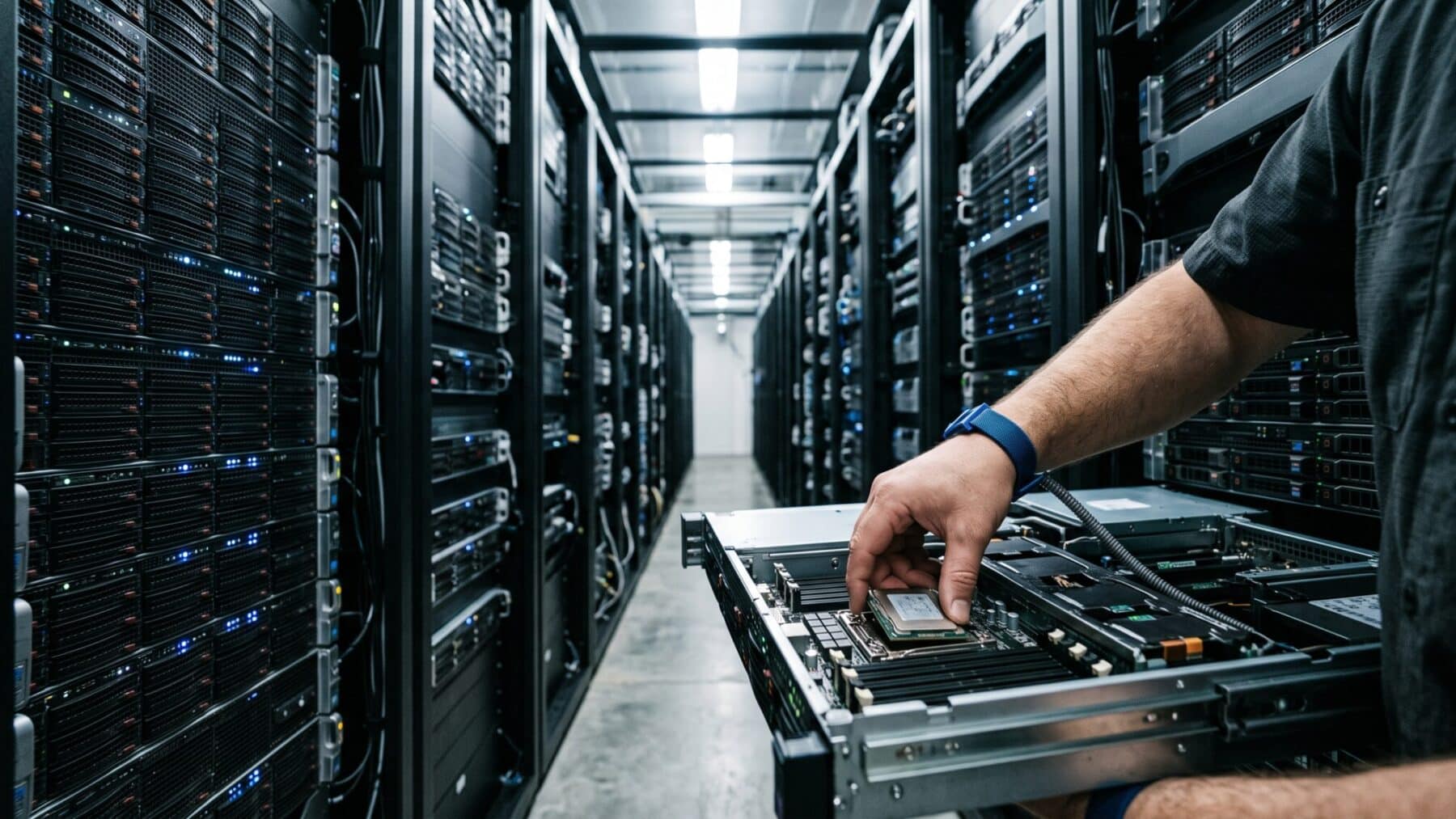
A steel-floored server hall hums at a constant 68 decibels.
Rows of chassis blink amber and white. Inside each tray, a processor socket decides whose name appears on the quarterly revenue report.
For most of two decades, that name was almost always the same one. Then came a quarter that changed the count.
A chip designer that once held almost no server presence reported that its data center division had outearned its long-dominant rival for the very first time. The gap is drawn from the two companies’ separate earnings reports.
How does a processor family get from nowhere to nearly half of all server CPU spending in under a decade?
How a modular chip architecture dismantled a two-decade monopoly
The mechanism is architectural, not accidental. When the company rebuilt its server chip around a modular tile design, it stopped competing on single-die brute force and started winning on core count per watt. Cloud providers measure everything in cost per workload, and a chip that packs more compute into the same rack space at lower power is simply cheaper to run at scale.
That calculus runs especially hot for AI inference, where a server farm might process billions of requests a day. Agentic AI pipelines need enormous numbers of CPU threads running alongside GPU accelerators, and a high-core-count processor that costs less per thread gives a hyperscaler a compounding advantage every time it adds a rack.
So a structural market shift aligned perfectly with what the newer chip already did well. Premium, high-density deployments tilted toward the challenger’s silicon while the incumbent held on in lower-margin commodity accounts. Unit share and revenue share pulled apart. That divergence is the clearest sign that one competitor was winning the expensive servers.
The quarter the numbers made it official, in concrete dollar terms
AMD generated data center revenue of $5.8 billion in Q1 2026, a 57% year-over-year increase. That surpassed Intel’s $5.1 billion data center revenue by roughly 700 million dollars. That margin is not a rounding error across a single quarter. Data center sales accounted for more than half of AMD’s total Q1 revenue, driven by EPYC processors and Instinct GPU shipments.
Then the second quarter made the first look conservative. Data center net revenue hit $6.7 billion for the three months ended June 27, 2026, up 107% from the same period a year earlier, as confirmed in the company’s earnings release.
“We delivered an excellent quarter, with record revenue and profitability as Data Center revenue more than doubled year-over-year,” said Dr. Lisa Su, AMD Chair and Chief Executive Officer. The Helios rack-scale system had entered full production and was expected to start shipping by the end of Q3 2026 , AMD’s play for the biggest AI infrastructure contracts of the year.
What independent server CPU tracking data confirms about the split
According to Mercury Research, AMD’s EPYC CPUs captured 46.2% of total server CPU spending in Q1 2026, an all-time high driven by rising AI and data center demand. Intel’s x86 server revenue share fell to 53.8% during the same period.
The most revealing detail is the gap between unit share and revenue share. AMD’s server CPU revenue share reached a record 46.2%, meaning it commands nearly half of all x86 server CPU revenue while shipping roughly one-third of units. That spread reflects significantly higher average selling prices for AMD’s processors and the popularity of the company’s high-core-count premium configurations. The challenger is winning the most expensive machines, the high-core-count servers that cloud providers deploy for AI, HPC and hyperscale workloads.
AMD started 2026 on a strong note, expanding its share in both client and server CPUs and setting new records for overall x86 CPU revenue share, according to Mercury Research. This is not a server-only story, and it matters to anyone deploying compute at scale.
Where the challenger still faces a ceiling, and who else is closing in
The revenue lead is real, but so are the structural limits. The challenge now is supply. AI demand is putting heavy pressure on advanced chip manufacturing, and TSMC is already dealing with huge wafer demand from many companies. AMD’s allocation of advanced packaging capacity at the leading foundry remains a primary production constraint, capping how many chips can ship regardless of demand.
Meanwhile, the competitive field is not just two players. The leading GPU designer still controls the large majority of AI GPU revenue. Underneath both, custom silicon from hyperscalers is compressing the merchant chip market from above. Cloud giants designing their own accelerators in-house shrink the total addressable market for every third-party chip seller, a dynamic that reshapes the pressure seen in enterprise AI spending more broadly.
Co-designed application-specific chips carry a meaningful cost advantage over general-purpose GPUs for specific internal workloads. That ceiling presses down on everyone selling into hyperscale data centers.
What the server CPU market looks like from here, and what is still unsettled
AMD has upped its growth forecast for the server CPU market from 18% to 35% annually, with the expectation that it would hit more than $120 billion by 2030. That figure was cited alongside earnings guidance and reflects a genuine structural shift in how AI compute is assembled.
The more autonomous AI systems become, the more CPU threads they burn through managing parallel tasks. AMD CEO Lisa Su has said the rise of agentic AI will cause GPU-to-CPU ratios to shrink from roughly 1:4 or 1:8 closer to 1:1 , a structural tailwind that plays directly to high-core-count processors rather than raw GPU throughput alone.
What remains genuinely open is whether the revenue lead holds through a full industry cycle. Intel is not standing still, and its next-generation server platform targets exactly the AI CPU workloads where EPYC has made its biggest gains. A packaging capacity expansion at the leading foundry could also shift the GPU side of the equation faster than current allocations suggest.
For now, the count in the server hall is different from anything seen in the last twenty years. One company’s name appears on nearly half the revenue of every server CPU sold to cloud infrastructure. That is a verified number, from Mercury Research, describing a chip market that looks structurally different from the one that existed even eighteen months ago.
