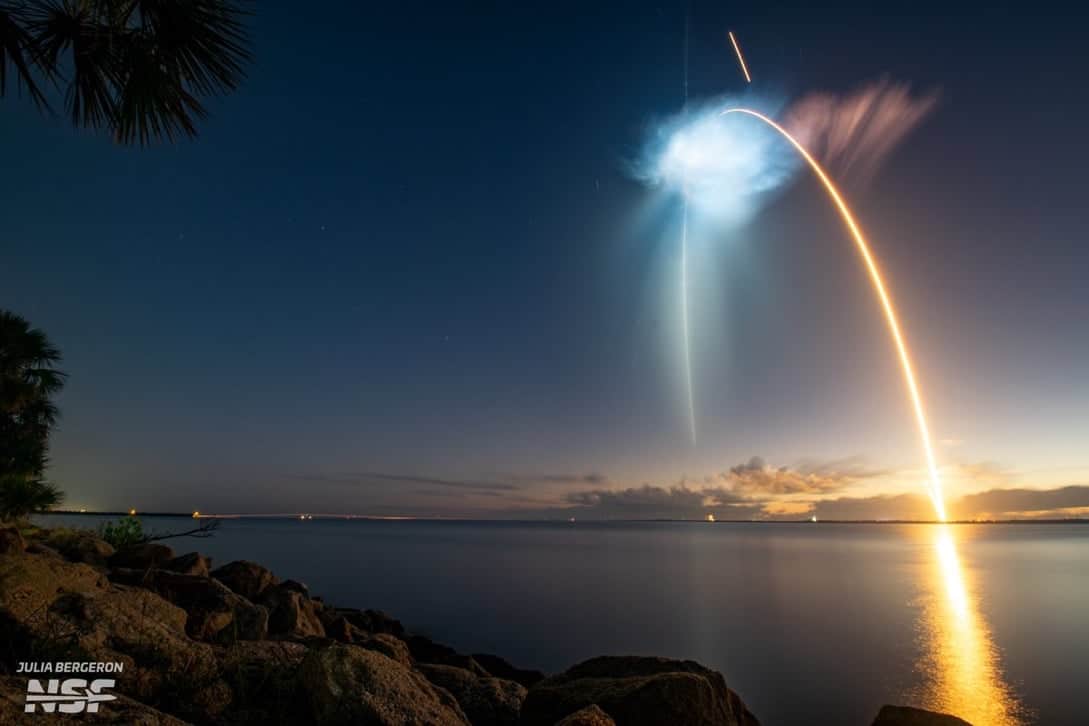
Arianespace successfully launched 36 satellites for Amazon’s Leo broadband constellation aboard an Ariane 6 rocket on Tuesday, marking the vehicle’s tenth flight.
It gave Amazon its first orbital delivery since a United Launch Alliance Vulcan rocket failed nine days earlier.
The flight, designated VA271 by Arianespace and Leo Europe 4 by Amazon, lifted off from Europe’s spaceport in Kourou, French Guiana, at 8:14 a.m. local time, according to ArianeGroup.
What happened
This successful launch brings the total number of Amazon Leo satellites deployed by Arianespace to 136 in under 10 months. Designated VA271 by Arianespace and Leo Europe 4 (LE-04) by Amazon, this is Ariane 6’s fourth mission for Amazon Leo this year.
On 24 November 2026 at 8:14 am local time, Arianespace successfully launched 36 Amazon Leo satellites aboard Ariane 6 in its Ariane 64 configuration, equipped with four enhanced-performance boosters, from Europe’s Spaceport in Kourou, French Guiana.
Arianespace CEO David Cavaillolès said the milestone demonstrated the rocket’s reliability.
David Cavaillolès, CEO of Arianespace, said: “Having now placed 136 Amazon Leo satellites into orbit this year, Arianespace has reached another milestone in the deployment of this ambitious constellation. We are proud to contribute to the development of global connectivity alongside Amazon Leo, and we thank our customer for its continued trust.”
It was the first satellite deployment in more than a week for Amazon Leo, which now has roughly 432 satellites in orbit for its planned internet service, according to Spaceflight Now.
The satellites were delivered in low Earth orbit, at an altitude of approximately 460 km, following a mission lasting 2 hours and 4 minutes.
A setback on a rival rocket
ULA lost 40 Amazon Leo satellites when its Vulcan Centaur rocket failed on November 15, the company’s first total mission failure since its founding in 2006 , after lifting off from Space Launch Complex 41 at Cape Canaveral Space Force Station in Florida , with the anomaly occurring about 10 minutes into flight.
Sunday’s launch was the fifth ever for the two-stage Vulcan Centaur, the successor to ULA’s workhorse Atlas V rocket. Vulcan debuted in January 2024 and has now experienced issues on three of its five flights, though Sunday’s was the only one that ended in failure.
Investigators later narrowed the cause. ULA traced the Nov. 15 failure of its Vulcan Centaur rocket to an inadequate supply of propellant to the vehicle’s first-stage engines , according to Space.com.
The flight was the first of 38 Vulcan launches Amazon has ordered from ULA, which previously flew eight Leo missions on Atlas V rockets , its rival to SpaceX’s Starlink, and Amazon had roughly 400 Leo satellites in orbit before the failure.
The lost payload was the largest Amazon had attempted on a single Leo flight.
Vulcan remains grounded for military missions while investigators continue examining the failure. That has left Arianespace and SpaceX carrying more of Amazon’s deployment load in the near term.
Why the constellation matters
Amazon Leo is Amazon’s low Earth orbit satellite network, whose mission is to deliver fast, reliable internet to customers beyond the reach of existing networks. The company must deploy 3,232 first-generation satellites by July 30, 2029, under its Federal Communications Commission authorization.
Amazon has said service could begin soon for some users even before the full network is built out.
Customers in certain areas can start connecting later this year using the nearly 400 satellites already in orbit, and each subsequent mission will extend the network’s reach, gradually filling in from northern and southern latitudes toward the equator, the company has said.
The fleet strategy behind Leo mirrors the industry’s broader push to pack more hardware into every rocket, a dynamic also playing out with ground infrastructure where networking gear links GPUs and software platforms race to manage growing tool fleets at scale.
The latest flight is part of a series of Ariane 6 launches contracted by Amazon for its Leo satellite constellation. The agreement covers 24 missions after Amazon announced six additional Ariane 64 launches in September 2026.
Steve Metayer, Amazon Leo’s vice president of production operations, credited the collaboration with Arianespace.
Steve Metayer, Amazon Leo VP of production, said: “Every Ariane 6 mission we fly with Arianespace builds on the one before it. Our Leo team works side by side with Arianespace on everything from satellite integration to launch day operations, and that shared expertise and trust is the driving force behind our cadence together this year.”
What comes next
Expected next developments include a final failure-investigation report, the Space Force’s response on Vulcan’s certification status, and Amazon’s revised Leo deployment schedule.
Until Vulcan returns to service, Arianespace and SpaceX are expected to shoulder a larger share of the remaining launches needed to build out Amazon’s broadband network.
