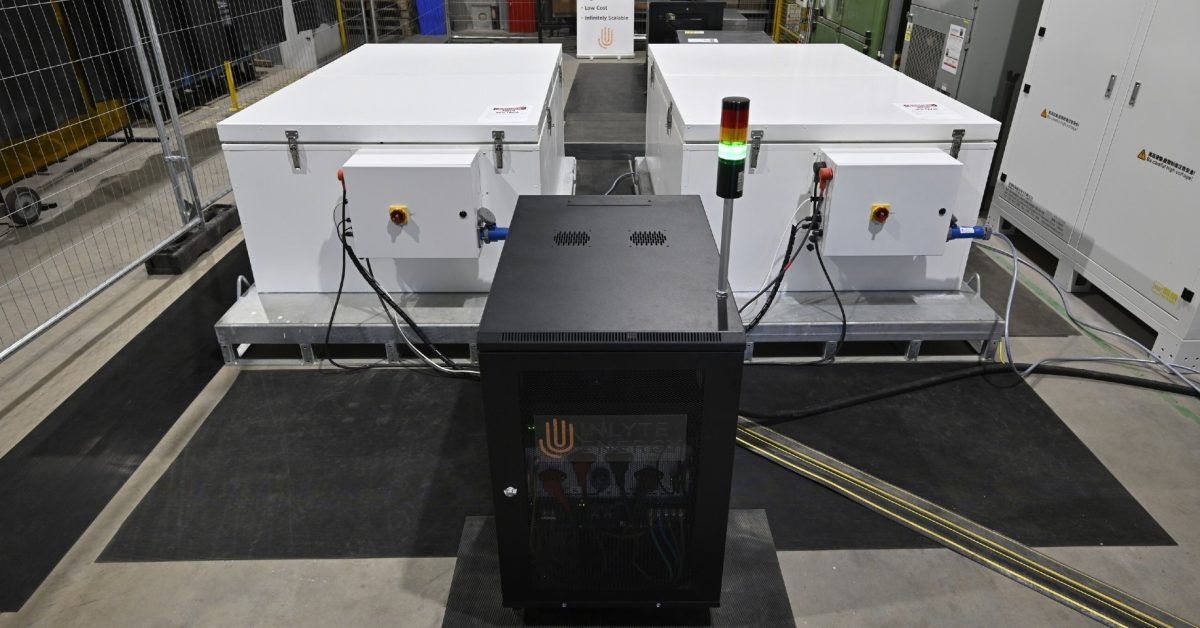
Eos Energy Enterprises has drawn an $87 million advance from the Department of Energy to help fund a second production line for its zinc-based battery technology at a Pennsylvania factory, the company announced.
The advance, issued through the DOE’s Office of Energy Dominance Financing, reimburses a portion of costs already spent building out the company’s Thorn Hill manufacturing site in Warrendale, Pennsylvania.
What the advance covers
Eos Energy Enterprises received an $87 million first advance under the second tranche of its loan agreement with the U.S. Department of Energy’s (DOE) Office of Energy Dominance Financing (EDF) , which reimburses 80% of eligible costs associated with the company’s Thorn Hill manufacturing facility in Warrendale, Pennsylvania . Eos has now drawn a total of approximately US$178 million from its DOE facility since 2024.
The advance was announced 14 September , 2026, and reimburses eligible costs associated with the company’s Thorn Hill manufacturing facility in Warrendale, Pennsylvania.
Eos describes itself as America’s leading innovator in designing, manufacturing, and providing zinc-based long-duration energy storage (LDES) systems sourced and manufactured in the United States . The company markets its zinc hybrid cathode battery chemistry as an alternative to lithium-ion for stationary grid and industrial storage applications.
Production ramp underway
Line 2 entered commercial production in June 2026 and is being ramped toward its designed annual manufacturing capacity of approximately 2 GWh.
Upon completion of the planned relocation of line 1 to Thorn Hill, subject to lender approvals, Eos expects Thorn Hill to support approximately 4 GWh of annual manufacturing capacity across two lines. That relocation would move Line 1 from battery manufacturing operations currently housed in Building 700 at the company’s Turtle Creek site , where approximately 250 impacted employees, including approximately 205 union-represented employees , are expected to be offered an employment opportunity or work-location assignment at Thorn Hill, Building 200 or the Company’s corporate offices .
The federal loan funding acts as a reimbursement mechanism tied to construction milestones already achieved at the site, rather than upfront project financing. The DOE Loan Facility provides for a multi draw term loan facility under a series of at least two and, if the Company elects, up to four tranches, subject to the achievement of certain conditions, with each tranche corresponding to the production, maintenance and development, and operation of a given production line to be funded using the proceeds of such tranche.
Eos received its first loan advance from the Department of Energy’s (DOE) Loan Programs Office in the amount of $68.3 million in December 2024, which covers 80% of eligible costs incurred to date , with additional draws following in subsequent tranches tied to the expansion.
Part of a broader federal storage push
The advance comes as the Department of Energy’s storage-focused offices pursue parallel efforts to diversify the domestic battery supply chain beyond lithium-ion chemistries.
The DOE’s Office of Electricity launched the Storage Design Strategies to Ease Production (STEP) Prize, a $500,000 competition to accelerate the development of next-generation energy storage technologies by addressing manufacturing and supply chain challenges early in the design process.
Non-lithium chemistries such as zinc, iron-air and iron-sodium have drawn growing federal and state interest because they avoid reliance on lithium and other critical minerals subject to global supply constraints and tariff exposure, similar to concerns that have prompted projects like the iron-sodium battery installation funded elsewhere in the Northeast.
Grid operators and utilities have increasingly sought storage options that can discharge for longer durations than standard lithium-ion systems, a factor that has also driven interest in thermal and mechanical storage alternatives such as the large-scale thermal battery project planned in Kansas.
Why it matters for the grid
Federal financing for alternative battery chemistries reflects an effort to build out domestic manufacturing capacity for grid storage technologies that developers argue are better suited to long-duration applications, where lithium-ion batteries can be more expensive to scale beyond a few hours of discharge.
Expanding Thorn Hill’s output is intended to help Eos meet demand from utility and commercial customers seeking storage systems rated for longer discharge durations without the price volatility tied to lithium supply chains. “Loan funding from the Office of Energy Dominance Financing has been critical in scaling Eos,” said Alessandro Lagi, Chief Financial Officer of Eos. “This advance reimburses a significant portion of the investment we have already made in Line 2 and returns that capital to the balance sheet, giving us more room to invest in the business while maintaining a disciplined approach to growth.”
The company has not disclosed additional draw schedules for the remaining balance of its DOE facility, though the pattern of incremental advances tied to construction progress suggests further disbursements are likely as the second production line ramps toward full capacity.
