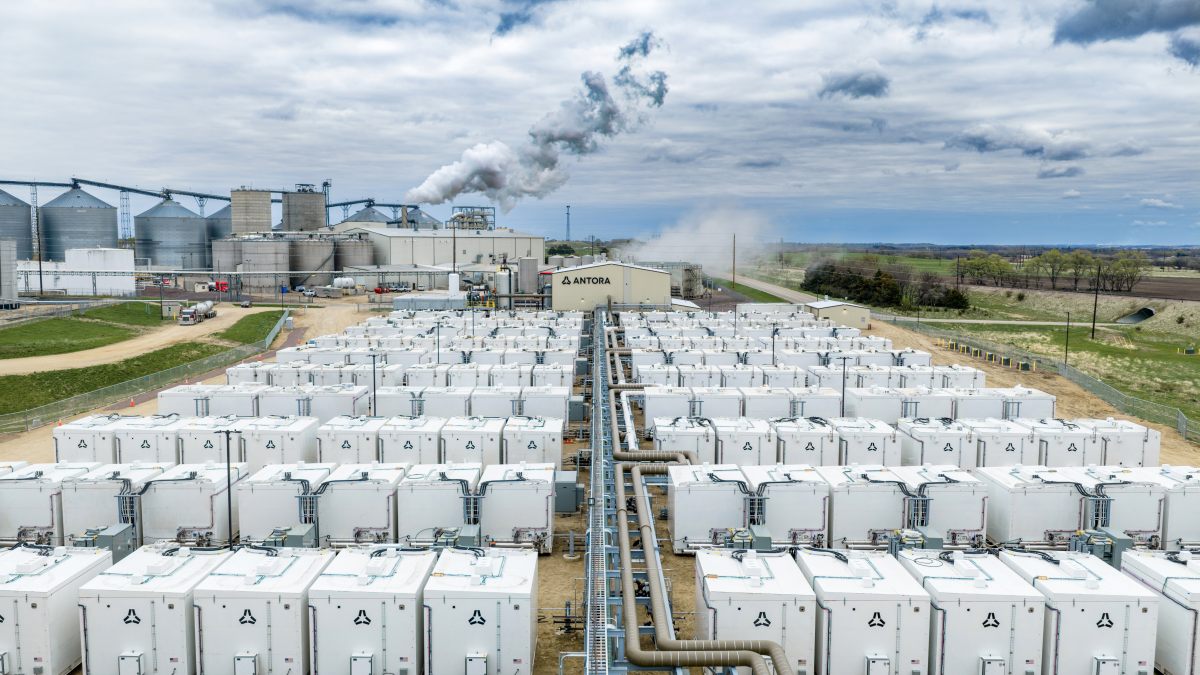
Antora Energy has announced plans for a 5.8 gigawatt-hour thermal battery storage project in Pratt, Kansas, a facility the company says will become one of the largest battery storage systems in the world once built.
The project is backed by investors including Copenhagen Infrastructure Partners, Grok Ventures and University Pension Plan Ontario, according to Antora’s announcement covered by ESG Today and pv magazine USA.
What the project involves
The new battery storage project will be based at renewable fuel producer Pratt Energy’s biorefinery in Pratt, Kansas.
Under the new offtake agreement, Antora will supply energy from the 5.8 GWh thermal battery system to Pratt Energy beginning in 2027.
Unlike the lithium-ion packs that dominate grid-scale storage headlines, Antora’s technology works differently. The battery will store low-cost electricity as heat in solid carbon blocks and supply that heat continuously to the biorefinery.
This kind of thermal storage targets industrial customers that need constant, high-temperature heat rather than the short bursts of electricity that typical grid batteries deliver. Antora has previously described its carbon block system as capable of reaching temperatures above 1,500 degrees Celsius, then releasing that stored heat as needed through heat exchangers or as electricity through a generator, depending on what the customer requires.
That flexibility is part of why the company has pitched its technology at heavy industrial users such as refineries, chemical plants and cement makers, sectors where process heat, not electricity alone, makes up the bulk of energy demand and the associated carbon footprint.
Why Pratt Energy signed on
Alongside the new project announcement, Antora also announced an offtake agreement to supply around-the-clock energy to Pratt Energy. The companies said the arrangement is meant to tighten the biorefinery’s operations.
The companies said that the project will improve Pratt’s operational efficiency and product competitiveness, as well as supporting the company’s efforts toward producing 100% zero-carbon-intensity ethanol.
For an ethanol producer, swapping a portion of fossil-fuel-driven process heat for stored electricity could lower both costs and the carbon footprint attached to each gallon produced, a selling point increasingly tied to compliance with low-carbon fuel credit programs that reward lower-emission production methods with higher-value credits.
Biorefineries like Pratt’s typically rely on natural gas boilers to generate the steam and heat needed for fermentation and distillation. Replacing even a portion of that gas-fired heat with a dispatchable, grid-charged thermal battery could reduce both fuel costs and emissions tied to the plant’s energy inputs, though the companies have not released specific projected savings figures.
A different approach to storage economics
Thermal batteries like Antora’s sidestep some of the raw material and fire-safety concerns tied to lithium-ion chemistry by relying on heat-retaining carbon blocks instead of electrochemical cells.
That approach has drawn interest from backers focused on long-duration, industrial-scale deployments rather than the shorter four-hour discharge windows common on the power grid.
The involvement of Copenhagen Infrastructure Partners, a major global infrastructure fund, and Grok Ventures, the investment vehicle of Australian billionaire Mike Cannon-Brookes, signals that institutional capital sees a commercial opening for storage technologies built around industrial decarbonization rather than grid arbitrage alone. Copenhagen Infrastructure Partners led third-party equity financing on the thermal battery project, while Australian investment firm Grok Ventures and University Pension Plan Ontario also participated.
The Kansas project adds to a run of large-scale storage investment nationwide that has already reshaped how utilities and manufacturers plan for both grid reliability and process heat, a dynamic also visible in Imperial Irrigation District’s geothermal deal.
Broader storage market context
The Pratt announcement arrives as developers and utilities continue experimenting with storage chemistries beyond lithium-ion, including iron-based and other long-duration systems aimed at niches lithium batteries do not serve well.
Massachusetts regulators recently backed a similar long-duration concept with an iron-sodium battery at a ski resort, part of a broader push toward storage technologies that can discharge for many hours rather than minutes.
Utilities have also been exploring new ways to integrate storage and flexible load management into daily grid operations, an approach reflected in PG&E’s flexible connection framework for EV chargers.
Industrial decarbonization projects of this scale also depend heavily on the cost of grid electricity used to charge the thermal battery, which is part of why developers increasingly site these systems in regions with abundant low-cost wind or solar generation. Kansas has significant wind capacity, and Antora’s Pratt facility is expected to draw on regional power markets to charge its carbon blocks during periods of low electricity prices.
Antora has not disclosed a construction timeline beyond the 2027 supply start date, and the company has not disclosed a power rating or cost for the project.
