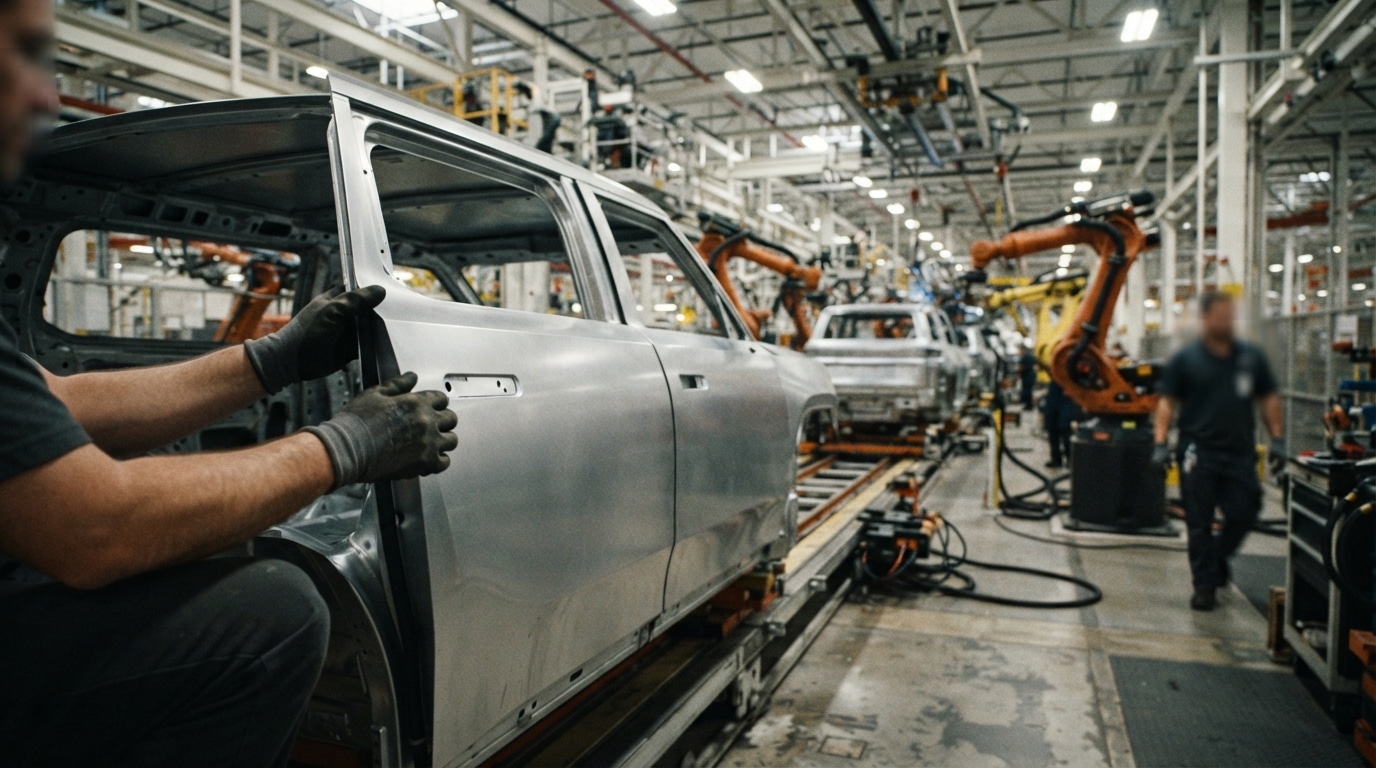
A massive new production hall rises across the Illinois prairie, freshly built and spanning 1.1 million square feet of floor space dedicated to R2 operations.
Workers in the factory town of Normal have been assembling a long-awaited electric SUV since spring. The vehicle carries a price tag that has been in every headline for two years. But walk into a dealership today and that number is nowhere on the window sticker.
So what exactly is on the sticker, and how did it get there?
Why the factory price and the advertised price are two completely different things
When an automaker announces a new model, the figure it puts in front of consumers is almost always the base trim price, the stripped-down configuration that gets the car into the cheapest possible headline. That number is real, technically, but it refers to a version the factory has not yet been told to build.
The trim that actually rolls down the line first is the one with the highest margin: loaded with options, premium hardware, and a price that can absorb the cost of a slow ramp-up before volume brings efficiency. This is not a bait-and-switch in the legal sense. It is a factory sequencing decision that lands squarely on the buyer’s lap.
The affordable version exists on a spec sheet. The expensive one exists on a car lot. The gap between them is not a rounding error.
What the Normal, Illinois plant is actually building right now
Rivian officially started R2 production at its Normal, Illinois plant on April 22, just days after an EF-1 tornado damaged Building 2, the section of the facility dedicated to R2 operations. Construction of the new manufacturing wing required a $1.5 billion investment.
The first trim rolling off the line is the Performance Launch Edition, priced at $57,990 before the $1,495 destination charge, a far cry from the $45,000 base price Rivian has been promoting since the R2’s unveiling. The Performance model packs 656 horsepower from a dual-motor all-wheel-drive setup, an 87.9 kWh battery, 330 miles of EPA-rated range, and a 3.6-second zero-to-60 time. Those are genuinely impressive numbers.
They are also attached to a price that is nearly $13,000 above what most reservation holders thought they were getting. External deliveries began in June, and every unit handed over so far has been that higher-priced launch trim.
The scale of the ramp and the evidence behind the price gap
The Normal plant produced 12,613 vehicles and delivered 12,194 in the second quarter of 2026, with the company citing robust growth in EDV commercial vans and its R1 lineup alongside the first R2 deliveries. Every one of those early R2 units carried the launch trim price.
The company raised its full-year delivery guidance to between 65,000 and 70,000 vehicles as the ramp accelerated, up from its prior range of 62,000 to 67,000.
Even so, the base $45,000 Standard trim, a rear-wheel-drive, single-motor configuration with a smaller battery, remains without a confirmed delivery date. Rivian has targeted late 2027 for that version, but no sub-$50,000 configuration is expected before the first half of 2027. With EV rebates falling sharply, that nearly $13,000 spread from the promoted price to the only available price is not closing through incentives alone.
Where this pricing pattern has real limits for ordinary buyers
Higher-margin trims first let a factory absorb start-up costs, work out supplier kinks, and build cash flow before the thinner-margin base model arrives. That factory logic creates a consumer reality where the person who reserved a car at $45,000 is now being offered a $57,990 substitute or a wait measured in years.
Reservation holders who decline the launch trim and hold out for the base price are essentially financing the ramp-up with their patience.
For buyers who stretched their budget to the $45,000 figure, the gap is not academic. It is the difference between approval and rejection on a car loan, or between keeping an existing vehicle another year and trading it in. A new US electric truck at $28,350 underscores just how wide the EV price range has become, making the distance between a company’s floor and its actual first delivery price feel even larger.
What happens next and what remains genuinely open
When fully scaled, the expanded Normal facility is expected to handle up to 215,000 vehicles of total annual capacity across all Rivian models. Rivian is also constructing a second plant in Georgia, with a revised initial annual capacity of up to 300,000 vehicles for the R2 and future models. At that combined volume, building base trims becomes not only feasible but necessary.
The price gap is a ramp problem, not a permanent condition. But ramp timelines slip, and buyers in the reservation queue have no contractual protection against an extended wait. Rivian’s CFO confirmed the R2 remains on track to reach positive gross profit before year-end, though the initial ramp will likely pressure margins before scale improves them.
The fair read is that the $45,000 R2 is real and will reach buyers willing to wait until at least late 2027. The less comfortable read is that no confirmed production date exists for when that happens, and the only way to take delivery today is to spend nearly $58,000.
