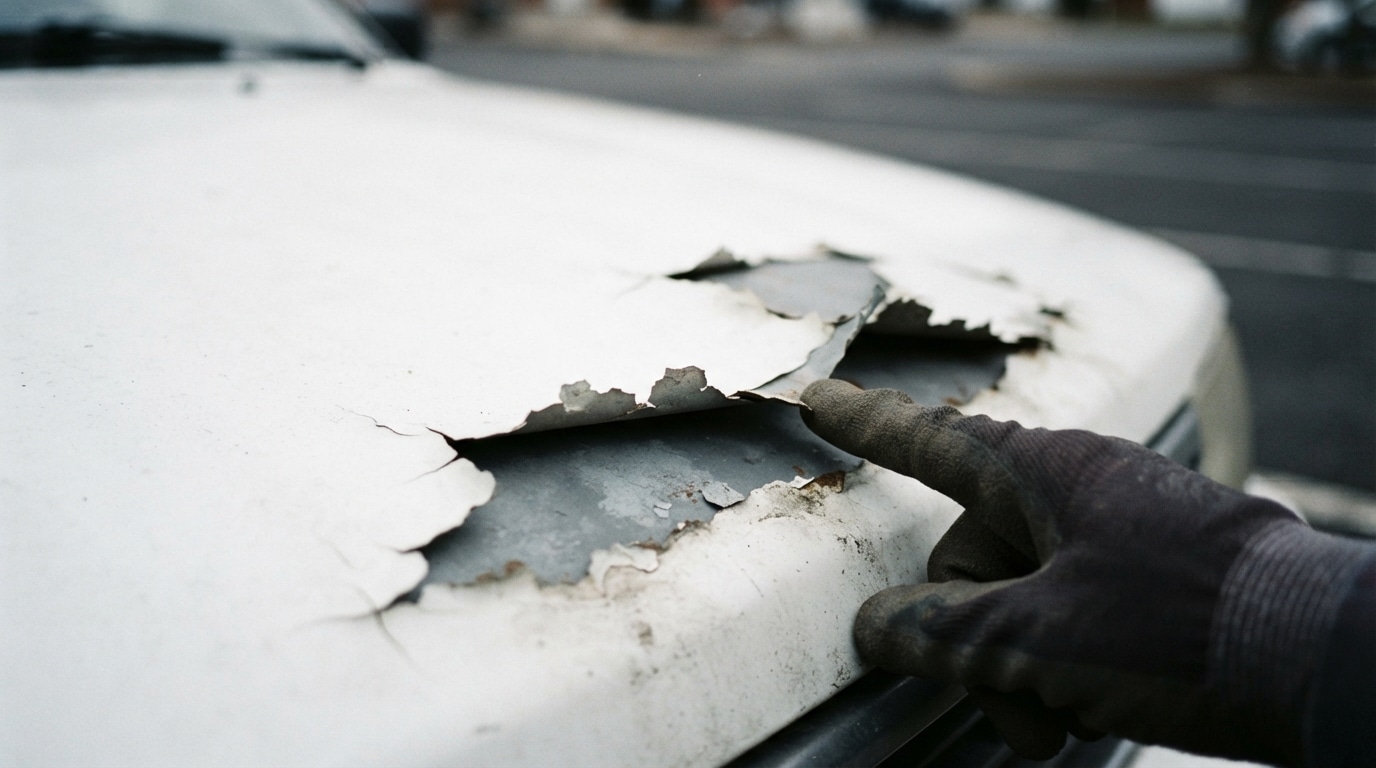
A car sits in a garage, barely touched since it left the dealer.
It has never seen a car wash brush, never been scratched by a shopping cart. Then one morning the owner notices a curl near the hood’s edge. She pulls gently and a palm-sized sheet of white paint comes away cleanly, leaving grey primer behind.
She has 10,000 miles on the odometer and a repair bill the original warranty will not cover. How does paint applied on a factory line simply let go?
Why factory paint separates from the metal before the car ages out
Every modern car body receives four layers in the paint shop: an electrocoated primer called e-coat, a primer surfacer, a color basecoat, and a clear coat on top. Each layer has to bond chemically to the one below it, and that bond depends on precise surface preparation and the correct film thickness applied at the correct temperature.
When the primer surfacer goes on too thin, or the surface retains microscopic contamination, the adhesion between the e-coat and the color layer is mechanically weak from day one.
The failure does not show itself immediately. Thermal cycling does the damage over time: metal expands in summer heat and contracts in winter cold, placing shear stress on any layer that is not properly bonded. Eventually the weak interface gives way, and paint separates in large sheets rather than tiny chips the way stone damage would.
White and light solid colors are particularly vulnerable. The dominant mechanism is adhesion failure at the primer-to-e-coat interface, and once the color layer departs, bare primer begins absorbing moisture within weeks.
Seven models, nine model years and a list that kept growing
Certain 2015, 2018 model year Elantra, 2015, 2019 model year Sonata, 2017, 2021 model year Tucson, 2017, 2018 model year Santa Fe Sport, 2019 model year Santa Fe, 2021, 2023 model year Santa Fe Hybrid, and 2020, 2023 model year Palisade vehicles with exterior white paint may exhibit peeling or bubbling on metal body panels: hood, fender(s), roof, door(s), quarter panel(s), and tailgate/trunk. That list spans nearly a decade of production, with the earliest affected models arriving in showrooms in the mid-2010s and the latest rolling out in the early 2020s.
The problem first surfaced publicly among owners comparing notes online. A Hyundai peeling paint Facebook group has thousands of members with similar stories and pictures, cars of many Hyundai models and colors, but predominantly white.
One owner described spending $48,000 on her vehicle only for the paint to begin peeling at 50,000 miles. Another said she had kept her car garaged, came out of work to find paint detaching, and thought she had been vandalized until she read about the paint issues Hyundai was having. One owner showed a news station how paint was falling off her white Sonata at just 10,000 miles, saying more came off every time she tried to wash it or when it rained.
The warranty evidence that confirmed this is a manufacturing problem
The clearest confirmation that this is a factory-origin defect comes from the automaker’s own warranty documentation filed with federal safety regulators. An earlier technical service bulletin states that certain vehicles manufactured at Hyundai’s Alabama plant may exhibit peeling or bubbling of the white paint, most commonly on or around the hood, fender, and roof. That language rules out driver behavior as a cause.
The current warranty extension covers affected vehicles for 10 years with unlimited miles from the date of original retail delivery or date of first use, and is valid for original and subsequent owners. The original warranty covered just three years and 36,000 miles, a window most drivers pass through long before the defect appears.
The April 2026 update also clarified that plastic body panels are not covered under the extension and must not be repainted, and added digital documentation requirements. You can check eligibility at Hyundai’s warranty portal using the 17-digit VIN.
Where the warranty extension does not reach, and what that means at resale
The extension only applies to factory-applied paint and does not cover collision-related paint repairs or vehicles with a salvage title. Any panel repainted after a fender-bender can be excluded from coverage, even if peeling clearly began on untouched factory metal nearby.
That creates a real problem for used-car buyers. A Palisade or Tucson purchased second-hand carries the extension since it transfers to subsequent owners, but only if no prior collision repair touched the affected panels. Buyers relying on a clean vehicle history report may not learn about a paid-out-of-pocket repaint until paint starts lifting after the sale.
A visibly peeling hood gives a dealer grounds to mark the vehicle down well beyond the cost of a repaint. On hidden resale traps in the used-car market, the pattern is consistent: cosmetic manufacturing damage tends to hit owners hardest at the moment they try to sell.
What owners can do now, and what the fix actually involves
The repair is a full panel repaint at an authorized dealer, performed at no charge within the warranty period. Owners should act promptly: vehicles whose 10-year window is close to expiring need a service appointment soon, and any vehicle already outside that window at the time of the announcement was given a fixed deadline of December 31, 2025 to present at a dealer.
Documentation matters enormously. The process begins with clear detailed photographs of the peeling and a note of the exact date the defect was first observed. The April 2026 bulletin added digital documentation requirements to tighten that process , and dealers must submit photographic evidence before a warranty claim is approved.
An owner who arrives without photos is at a real disadvantage. Factory paint, like any other manufactured component, can carry a latent defect invisible at delivery. Rising pressure on new-vehicle pricing makes an out-of-warranty repaint, often $1,500 to $3,000 per panel at a body shop, land even harder for owners who believed their car’s finish was guaranteed for life.
