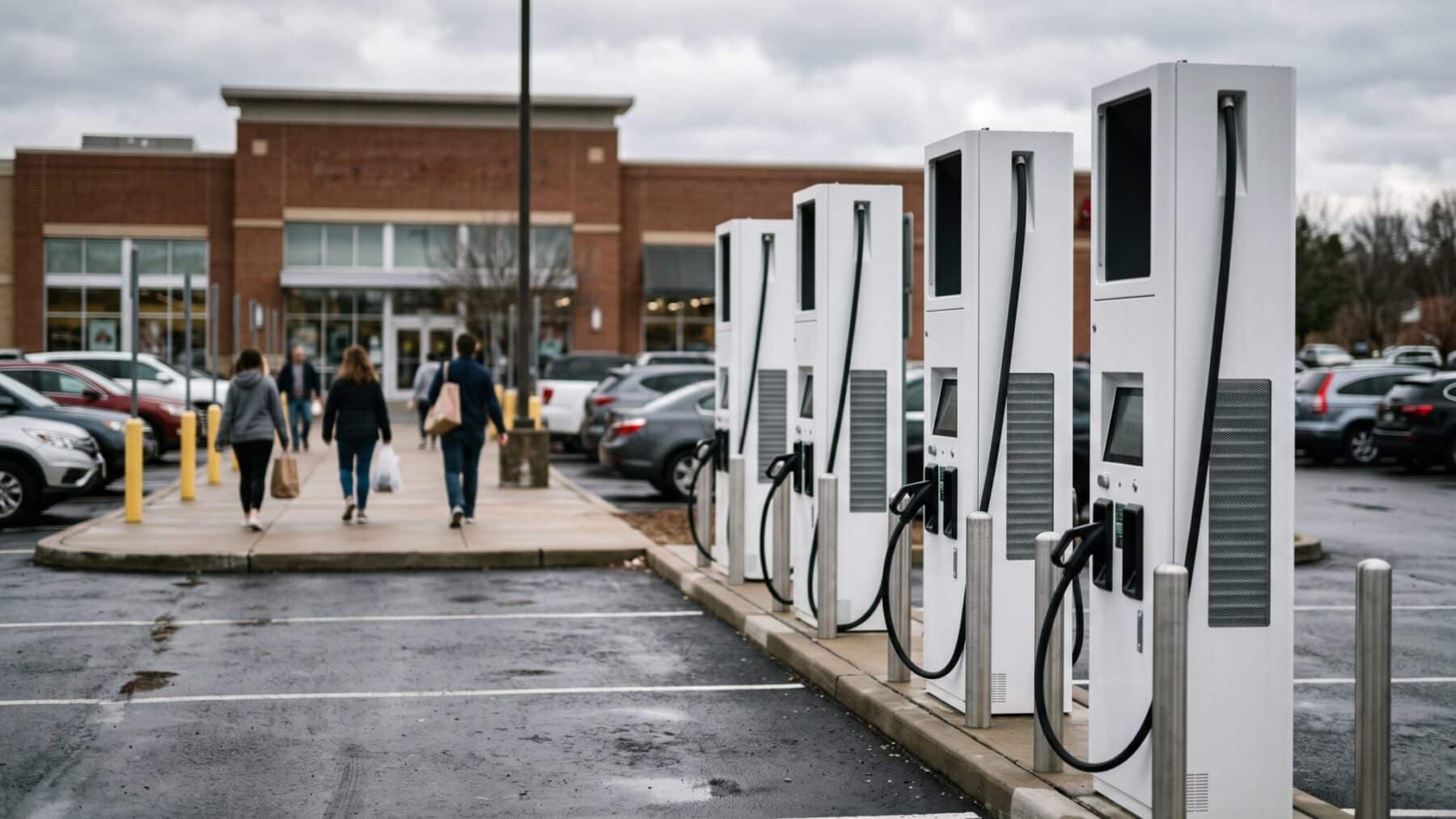
EVgo and Regency Centers Corporation announced on September 9 an expansion of their national partnership, with plans to add more than 400 fast-charging stalls at Regency shopping centers across the United States. The deal represents one of the larger retail-sited charging commitments announced this year by a public network operator working without federal NEVI support.
Scope of the expansion
Once complete, the new EVgo stalls are expected to help increase Regency’s EV infrastructure footprint by more than 20%. EVgo installed its first charger at a Regency center in 2020 and today operates over 150 stalls at Regency locations, meaning the addition would more than triple the existing installed base at those properties.
Each new EVgo site built through this partnership will feature up to 24 high-power chargers, capable of delivering a full charge in as little as 15 minutes, depending on the vehicle.
The new EVgo stalls are expected to be located at retail centers in metropolitan locations in Colorado, Florida, Illinois, New Jersey, New York, Pennsylvania, Texas, Virginia and other states.
Why grocery-anchored centers
Located in high-density markets and anchored by top grocers, Regency locations are prime places for public fast charging. The location logic is straightforward from an infrastructure utilization standpoint.
According to Mobility Plaza data cited in the announcement, supermarkets and shopping centers rank as the top preferred charging location, and roughly half of drivers who stop at a site enter the adjacent retail or food space.
EVgo’s executive vice president of growth, Scott Levitan, said in the announcement that “EV drivers are looking for convenient charging options where they already spend their time, like grocery-anchored shopping centers,” and that expanding the partnership with Regency would help meet growing customer demand while making public fast charging more accessible in the places people shop, dine and connect with their communities.
Network scale and market context
EVgo currently operates more than 1,200 fast-charging stations across 47 states, partnering with retailers, grocery stores, restaurants, shopping centers, gas stations, rideshare operators and autonomous vehicle companies. The Regency expansion adds a significant tranche of grocery-co-located capacity to that footprint.
The deal arrives as the broader US public charging market is growing but faces financing headwinds. In January 2026, Congress passed a budget law that rescinded just over $503 million in NEVI funding across 30 states and territories, pushing operators toward private retail partnerships as an alternative funding model.
Regency Centers’ vice president of sustainability, Mark Peternell, said “Expanding our EVgo partnership grows Regency’s EV charging footprint and gives more drivers reliable, convenient access to fast charging at the properties where they already shop and dine,” according to the joint announcement on GlobeNewswire.
What comes next
Neither company provided a completion deadline or a full list of locations. Installation sequencing across the named states will likely be determined by grid interconnection timelines and permitting at individual sites, factors that have slowed similar retail-charging programs elsewhere.
The Regency partnership is part of a wider industry pattern of charging networks anchoring deployments to grocery and convenience retail, a strategy also pursued by competitors. With EV inventory sitting at elevated levels on many dealer lots this autumn, operators like EVgo are betting that expanding the charging footprint at frequent-visit destinations will reduce one of the most-cited barriers to EV adoption among undecided buyers.
Industry data consistently shows that confidence in public charging availability ranks alongside upfront cost as a top purchase hesitation, a dynamic that makes the grocery-center location model commercially rational for both the charging operator and the property owner.
Regency Centers operates shopping centers in high-density metropolitan markets, many anchored by major grocery stores, giving the rollout a geographically concentrated reach in some of the country’s highest EV-ownership zip codes. For Regency Centers, the agreement adds a traffic-driving amenity to its retail properties at a moment when brick-and-mortar landlords are competing aggressively for foot traffic.
