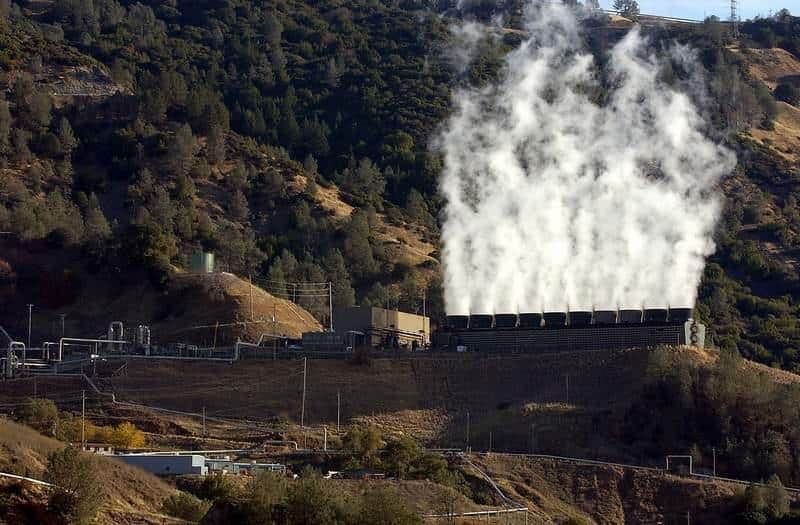
A steam pipe hisses quietly at the edge of a geothermal plant, the same low sound it has made for decades.
Inside the control room, a screen tracks every megawatt leaving the turbine hall. The sales pitch on that power started with a single word: always. Always on, always steady, a plant that never waits for wind or sun.
But the meter tells a different story than the brochure did. So what actually happens underground to make that gap show up on paper?
The ground itself is the limit nobody puts in the marketing deck
Geothermal power runs on heat pulled from brine deep underground, and that brine behaves less like a tank and more like a slowly draining reservoir. As operators pump it out to spin turbines, the pressure that pushes new fluid toward the wellhead starts to fall, and that decline does not reverse itself on its own.
Engineers call this reservoir pressure decline, and it sits alongside a second, quieter problem. Minerals dissolved in the hot brine slowly coat the inside of pipes and heat exchangers.
That buildup, known as scaling, narrows the channels the fluid has to pass through. It gradually chokes a plant’s throughput even when the wells themselves still have plenty of heat left.
Together these forces open a gap between the nameplate rating stamped on a plant’s turbines and what it actually sends to the grid. That gap has a name in the industry: the capacity factor, and it is one of the key numbers that decides whether a plant’s always on promise holds up.
What that gap looks like at the largest geothermal complex on Earth
The clearest real world case sits in Northern California, where a sprawling complex of steam wells once stood as the largest concentration of geothermal power anywhere in the world. At its late 1980s peak, that field carried roughly 2,000 megawatts of installed capacity feeding the regional grid.
Decades later, net generating capacity there runs closer to 825 megawatts by some estimates, with the complex’s own operator advertising a current capacity nearer 725 megawatts, a drop operators have never fully reversed. Crews have injected treated wastewater back into the underground reservoir to prop up pressure.
That fix slowed the slide but did not restore the field to its original output. And that history matters well beyond California, because newer geothermal projects elsewhere are now signing the same kind of long term power contracts that assume near constant output, even as the underlying physics pulling pressure down underground has not changed since the 1980s.
The hard numbers behind the promise, and where they come from
Federal data going back more than a decade back up the pattern seen at individual fields. Research built on the Energy Information Administration’s own reporting forms, the same annual and monthly filings geothermal operators submit under EIA Forms 923 and 860, indicated this plant performance metric had declined for geothermal power plants since 2008.
More recent EIA figures complicate a simple decline story: geothermal’s reported national capacity factor has stayed comparatively high and even climbed in some years before easing again, so the industry-wide trend is uneven rather than a straight line down. A separate global tracking analysis found a similar gap between capacity and output at the fleet level: for the period 2018-2023, installed capacity grew 10.3%, though annual generation increased by a mere 2.5%, with average capacity factor dropping from 74.6% to 69.3%, a decline attributed to the gradual deterioration of steam production in older geothermal fields.
The Department of Energy itself does not dispute the mechanism. Its own public guidance states plainly that some geothermal power plants have experienced pressure and production declines, but that operators are finding solutions to maintain reservoir pressure, language that confirms the problem while framing it as manageable rather than fixed.
Engineers who study aging geothermal fields generally agree on the underlying logic: a drawn-down reservoir eventually forces output lower, and good engineering can only slow that process, not stop it indefinitely.
None of that makes geothermal unreliable compared with other power sources; wind and solar face their own well known output limits. But a plant sold specifically on round the clock power is making a narrower promise than a wind farm ever does, which is exactly why the gap between contract and meter matters more here.
Where the physics does not apply, and why newer designs complicate the picture
Not every geothermal project faces the same exposure. Binary cycle plants, which run a closed loop secondary fluid instead of pulling steam straight from the ground, tend to see gentler declines than dry steam fields built in the 1960s and 1970s, because their equipment is less exposed to the raw mineral content of deep brine.
Newer enhanced systems that pump fluid through engineered rock are still too young to show a multi decade trend. Developers behind projects like the commercial plant that recently came online in Utah argue their approach manages pressure more actively than older fields ever could.
That claim will only be tested by years of operating data. Even so, the same federal filings that exposed the decline at older fields will be the record that proves or disproves it, and buyers signing long term power deals today, including the storage developers behind a nonstop battery pack, are increasingly building in output guarantees rather than taking nameplate figures at face value.
What this means for the next contract signed on a geothermal promise
For a utility or a large power buyer, the fix is not complicated. Build contracts around measured output history rather than headline capacity, the same shift already playing out where battery storage undercuts gas peakers on guaranteed performance rather than sticker numbers.
Geothermal developers who disclose real decline curves upfront tend to face fewer disputes once a plant is several years into operation. For ratepayers, the practical effect shows up quietly on a utility bill rather than in a dramatic headline.
A plant contracted at a capacity factor well above what its field can sustain often gets backed up by other generation when output slips, and that backup capacity carries its own cost somewhere on the grid. Geothermal still offers something few other power sources can match: heat that keeps flowing underground long after the sun sets or the wind stops.
The open question is not whether that heat exists, but whether the industry keeps selling it at a number the ground cannot actually hold.
