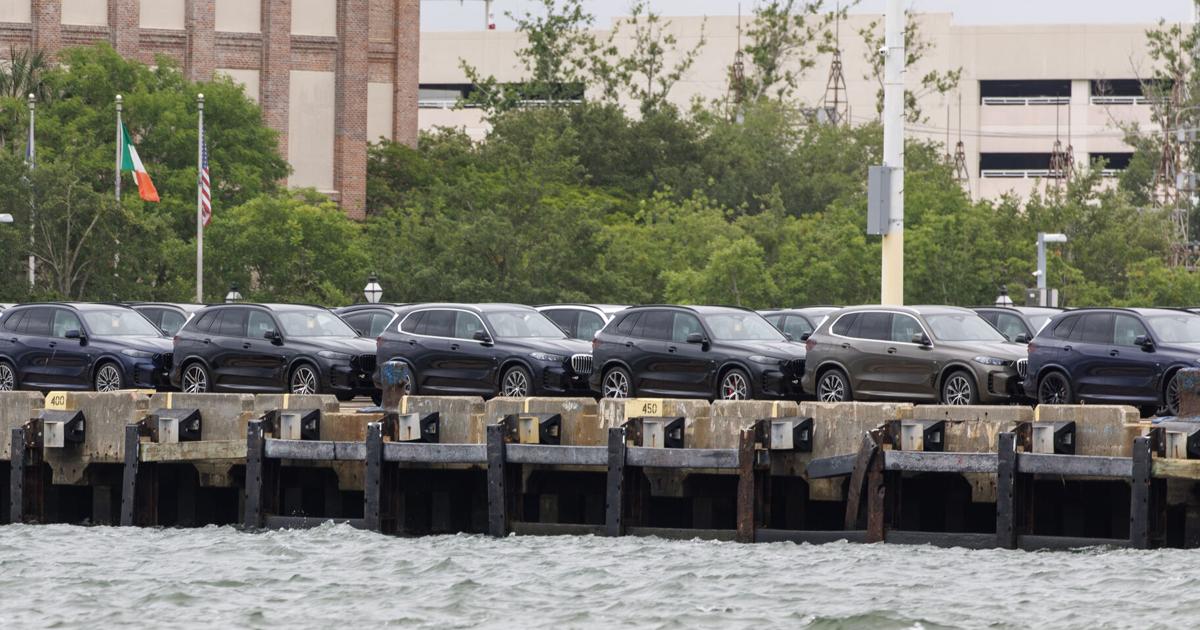
A line of sedans sits wrapped in plastic film on a dock, waiting for a customs stamp before they can roll onto American highways.
Each one carries a hidden cost that never shows up on the window sticker itself.
That cost now adds up to a number large enough to reshape a factory’s future.
It also explains why executives keep flying to Washington this fall.
So what actually determines whether a shipment gets taxed, and by how much?
How the tariff bill actually gets calculated
The math behind these numbers runs through a federal trade rule known as Section 232. On March 26, 2025, President Donald Trump issued a Proclamation imposing 25% tariffs under Section 232 of the Trade Expansion Act of 1962 on imports of automobiles and certain automobile parts, citing “a critical threat to U.S. national security.” That flat rate does not care whether the car is a budget hatchback or a luxury sedan.
That flat structure means the size of a company’s bill depends almost entirely on volume. A brand that ships hundreds of thousands of cars into American ports every year absorbs a far steeper total cost than a brand that builds nearly everything domestically, even though both pay the identical rate per vehicle.
One German automaker now sits squarely in that bind. Last year, BMW imported 215,000 cars into the U.S., which were hit by the new tariffs; most of these cars were the 3 and 4 series sedans built overseas for American buyers who want that specific body style, none of it built on US soil.
Inside a South Carolina plant now central to the pricing fight
The company’s largest American factory sits in Spartanburg, South Carolina, a sprawling complex that assembled about 400,000 vehicles last year and shipped roughly half to 120 foreign markets . That export volume is why the BMW Group remained the largest automotive exporter by value in the United States in 2025, according to data released by the US Department of Commerce , a distinction that now anchors its entire case for relief.
Instead of walking away from that plant, the company just put more money into it. BMW Group announced the completion of a $1.7 billion investment in its South Carolina operations, with the iX5 confirmed as the first fully electric BMW to be assembled in the U.S.
That new EV began building on the same line as gas and hybrid X5s, and its battery packs are assembled at the nearby Woodruff facility. Initially, the battery cells used in the iX5 will come from China, with BMW planning to transition towards locally manufactured cells later in the decade, switching to U.S.-sourced cells from LG Energy Solution’s Arizona plant by the end of the decade.
So the pitch to federal officials is simple. A company already building hundreds of thousands of vehicles domestically and exporting more than any rival is asking why it should still pay full freight on the sedans it imports.
What the company and state officials are actually saying
The manufacturing chief overseeing US operations put the company’s position plainly in comments reported this week, confirming BMW paid more than $1 billion in import duties last year and says its $1.7 billion U.S. expansion and export role justify lower tariffs, such as those sought by Toyota and Audi . “Our business model is to export, so for sure we are in close contact with the federal government,” Robert Engelhorn, CEO of BMW Manufacturing, said in an interview. “We are looking towards free trade. We are looking toward the lower tariffs.”
That framing is not a generic complaint about trade policy. It is a pointed argument that a company exporting at this scale should not face the same duty as an importer with no US manufacturing footprint at all.
Other foreign brands, including Toyota and Audi, are reportedly making nearly identical arguments to federal officials about their own US investments and export roles.
Where the relief case gets complicated
None of this guarantees a lower rate is coming. Officials close to the discussions have offered no timeline or dollar figure, and the company itself has acknowledged there is no telling how much relief, if any, will actually materialize.
Even so, the stakes are not abstract for American buyers. Destination fees and sticker prices across the industry have already climbed as automakers pass tariff costs down the line, with some full-size trucks and SUVs seeing record high fees tacked onto final price tags this year.
That pressure sits alongside other shifts reshaping showrooms, including the steep drop in electric vehicle sticker prices since a federal tax credit expired earlier this year.
Meanwhile, the math only grows messier as parts tariffs stack on top of vehicle tariffs, with components from different countries facing wildly different rates.
What it means for buyers and the industry watching closely
For now, the automaker is betting that its domestic investment record carries more weight in Washington than its import volume works against it. That bet mirrors a broader pattern, where companies increasingly frame tariff relief requests around jobs and factory dollars rather than pure trade arguments.
Because the outcome will likely shape how other importers structure their own pitches, this case is being watched well beyond one company’s balance sheet. A favorable ruling could set a template other foreign brands lean on.
Shoppers eyeing a European sedan built overseas will not see any change tomorrow. But the next round of pricing will trace directly back to how this negotiation ends, much like shifts already visible in wholesale market data this fall.
What is clear already is the scale of the number on the table. A billion dollar bill tied to 215,000 cars is not a rounding error for any company.
