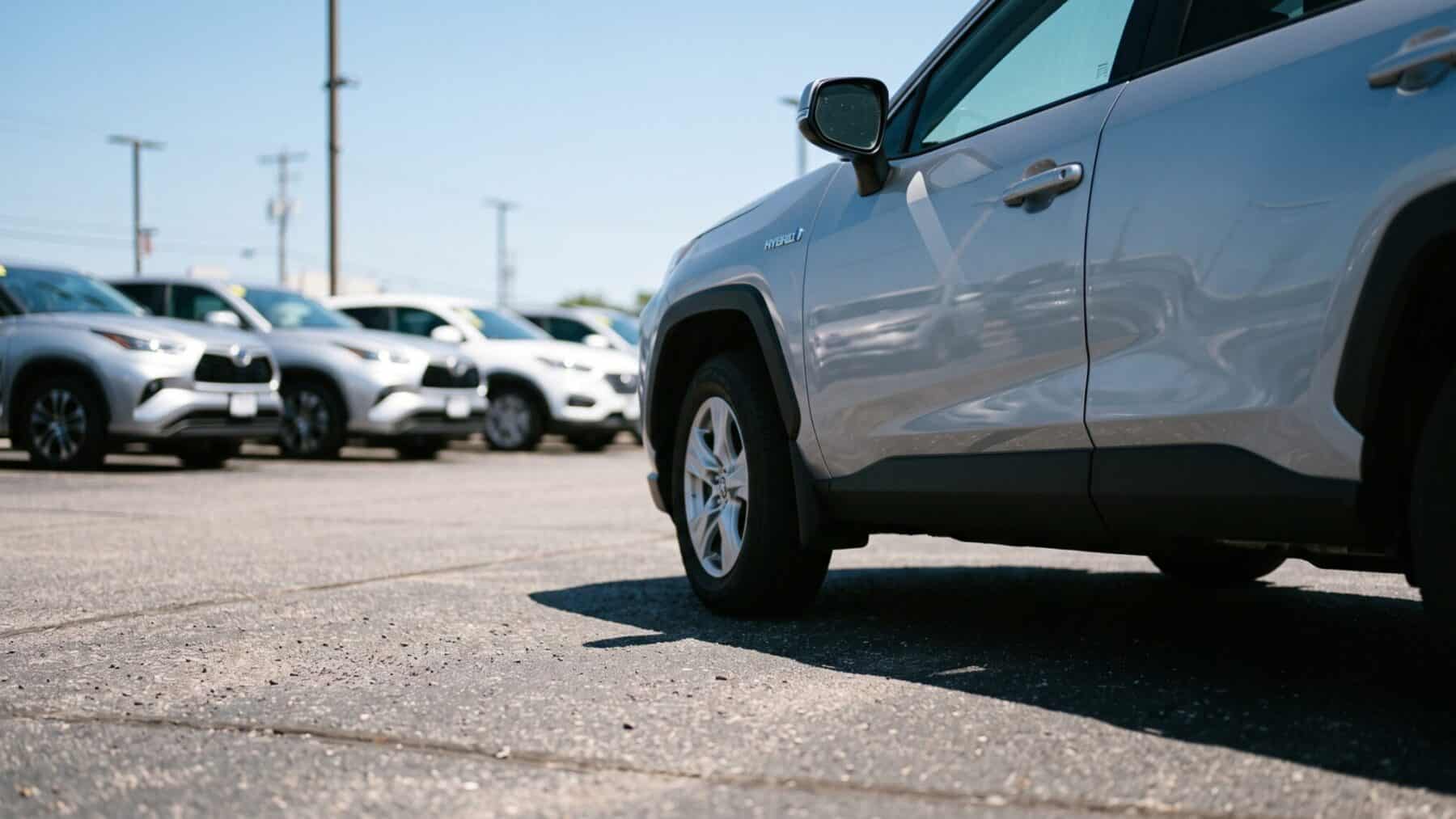
Walk onto any major US dealership lot this summer and you will spot a pattern.
The hybrid badges are everywhere. The sedans wear them. The compact SUVs wear them. Even the family haulers in the back row wear them. So does the sales board behind the finance desk, where a Korean automaker just posted a number nobody in that building has ever seen before.
How a hybrid drivetrain turns one fuel tank into two power sources
A conventional hybrid does not plug in. It pairs a gasoline engine with an electric motor and a small battery pack, and the two power sources trade off automatically depending on what the driver demands. At low speeds and light loads, the electric motor handles most of the work, while the gasoline engine steps in at highway pace or when the driver asks for a burst of acceleration.
The battery never needs an outlet because it charges itself. Every time the driver lifts off the throttle or touches the brakes, the motor runs in reverse, converting the vehicle’s momentum back into electricity. That cycle, called regenerative braking, means fuel savings stack up quietly in stop-and-go traffic, precisely the conditions that defeat a conventional engine.
Because no charging cable is involved, the buyer does not have to think about range anxiety or a home charger installation. That frictionless ownership is a large part of why hybrid sales have climbed while fully electric volumes have stalled in segments where buyers still feel uncertain about the infrastructure.
What the record sales board actually shows, model by model
Hyundai Motor America sold an all-time record of 450,568 total units in the first half of 2026, a 3 percent increase on the same period a year earlier, and capped the run with its best-ever June total of 77,555 units, an 11 percent jump.
Record June results appeared across several nameplates. The Santa Fe hybrid rose 12 percent, the Sonata hybrid surged 246 percent, and the Tucson hybrid climbed 14 percent. Hybrid vehicles drove the overall monthly gain by surging 74 percent year on year.
In the second quarter, the Elantra hybrid, Santa Fe hybrid, Sonata hybrid and Tucson hybrid all set records. Hybrid sales jumped 71 percent to reach all-time highs for a single quarter.
The automaker delivered 489,656 units in the US in the first half when including Genesis models, up approximately 3 percent. The deepening hybrid lineup and the Tucson and Palisade families led the way, while the flagship IONIQ 5 electric model rose 9 percent over the same period.
Where the evidence comes from and how reliable it is
The 450,568 figure and the best-ever June result of 77,555 units were published directly by Hyundai Motor America on July 1, 2026. These are manufacturer-reported retail figures drawn from the company’s own sales tracking, the same methodology used consistently for decades and the standard source relied on by industry analysts.
Combined with its sister brand Kia and the Genesis luxury label, the group sold 920,383 vehicles across the first six months of 2026, a 3 percent year-on-year increase. The three labels together moved 225,321 hybrid units in that period alone, the clearest sign that the shift in buyer behavior is structural rather than a one-month anomaly.
Hybrid sales at the brand rose 74 percent in June, 71 percent in the second quarter, and 67 percent for the full first half, according to Hyundai Motor America’s official first-half 2026 sales release. Three consecutive windows pointing in exactly the same direction rules out a promotional blip.
Where the record runs into limits and what it does not prove
Record sales in a category do not automatically mean the automaker is winning the overall market. Through the first six months, General Motors led all manufacturers with roughly 1.34 million US sales, Toyota Motor Corp followed at 1.24 million, and Honda sat third at just under 760,000 units.
The Korean brand’s record first half still places it fourth in the overall manufacturer ranking. Automakers without a comparable hybrid range face a real disadvantage right now, but that gap is also temporary. A rival jumped 136 percent in US electric vehicle sales in the first half of this year, signaling that the zero-emission segment is not standing still.
There is also a tariff cloud overhead. Many buyers pulled forward purchases earlier due to tariff uncertainty, which means the 3 percent overall gain may be more modest than it first appears in the second half.
What the milestone means for the broader market and what comes next
The record first-half figure is the clearest signal yet that the US car market is settling into a dual-track electrification pattern: fully electric vehicles for buyers with home charging and high annual mileage, conventional hybrids for everyone else.
North America delivered the brand’s best first half in history, US sales rose 4 percent in the second quarter, and hybrids reached an all-time high in the region. Those three milestones arriving together suggest the performance was broad-based rather than concentrated in a single lucky nameplate.
For the ordinary buyer on that dealership lot, more hybrid variants are arriving, transaction prices are competitive, and waiting lists that plagued certain models a year ago have shortened. The automaker has expanded its dealer network substantially over four decades, which means the distribution network for further growth is already in place. Whether the second half matches the first is the question the industry will be watching very closely.
