Deep below the ground, superheated water dissolves the rock around it as it climbs toward the surface.
It carries that dissolved rock all the way into the turbine hall. Inside every pipe it travels through, it begins to deposit what it carried. And what it leaves behind is one of the most stubborn industrial problems in the power sector. So what exactly is this mineral trap, and why does no current fix fully stop it?
How dissolved rock turns into a plant-killing crust the moment heat is removed
Silica is highly soluble in hot geothermal water, and its solubility drops sharply as that water is cooled inside a geothermal power plant. That single physical fact is the engine of the entire problem. When a plant extracts heat from the brine, the temperature drops, and the silica saturation limit falls below the concentration already dissolved in the water.
At that point, the mineral has nowhere to go but the nearest surface. Scale forms in steam separators and heat exchangers, restricting flow and cutting energy extraction. And the material it forms is not soft or flaky.
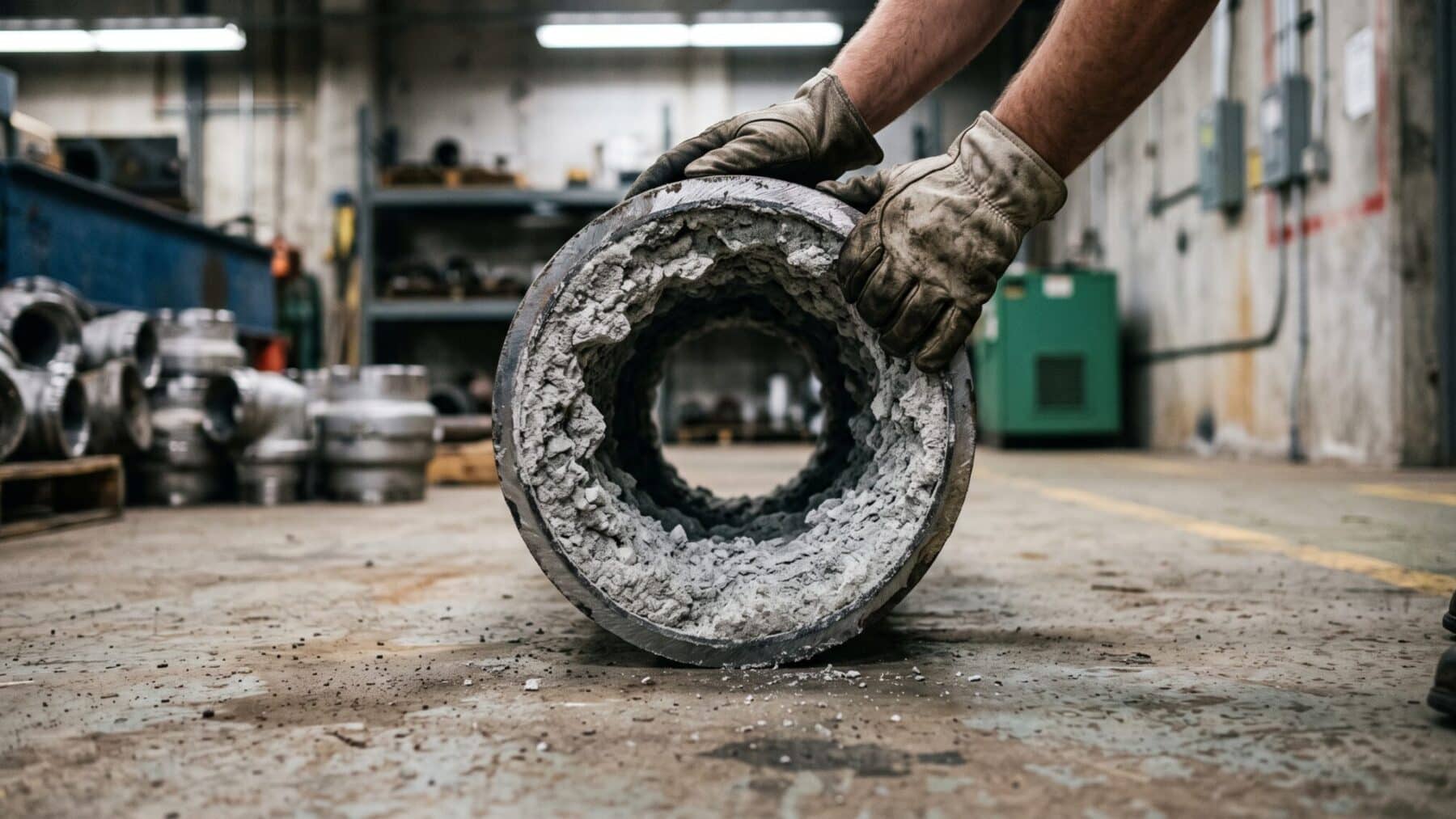
Silica scale is extremely hard, approaching quartz hardness, thermally insulating, and flow-restricting. Scrubbing it out is not a quick job.
What a geothermal plant’s pipes actually look like after a year without active treatment
The pitch made to grid operators and project financiers emphasizes the fuel-free economics. Geothermal power projects carry high capacity factors, reaching 65.9 percent in 2025, compared with 34.2 percent for wind and 24.4 percent for solar. That reliability number is the selling point.
But it depends entirely on keeping the mineral layer off every internal surface, which is a continuous and very expensive battle. Accumulation of just 5 to 10 millimeters of scale inside production pipelines reduces flow capacity by 15 to 25 percent, and clearing it can require hydrojetting or chemical dissolution campaigns costing hundreds of thousands of dollars per event.
The problem does not confine itself to pipes. Individual mineral molecules aggregate into solid formations that coat turbine blades too. A blade coated in near-quartz-hard scale can no longer run at design efficiency, and the coating thickens with every operating hour that passes without intervention.
The numbers behind a single scaling incident at a mid-size plant
Operations and maintenance costs for geothermal projects commissioned in 2024 ran around $125 per kilowatt per year, according to IRENA’s most recent global cost report. That figure represents the baseline. When unplanned scaling events hit, the real cost runs well above it.
A 50-megawatt geothermal plant that experiences an unplanned 72-hour turbine outage due to severe scaling loses $234,000 in revenue at $65 per megawatt-hour. A scheduled online wash to prevent that outage costs around $4,000. Yet reactive maintenance, including emergency labor and expedited spare parts, can easily exceed $300,000 per incident.
That gap between a $4,000 prevention and a $300,000 repair is the economic core of the scaling problem. The capital base that scaling erodes is already steep: geothermal flash plants average around $7,000 per kilowatt, and binary plants around $9,200 per kilowatt, far above onshore wind.
Where the standard fixes fall short and why the industry still has no complete answer
Operators do have tools. Chemical inhibitors can delay the point at which silica starts to precipitate. Acid injection can extend the window before precipitation begins, and quick brine reinjection can reduce the time available for polymerization to start. None of these fully close the gap, and all current methods are costly enough that mechanical cleaning campaigns remain necessary regardless.
Mitigation attempts can also introduce significant corrosion issues, so the chemical fix for one problem spawns a second maintenance burden. That trade-off is poorly understood outside the industry and rarely shows up in project pro formas.
The reinjection well is a particular vulnerability. Once scale blocks the well casing or the surrounding rock formation, the plant has no route to return used brine to the reservoir, and the whole operation can stall. The DOE’s new geothermal research center in Colorado has identified scaling and brine chemistry as active targets for the next generation of reservoir management.
What the next round of geothermal development needs to solve before the sector can genuinely scale up
Geothermal’s baseload profile is genuinely valuable to a grid adding more intermittent solar and wind every month. US geothermal electricity generation reached approximately 15.7 terawatt-hours in 2024, according to the EIA, a figure that grid planners expect to grow substantially as next-generation projects come online, but only if scaling problems are better managed than they are today.
The nearest path forward is real-time monitoring combined with predictive chemistry management. Sensors and data analytics can track performance metrics, identify anomalies, and predict maintenance needs before failures occur. That approach will not eliminate scaling, but it can convert reactive six-figure emergencies into planned low-cost interventions.
A grid leaning on fast-growing battery storage to cover gaps can tolerate some geothermal downtime, but not the chronic, compounding kind that silica makes inevitable without aggressive chemistry management. Silica scaling remains, in the words of the geothermal research community, the largest unsolved problem in the full utilization of geothermal resources, and solving it is the single engineering challenge standing between geothermal’s modest US footprint and the expansion that grid planners are counting on.
