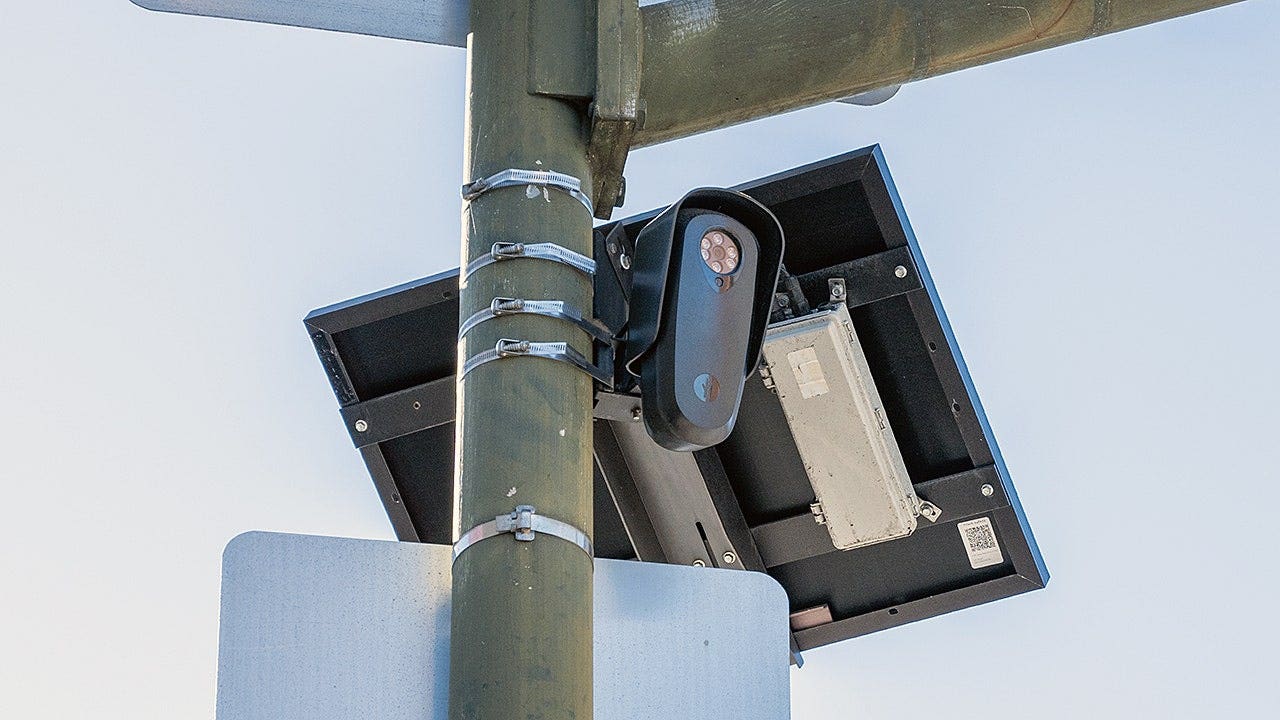
More than 100,000 automated license plate readers now line American roads and neighborhood entrances, according to a new Pew Research Center analysis published Monday.
The study found that most of the devices come from a single company, Flock Safety. Basic details about where they sit and how long they keep footage remain surprisingly hard to pin down.
There are more than 100,000 Flock cameras in the U.S. , Pew reported, though the exact number varies from source to source.
In a statement reported by other outlets, Flock claimed more than 120,000 cameras in 6,000 communities in August . Volunteer mappers on OpenStreetMap have listed roughly 110,000 Flock license plate readers.
A separate crowdsourced project identified as many as 175,000 nationwide , Pew found.
Where the cameras are concentrated
Data on the number and locations of Flock cameras comes from OpenStreetMap, a crowdsourced mapping project. Pew analyzed locations entered into OpenStreetMap, a crowdsourced mapping project, as of September 17. Researchers also drew on the Census Bureau’s urban-rural classification, state and county geographies, population estimates and tract demographics to study where the devices sit.
Pew’s analysis was based on 109,577 Flock ALPR nodes from OpenStreetMap , according to the Pew report.
Pew’s data show the camera network is heavily concentrated in a handful of states and urban centers, though Pew did not provide a single combined percentage for the top five states in the published analysis reviewed for this report.
A new Pew Research Center analysis, published November 9, mapped 15,450 Flock license-plate cameras in California, including 2,457 in Los Angeles County. Other large metro areas, including Atlanta, Houston, Chicago and Dallas-Fort Worth, also rank among the counties with the most mapped devices, according to Pew’s county-level breakdown.
Neighborhoods, not just police departments, are buying in
While police departments remain Flock’s primary customers, the cameras have increasingly become a fixture of ordinary residential life. Users include not only law enforcement, but also homeowners associations and businesses.
A recent Atlanta News First report found that neighborhoods across the country are using license-plate reader cameras to help curb crime, but as surveillance companies face scrutiny over privacy and data concerns, some homeowners and associations say they are now questioning safety against privacy.
That residential spread has produced friction in some communities. The report featured Angela Davis, the HOA president of a small metro Atlanta community , discussing concerns about who controls access to the cameras in her neighborhood.
What the data does not show
Despite the scale of the network, Pew’s analysis underscores how little standardized public information exists about individual installations.
Flock does not publish a list of where its cameras are located, so Pew used crowdsourced data from OpenStreetMap to see where these cameras are most prevalent.
Retention and access policies also vary widely by agency. Pew found 1,517 agencies with public Flock transparency portals , and Pew found that the median agency with a public portal retained camera data for 30 days. Individual departments can set their own rules within that general framework. The Atlanta-based surveillance company announced a sweeping overhaul of its data retention and access policies in August, cutting its default retention period to seven days , though existing customers will retain their current retention periods unless they choose to opt into the new seven-day standard.
Flock estimates that its cameras assisted more than 1 million law enforcement investigations in 2025, Pew reported.
That figure does not establish that the cameras solved 1 million crimes, prevented that many offenses or produced evidence unavailable through other methods.
A debate playing out city by city
The growth of the camera network has not gone unchallenged. Some municipalities have already begun pulling back.
Auburn and Ithaca voted this year to end their relationships with Flock Safety after debates over privacy, data sharing and police oversight , mirroring similar fights in other cities over who can search the footage and for what purpose.
The patchwork of local rules and conflicting camera counts mirrors broader questions this desk has tracked about how everyday surveillance and data collection quietly reshape routine life.
That includes concerns about who can access systems meant to make neighborhoods and workplaces feel safer, such as the job satisfaction gaps Pew has documented among American workers.
It also echoes the way niche digital communities, like the hobby groups Pew has tracked, operate with far less oversight than many residents assume.
