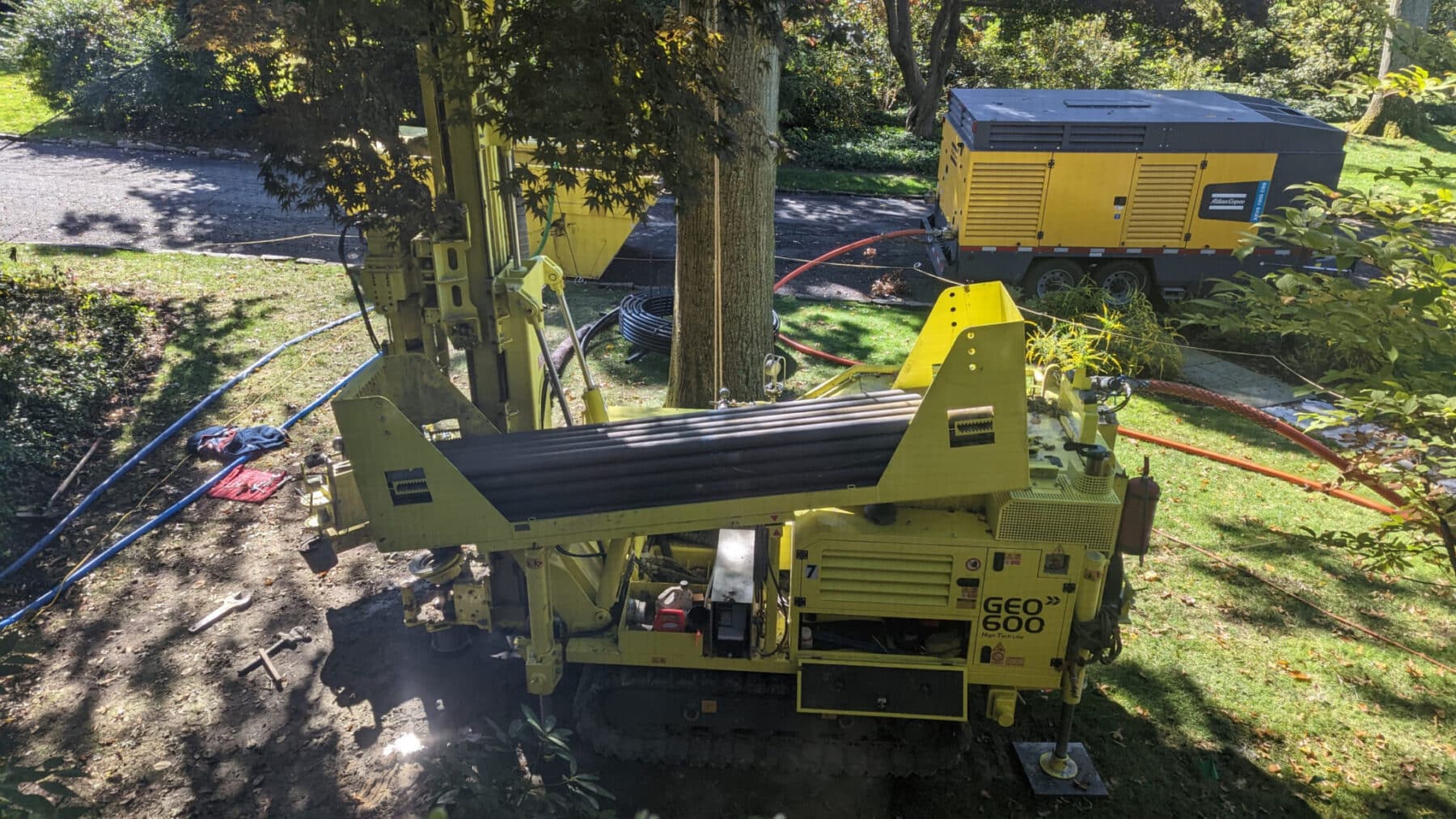
A drilling rig sits parked between two driveways on a quiet residential street outside Boston.
Beneath the asphalt, a narrow borehole drops more than 600 feet into bedrock.
Inside nearby basements, old gas furnaces have already been unbolted and hauled away.
The homeowners who signed up pay a flat $10 a month for heating and cooling drawn from the earth.
Nobody told them who was really footing the rest of the bill.
How one shared loop heats dozens of separate homes
The system works like a single, giant ground source heat pump stretched across an entire block instead of one backyard. A mile long buried loop connects to houses, apartments, commercial buildings, a community college campus, and a fire station, circulating a water-and-glycol solution through 88 boreholes that extend hundreds of feet into the earth , pulling up steady underground warmth in winter and dumping summer heat back into the rock.
The network runs through houses, apartments, commercial buildings, a fire station and a community college. The shared underground pipe connects every one of those buildings to the same loop, rather than each structure drilling its own private well field.
Households have their own heat pump units that provide heating and air conditioning, installed by the utility, taking heat from the loop and releasing it as warm air into the homes. The project is really two layers stacked together, a shared underground network that behaves like a mutual thermal battery, and a private appliance inside every home that taps it.
That layered design is what makes the pitch to homeowners so simple. Instead of a resident financing an expensive private well field and compressor alone, the cost spreads across neighbors, which is exactly why the monthly charge for participants can be so low to begin with.
A Framingham street becomes the test case
The project putting that idea into practice sits in Framingham, Massachusetts, where the nation’s first networked geothermal system owned by a utility went live June 4 in Framingham, Massachusetts, with the roughly $15 million network of ground-source heat pumps cooling and heating 36 buildings without fossil fuels .
By the time the network finished expanding, after nearly a year of construction, the system was turned on, circulating fluid, and ready to serve approximately 135 residential and commercial customers with ground-sourced heating and cooling .
That includes a fire station and a community college building alongside ordinary houses.
For one Framingham household, the appeal was obvious before the drilling even started. When utility company Eversource announced it was building a geothermal network in Framingham, and offering no-cost retrofits to participating homeowners, dozens of neighbors signed consent forms without hesitating once they saw what a private install would have cost them on their own.
Who actually paid for the drilling
Here is the part that rarely makes the brochure. The drilling, piping and indoor equipment were not paid for by the 135 participating addresses at all, even though they are the ones using it every day.
Eversource paid for the construction of the system and the new equipment for homes and businesses. Customers will pay a monthly fixed charge to use the system, about $10 for residential customers and $7 for income qualified customers .
So where did the rest of that roughly $15 million come from? Regulators allowed the utility to recover those costs the same way it recovers any other pipeline or wire upgrade, through rates charged to its entire customer base, not just the households on one street. That arrangement meant every customer in the service territory helped cover equipment that would normally fall only to the people using it, including heat pump units and electrical panel upgrades.
That arrangement is standard utility financing, the same logic behind grid upgrades covered in recent rate hike requests working through other state regulators. It means every ratepayer in the service territory, whether they ever see a borehole or not, is subsidizing a handful of lucky neighbors.
The approval process is where the methodology behind that number becomes clear. Approved by the Massachusetts Department of Public Utilities in 2020, this project broke ground in June 2023 and connects 31 residential and five commercial buildings, serving approximately 135 customers , and once in service, the pilot is intended to run through two heating and cooling seasons.
A research team comprising multiple project stakeholders began collecting data on the network, tracking cost, smoothness of operation, customer satisfaction and emissions reductions before publishing their findings. Nobody, including the utility, can yet say what a permanent unsubsidized version of this bill looks like.
Two years is a trial, not a promise
The pilot nature of the project adds another wrinkle that participants had to accept upfront. After the monitoring window closes, nothing about pricing or ownership is locked in.
Participants were told plainly that the current deal has an expiration date. According to the utility’s own project page, customers on the route began receiving energy from the looped system in the fall of 2024, with the official testing period running for 24 months before any permanent decision gets made.
That means today’s flat $10 charge is a research era price, not a guaranteed long term rate. The real test begins only after the pilot label comes off.
What this means for the next neighborhood in line
None of this makes the Framingham pilot a bad deal for the families on it. It does mean the headline price, a flat monthly charge far below a private geothermal install, was never the full cost of the system, only the portion assigned to the people standing closest to the boreholes.
Other utilities are already borrowing the model. National Grid has pursued a pilot of its own in the Boston area, while Minnesota’s legislature has separately cleared gas utilities to pursue the same networked approach as an alternative to pipelines.
As thermal networks spread, like the loop financing arrangements already reshaping heat pump economics covered in our look at a Vermont utility’s geothermal loops, regulators will need to decide how much of that underground infrastructure belongs on everyone’s bill versus just the households above it.
For now, the warm floors in Framingham are real, the $10 charge is real, and so is the much larger invoice spread across a utility’s entire customer base.
