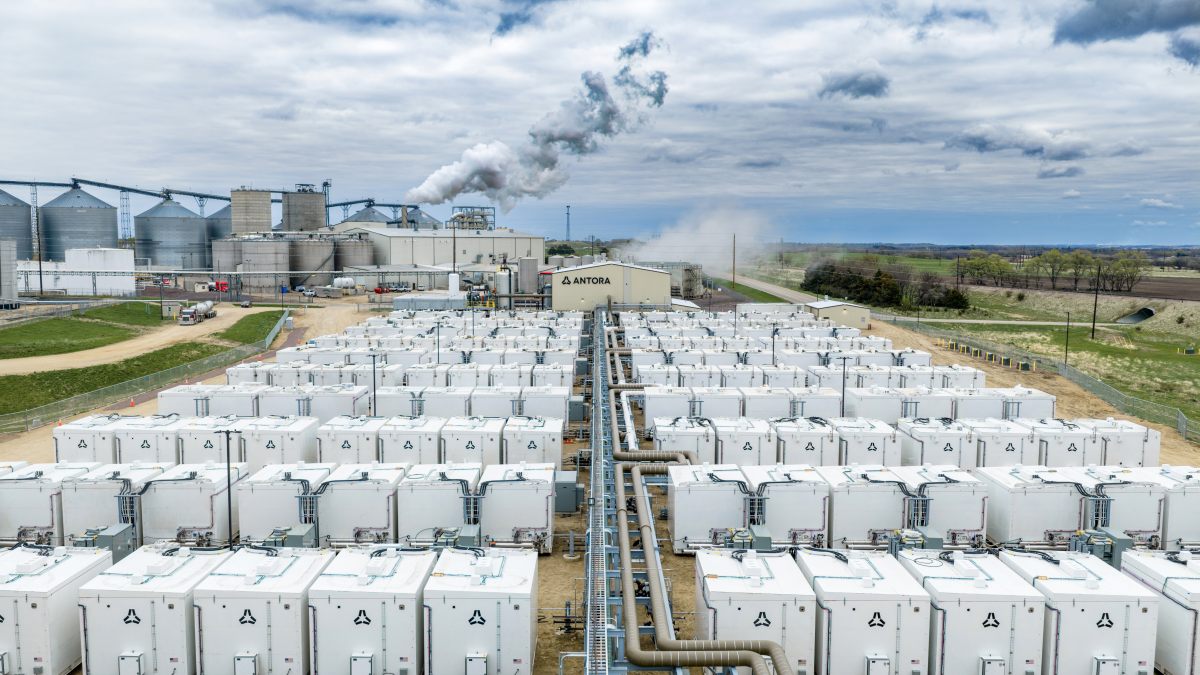
A quiet stretch of farmland outside a small Minnesota town is about to host something that looks nothing like a power plant.
Steel boxes the size of washing machines will stack into rows under open sky.
No flame, no turbine, no spinning blade.
Just iron, air and water, breathing in and out for days at a time.
What makes that chemistry worth a record-setting contract is the question the rest of this story answers.
How an iron and air battery actually stores power for days, not hours
The basic chemistry is almost embarrassingly simple. Iron rusts when it reacts with oxygen pulled from the surrounding air, and that reaction releases electricity that can be captured and used. Reverse the process with a charge, and the rust turns back into bare iron, ready to rust again tomorrow.
That cycle is why Form Energy built an iron-air battery meant to store clean power for far longer stretches than lithium-ion ever could. Lithium cells are built for sharp bursts measured in hours.
Iron-air cells are built differently. They run on a slow, steady drain that can stretch past four full days.
So the system is engineered to run thin and long rather than race to discharge. Because the raw materials are iron, water and air rather than scarce battery metals, the cost per unit of power can stay low even as the tanks grow far larger.
The scene in Minnesota where the record deal is taking shape
The project sits in Pine Island, Minnesota, where the utility Xcel Energy announced it will power a new Google data center in Pine Island, Minnesota. That power rating is paired with a storage figure that dwarfs almost anything built before.
Xcel will install 30 gigawatt hours of iron-air batteries to serve the data center, a pairing that stands out even against a grid storage market adding capacity at a blistering pace all year. The company’s own announcement calls it the largest battery project by energy capacity announced to date anywhere in the world.
And the purpose is specific. The batteries exist to keep the data center running on round the clock clean power, paired with new wind and solar instead of backup generators.
That answer matters well beyond one campus, since grid planners nationwide are wrestling with the same question of what covers demand when renewables dip.
What the manufacturing record books actually show so far
Before anyone celebrates a finished plant, it helps to look at what has actually been built. Form Energy’s first commercial iron-air project, a much smaller pilot in Cambridge, Minnesota, has run behind its own schedule for more than a year.
A regulatory filing from the pilot’s utility partner, Great River Energy, said structures and balance of plant were substantially complete, remaining modules were still awaited, and commercial operation is targeted by the end of 2026. An independent check of the site months later found little visible progress beyond the initial shell.
So the record is, for now, a contract and an engineering target. Form’s own roadmap says the first modules for the 300 megawatt, 30 gigawatt-hour system should ship by the end of 2028.
That gap between announced and built is where every new chemistry proves itself, including the thermal storage projects now racing toward similar multi-day targets.
Why the slower, heavier battery still has a real limit
Iron-air cells trade speed for stamina, and that tradeoff is not free. The same chemistry that lets the battery discharge for days also makes it bulkier and heavier per unit of power than lithium, so it is a poor fit for fast-response needs like smoothing a sudden frequency dip.
Caution has followed the technology for years. One assessment of the deal noted plainly that far more novel battery startups have gone bankrupt than have ever built at multi-megawatt scale.
Even the company admits the road ahead is a manufacturing climb. Its Weirton, West Virginia factory is on track to reach only 500 megawatts of yearly production by 2028, a pace that would need years to fully supply the Minnesota order alone.
None of that erases the chemistry’s promise. It just means the record belongs, for now, to a signed deal rather than a battery already keeping lights on.
What the record means for the grid still figuring out long duration storage
Even as a target, the 30 gigawatt-hour figure resets expectations for what one storage project can be. Grid planners have spent years treating four-hour lithium batteries as the practical ceiling, and a multi-day alternative changes that math.
Because the record sits inside a broader boom, it lands as battery supply deals of every chemistry get signed at a pace that would have seemed unlikely a few years ago. Iron-air is simply staking out the far end of that curve.
Watch whether the Cambridge pilot finally switches on. That small plant is the proof point every larger order depends on.
If it works, the Minnesota site could become the template for keeping power flowing through the slow, cloudy stretches batteries were never built to survive.
