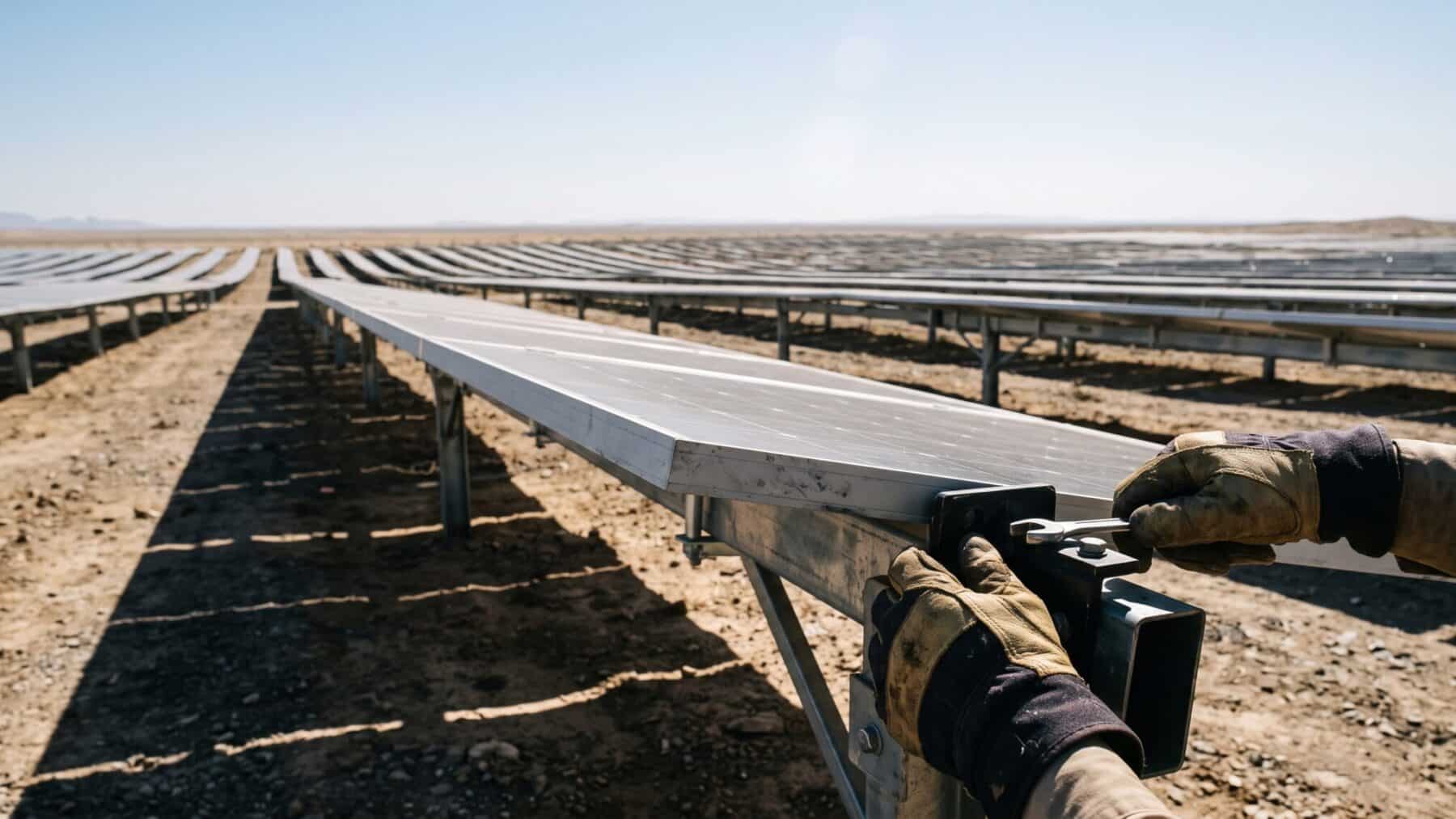
Stand at the edge of a large solar farm and the first thing you notice is the gravel.
Not dark soil. Not grass. Pale white rock, raked flat, stretching the full length of every row.
That is not landscaping. It is engineering.
Most new utility panels are now transparent on both sides, and the rear surface generates real electricity from whatever light bounces back up from below. The gravel is the fuel.
So what is it about the ground that changes the numbers so dramatically?
The second engine: how reflected light from the dirt below becomes electricity
A standard solar panel captures one stream of energy: photons arriving directly from the sun, striking silicon at the front. The back is sealed with an opaque white or black backsheet, which protects the cells but contributes nothing to output. Bifacial panels change this by replacing that backsheet with a transparent layer, giving the rear cells a second photovoltaic surface that harvests whatever light bounces back up from below.
That reflected energy is measured by a property called albedo, expressed as a fraction from 0, meaning perfectly absorbing, to 1, meaning perfectly reflective. Albedo is the dominant variable that separates a bifacial installation delivering a modest 3 percent bonus from one approaching 30 percent more power than an equivalent conventional module, a ceiling that also requires the panels to be mounted well clear of the ground.
The panel itself is identical in both cases. The ground and the height above it are not.
What the surface under each panel is actually worth in kilowatt-hours
Dark asphalt or dark shingle roofing carries an albedo as low as 0.05 to 0.1, meaning it absorbs the overwhelming majority of light that hits it. A homeowner who pays a premium for bifacial modules and installs them on a dark-tiled roof is buying a technology the roof will simply not let perform. The rear cells stare at a surface that sends almost nothing back.
Move to a utility-scale ground-mount and the math changes fast. Fresh snow reaches 80 to 95 percent reflectivity. For permanent installations, white gravel and white roofing membrane are the best practical options, and developers at high-irradiance sites now apply them deliberately. Research from national laboratories confirms that the ground is not passive infrastructure; it is an active component of system yield.
Mount height matters alongside surface choice. Panel clearance of one meter or more consistently shows stronger bifacial performance in field data, because height widens the cone of reflected light the rear cells can see, and the 30 percent ceiling in the title requires both a highly reflective surface and that clearance working together.
How the national lab measures the rear side, and what real farm data shows
The National Renewable Energy Laboratory built a dedicated open-source raytracing toolkit, bifacial_radiance, to model rear-side irradiance with full customization of albedo, tilt, pitch, clearance height and module spacing. It is the only open-source ray-tracing toolkit of its kind for bifacial PV, and it is widely used by researchers and developers to model complex bifacial system geometries before a single panel is shipped.
In typical installations, field studies from national laboratories and IEA working groups document gains of 6 to 15 percent. Bankable yield estimates frequently discount optimistic model output by 2 to 3 percentage points to stay conservative. That middle range is the honest number most lenders rely on.
The gap between the advertised 30 percent ceiling and the field-validated 10 percent center is not a scandal. It is a site-design problem, and the US solar manufacturing boom is forcing it into the open. The earlier push on anti-dumping duties reaching 249 percent on imported cells from several Asian nations has reinforced domestic demand for every link in the supply chain, directing more modules to projects where ground conditions have not always been optimized.
Where bifacial gains break down, and the installation decisions that cost projects money
The technology’s biggest practical trap is the gap between manufacturer spec sheets and site reality. Manufacturer bifacial gain claims almost always assume a baseline albedo of 0.2 to 0.3, corresponding to light-colored concrete or dry grass. Dark soil, wet fields and asphalt parking lots all fall below it, pulling real-world gains well under the advertised figure.
There is also a bifaciality factor baked into the module itself. Bifacial panels carry a bifaciality factor typically between 70 and 90 percent, meaning the rear side can generate up to 90 percent of what the front generates, but only if the light reaching the back is comparable. A module rated at 80 percent bifaciality loses 20 percent of whatever rear-side irradiance the ground sends up, before a single cloud or shadow is factored in. Heterojunction panels typically reach above 85 percent bifaciality, while most TOPCon units sit around 80 percent.
Understanding which domestic polysilicon supply chain feeds which cell type is now a procurement decision that shapes real farm output, not just factory specs.
What the albedo arms race means for the next wave of US solar farms
Bifacial panels command a 3 to 8 percent price premium over equivalent monofacial modules, a gap that has narrowed sharply as the technology went mainstream. In well-designed ground-mount conditions the rear-side gain pays that premium back in under two years. The economics are clear.
Ground preparation costs are now a genuine line item in project budgets at the largest US farms. Spreading white gravel beneath rows, painting concrete pads, or choosing sites where light-colored caliche soil is already present are decisions made before the first racking post goes in, not after the panels arrive.
Utility-scale projects account for roughly 70 percent of the global bifacial solar market by application, and bifacial’s share of that segment continues to climb. As that dominance grows, the competitive edge will belong less to which module a developer buys and more to how precisely they model and prepare the surface it looks down on. The panel facing the sky is the story everyone tells. The ground beneath it is the story that decides the bill.
