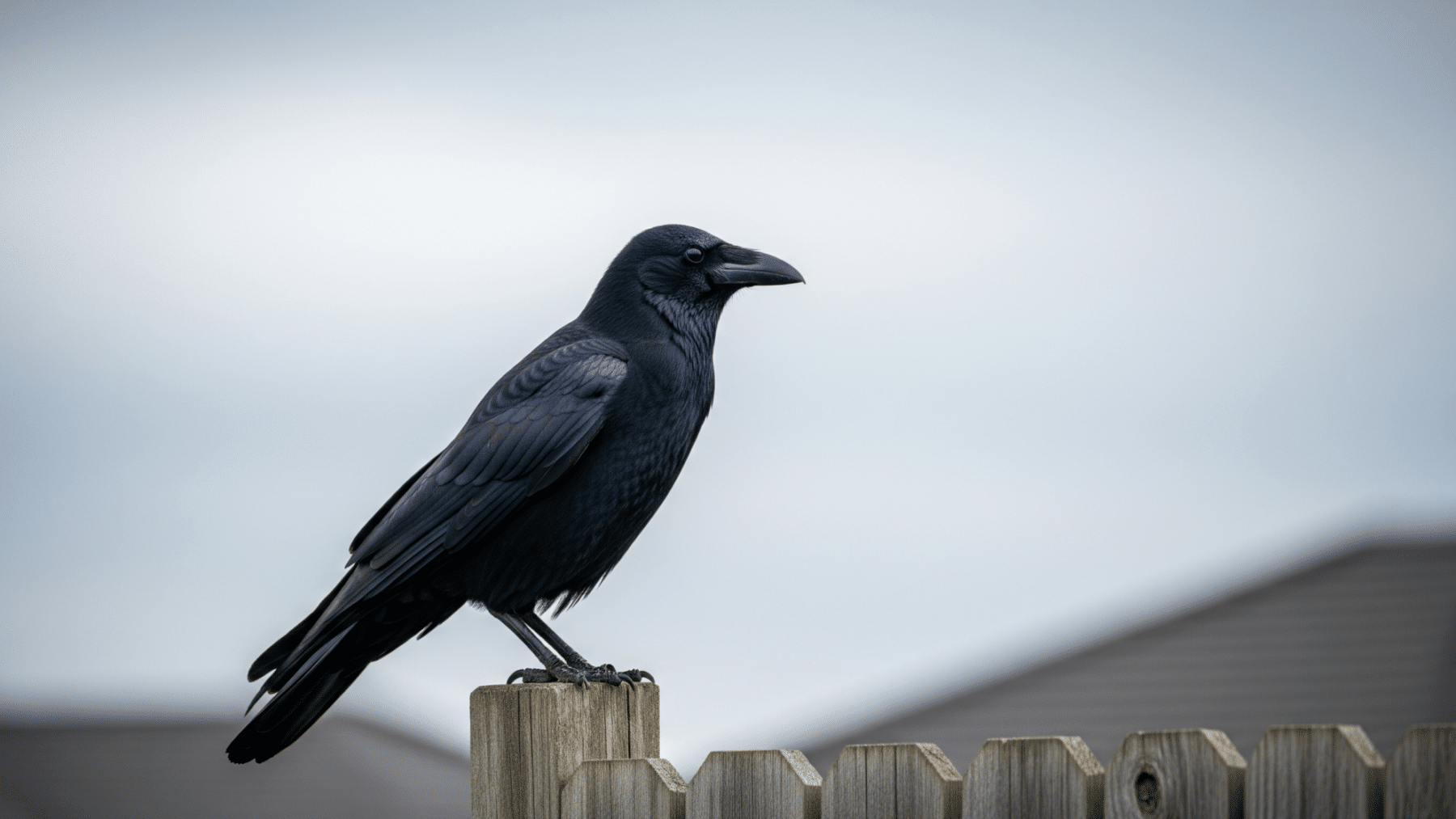
You have almost certainly seen one today.
On a fence post. On a telephone wire. Watching you from a gas station parking lot with what feels, unsettlingly, like genuine attention.
Crows are everywhere in America, from the quietest rural roads to the loudest city blocks. Most people walk past them without a second thought.
But a discovery made public in the spring of 2025 suggests the crow looking back at you may be processing the world in a way that scientists reserved, until very recently, for one species only.
The bird that science kept underestimating
For most of history, “bird-brained” was the definitive insult for a reason.
Birds were assumed to be locked into instinct, unable to reason flexibly the way mammals could.
Corvids, crows, ravens, jays and magpies, chipped away at that assumption one study at a time.
Researchers documented crows making and storing tools for future use. They showed that crows can remember individual human faces and hold a grudge for years.
A 2022 paper in Science Advances even found that crows could grasp recursion, the process of embedding structures within similar structures, long considered a cognitive building block of human language.
Each finding reset the ceiling. And then researchers in Germany raised it again.
What happened when scientists put shapes on a screen
The experiment sounds deceptively simple.
Place six shapes on a screen at once. Train a crow to peck the one that does not belong.
The shapes shift every round. The rules stay the same: find the intruder.
The crows learned the concept. Then researchers swapped in quadrilaterals, four-sided figures of very different geometries, and watched what happened.
No new training was given. The birds had never seen these shapes before.
Yet they immediately began sorting them, performing better or worse in a pattern that told researchers something striking about what the crows were actually seeing.
The pattern the birds could not have been taught
The crows were not simply memorizing shapes.
They consistently performed better when the target shape had right angles, parallel lines or symmetry, and worse when the shapes were more irregular.
That pattern matched the human response to the same task almost point for point.
It suggested the crows were not just spotting visual differences. They were perceiving geometry, Euclidean properties of form, spontaneously and without instruction.
Researchers noted that this performance advantage did not require learning. Something deeper was going on.
If you find yourself wondering whether the mind drifts toward pattern even when we are not trying, science has been exploring that territory in humans too, including what researchers found when the wandering mind appears to be doing nothing at all.
The finding that overturned a long-held assumption
A study led by researchers at the Animal Physiology Unit of the University of Tübingen in Germany revealed that carrion crows can recognize geometric regularity, a skill once thought exclusive to humans.
The perception of geometric regularity in shapes, a form of elementary Euclidean geometry, is a fundamental mathematical intuition in humans. The researchers demonstrated this same geometric understanding in the carrion crow.
The crows were able to immediately apply the intruder concept to quadrilaterals, identifying the one with differing geometric properties. They showed better performance with shapes featuring right angles, parallel lines or symmetry over more irregular shapes.
The study, published in Science Advances on April 11, 2025, was authored by Philipp Schmidbauer, Madita Hahn and senior author Andreas Nieder at the University of Tübingen.
The findings suggest that geometric intuitions are not specific to humans but are deeply rooted in biological evolution, and that animals have rudimentary forms of mathematical capabilities.
Giorgio Vallortigara, a neuroscientist at the University of Trento who was not involved with the work, described it as “a sort of intuitive, strictly perceptual recognition of geometric properties.”
What a backyard crow might tell us about the human mind
The implications reach well beyond ornithology.
Researchers suspect this ability may help crows with navigation and orientation as they fly, and the birds may also have developed it to help them forage for food or identify individual crows, including mates, based on facial features.
Senior author Andreas Nieder told Scientific American that “all these capabilities, at the end of the day, from a biological point of view, have evolved because they provide a survival advantage or a reproductive advantage.”
The broader question the finding raises is what other cognitive abilities are quietly present in species we assume to be simple.
It is the same curiosity that keeps reshaping what we know about human social behavior, like the unexpected ways people rebuild connection when familiar patterns of belonging break down.
In the future, researchers hope to investigate which areas of the birds’ brains are helping them excel at geometry.
For now, the next time a crow holds your gaze a beat too long from a parking lot fence, the science says you are not imagining it. Something is calculating. It just took us this long to find out what.
