NVIDIA has released a free, open-source software tool called Personal AI Router, or PAIR, that automatically distributes AI agent workloads across multiple computers on a home network, cutting a representative five-agent task from 18 minutes down to 8 minutes and 48 seconds in the company’s own benchmark.
What PAIR does
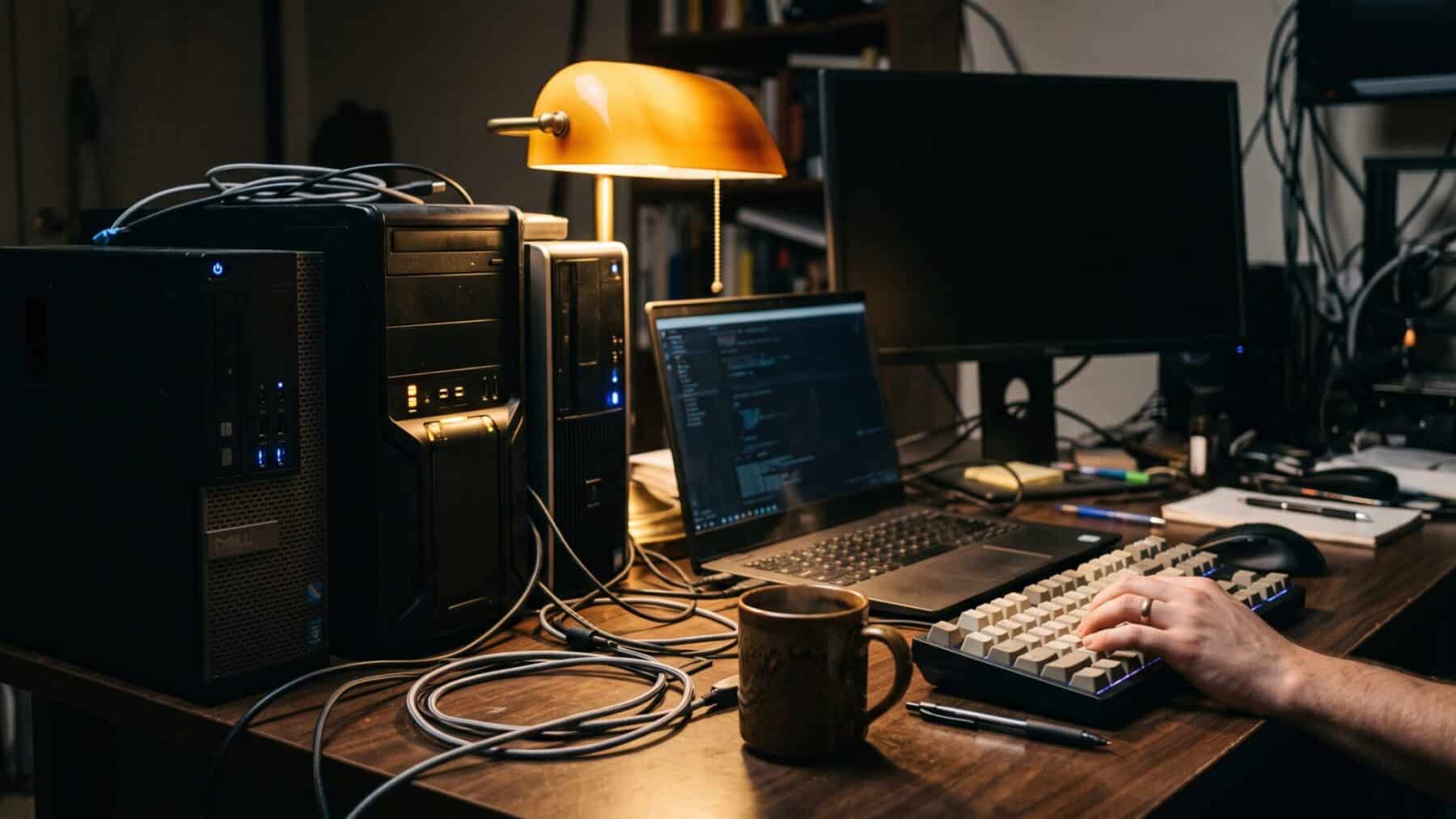
NVIDIA introduced PAIR as a free, open-source software tool that connects multiple home systems for local AI, addressing a core bottleneck: agent workflows often break complex tasks into smaller parallel subtasks, but performance suffers when each request competes for a single graphics card.
PAIR automatically detects compatible PCs on a local network and routes independent inference requests to whichever system has capacity. The software works with Ollama and LM Studio and can adapt as devices join or leave the network.
The PAIR beta supports Windows, macOS and Linux, and is compatible with GeForce RTX 20 Series GPUs and newer, NVIDIA RTX PRO workstation GPUs, NVIDIA DGX Spark, and Apple M4 silicon.
In a five-subagent demonstration, a single RTX Spark laptop running Qwen3.6-35B through Ollama completed a simulated inbox-sorting task in an average of 18 minutes. The same task spread across three devices, the same RTX Spark laptop, a DGX Spark and an RTX 5090 desktop, finished in 8 minutes and 48 seconds.
One-click agent setup and inference gains
NVIDIA also addressed one of the persistent barriers to local AI adoption: setup complexity. Simplified local AI support for NVIDIA GPUs is coming in Hermes Agent, OpenClaw and Perplexity Portable Computer, each built on llama.cpp with NVIDIA’s inference optimizations already applied.
On the performance side, the llama.cpp backend now delivers up to 1.9x higher throughput on a GeForce RTX 5090 through kernel optimizations, enhanced speculative decoding techniques and faster prefill. vLLM delivers 1.2x on the RTX PRO 6000 Blackwell Workstation Edition and up to 1.4x on two-DGX Spark clusters. New XQA attention kernels in FlashInfer and backend optimizations help to accelerate inference across both platforms.
Developers can download PAIR immediately from NVIDIA’s AI-on-RTX page. The move extends NVIDIA’s broader software momentum; the company’s approach here is architecturally distinct from the cloud-based inference model that has driven billions in IaaS and PaaS spending, positioning on-device compute as a privacy-preserving alternative.
RTX Spark hardware arrives in October
At IFA 2026, NVIDIA confirmed that RTX Spark Windows PCs, spanning compact desktops and thin-and-light laptops, will arrive in just a few weeks from over half a dozen OEM partners.
These systems pair a 20-core NVIDIA Grace CPU with an RTX Blackwell GPU to deliver up to 1 petaflop of local AI compute, with up to 128GB of unified memory.
There will be two configurations of the RTX Spark N1X chip. The high-end version supports up to 128GB of unified memory, 20 CPU cores and 6,144 Blackwell GPU cores. A less powerful configuration is limited to 32GB of unified memory, a 5,120-core Blackwell GPU and an 18-core CPU.
The first wave of OEM partners includes ASUS, Dell, HP, Lenovo, Microsoft Surface and MSI. At IFA, Lenovo announced the Yoga Pro 9n and Yoga 9n 2-in-1 as part of the lineup. NVIDIA has not announced official pricing for RTX Spark PCs.
The company also confirmed that major game publishers including EA, Ubisoft, Capcom and CD Projekt Red are among those supporting the RTX Spark platform.
Why it matters
PAIR is architecturally closer to a lightweight local scheduler than to distributed tensor parallelism. It increases available parallel capacity without requiring ordinary home networking to turn several GPUs into one coherent accelerator for a single inference request.
As more models are optimized for local deployment and more households adopt multi-PC setups, the distributed inference model could become a standard pattern for running AI agents at home and in small offices.
The announcement positions NVIDIA’s existing installed base of RTX cards, not just new hardware, as active participants in an on-device AI ecosystem that competes directly with cloud subscription services.
