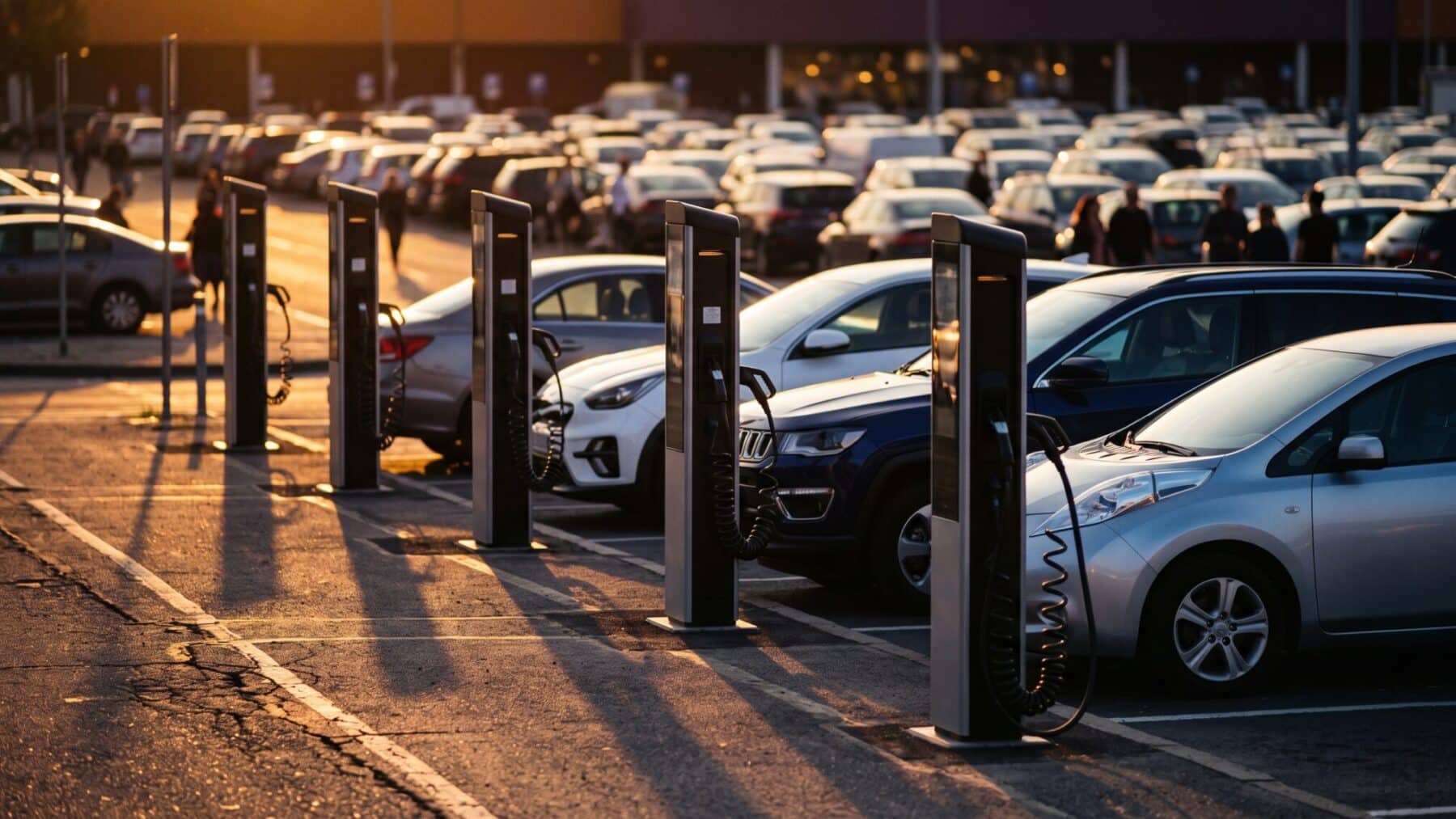
Pull off almost any American interstate today and the charging canopy looks different than it did two summers ago.
More stalls. More brand names. More power outputs stamped on the pedestals. The hardware is changing, and so is who owns it. The single network that once dominated every new installation is watching its slice of that growth shrink quarter by quarter, while a cluster of rivals races to fill the gap it leaves behind.
How a dominant network loses its grip on new builds
Market share in charging is not simply about how many stalls a network already has in the ground. It is about who is winning the race to install new ones each quarter, because new ports are where future revenue and driver habits get locked in.
When one player captures more than 40 percent of every fresh installation, competitors are perpetually playing catch-up against a widening base. The moment that share slips, the compounding advantage reverses. That reversal is now measurable and accelerating each quarter.
The trajectory is consistent across every data source available: a dominant network is losing the new-build race faster than almost anyone anticipated, and the gap is widening with each quarterly report.
What the highway stops actually look like right now
Stand at a modern fast-charging hub along an American highway corridor and the equipment tells the story. Power levels are rising sharply: chargers rated at 250 kilowatts or higher made up 55 percent of new non-Tesla installations in the first quarter of 2026, according to charging data firm Paren, while sub-150-kilowatt units dropped to just 21 percent of new installs.
Across all DC fast-charging ports in service, 67 percent now deliver 250 kilowatts or more. High-power charging is no longer a premium tier. It is the floor.
Operators are also packing more chargers into each site rather than opening new locations. Non-Tesla networks increased their average station size by over 31 percent year-over-year, reaching 4.6 ports per site in Q1 2026, while the overall average for new stations climbed to 5.5 ports, up from 4.6 a year earlier.
The Q1 leaderboard for new deployments included Ionna, Red E, ChargePoint, EVgo, a luxury automaker’s high-power network, a major truck-stop chain, a fuel retailer and a retail giant that has been rapidly expanding its fast-charging network across dozens of locations nationwide.
The numbers behind the shift and where they come from
According to the Alternative Fuels Data Center, there were more than 72,000 public DC fast-charging ports across the United States by spring 2026. That total has been rising by roughly 30 percent year over year. Those figures come from federal infrastructure tracking, not industry self-reporting, making them among the most reliable benchmarks available.
Non-Tesla providers installed more new fast chargers than the leading automaker’s network combined during Q1 2026, according to data from charging analytics firm Paren. That firm’s Q1 2026 report put Tesla’s share of new deployments at 26 percent, down from above 40 percent the prior year. Whichever measure you use, the direction is the same.
Paren noted that six of the ten operators in the top ten for new deployments in Q1 2026 were not in that group a year earlier, a sign of unusual turnover in an infrastructure market where capital costs tend to entrench incumbents.
Reliability is rising alongside competition. Paren’s data for Q1 2026 put nationwide charger reliability in the 90 to 95 percent range, an improvement on the prior year. As GCN has reported, Ionna topped J.D. Power public charging rankings in its first year of eligibility, a sign that newer entrants are competing on experience, not just port count.
Where the dominant network still leads and where it does not
The leading network remained the largest single operator with approximately 38,000 stalls in the United States in early 2026, but its overall share of the installed base had already slipped to just over 51 percent. Analysts tracking the data said that figure could fall below 50 percent before the year is out. Total installed base is a lagging indicator; the new-build share is the leading one, and that number has already shifted decisively.
One rival held the largest network by station count, but the overwhelming majority of its chargers are Level 2 units. Level 2 chargers require hours, not minutes. The drivers who most need public infrastructure are precisely those without time to wait, so fast-charging dominance and overall station count are two very different competitions.
Utilization tells a more complicated story. Average utilization across the US sat at around 15.6 percent in Q1 2026, according to Paren, easing from a Q4 peak of 16.5 percent, but some low-density regions were seeing just a fraction of that while top urban markets were considerably above average. That gap has not narrowed year over year, which means the map of genuinely useful fast charging remains uneven no matter what the national totals suggest.
What the fragmented race means for EV drivers going forward
Competition is doing what competition is supposed to do. Power outputs are climbing, sites are getting larger, reliability scores are rising and new operators are entering a market that three years ago looked like a two-player game.
Charging companies are now less focused on expanding their footprint by building new stations and are instead adding stalls at sites that are already operational. That density strategy produces faster, more useful stops rather than a thinner national map. The United States now has millions of electric vehicles in operation, served by more than 250,000 publicly available charging outlets across all levels, a total that has grown substantially faster than the vehicle fleet.
Closing that gap will require every operator now competing for new-build share to keep deploying at record pace. The race for ports is no longer one network’s to lose alone.
For ordinary EV drivers, the shift translates into a concrete improvement: more stalls at each stop, higher power at most of them, and a far better chance that the pedestal you pull up to is actually working. The quarterly leaderboard has already been reshuffled once, and the trend is pointed in the right direction.
