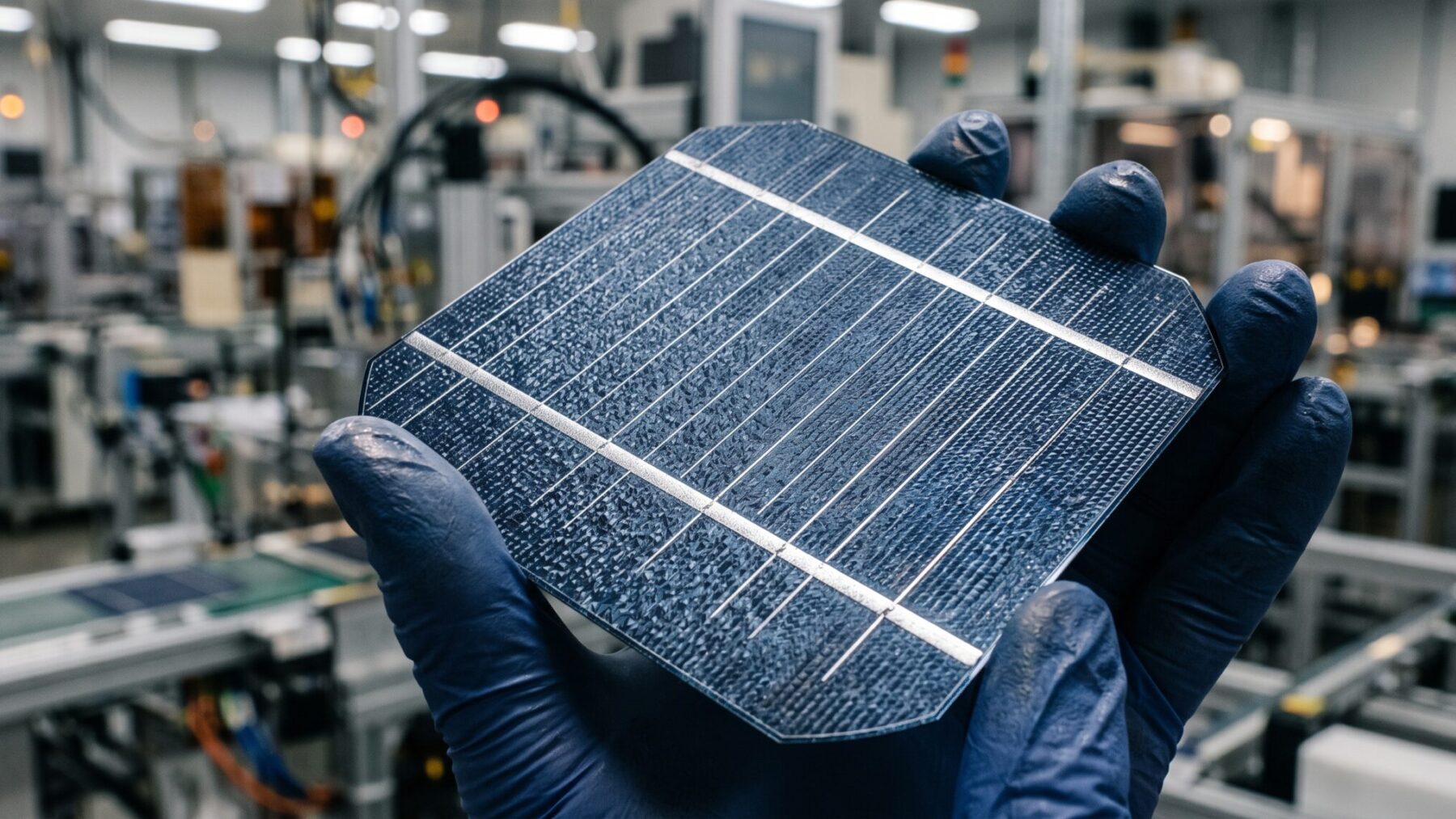
The panel looks like every solar panel you have ever seen.
It sits flush in a rack, wired into a string, facing the sun. But on its rear surface, invisible to any naked eye, sits a film of silicon oxide so thin that seventy thousand of them stacked together would equal the width of a single human hair.
That film is the reason the solar industry is having the most consequential efficiency argument in six decades. What, exactly, does a layer that small actually do?
How a layer one atom thick controls where electricity goes
Every solar cell faces the same enemy: electrons knocked loose by sunlight that find their way back to the wrong place and release their energy as heat instead of current. The metal contact on the back of a conventional cell was the worst offender, because it touched the silicon directly and gave stray electrons an easy recombination path.
TOPCon, which stands for tunnel oxide passivated contact, solved that by inserting a barrier so thin that the physics changes entirely. At roughly 1 to 2 nanometers, the oxide layer is too thin to block electrons the way a normal insulator would. Instead, quantum tunneling takes over: electrons with enough energy pass straight through as if the barrier were not there, while slower, misdirected electrons are turned back.
The polysilicon layer deposited on top then funnels only the right carriers out to the metal contact. TOPCon replaced the older aluminum back-surface field used in PERC cells with this tunnel oxide passivating contact, delivering another 2 to 3 percentage points of efficiency. On a rooftop system, that gain is worth thousands of dollars over a panel’s lifetime.
The factory floor where this film runs at gigawatt scale
TOPCon is no longer a laboratory curiosity. It dominates 2026 production at 25 to 26 percent cell efficiency, meaning the tunnel oxide trick is being applied to hundreds of millions of wafers every year.
The manufacturing sequence involves growing the oxide in a wet chemical bath or plasma chamber, depositing polysilicon by vapor deposition, then annealing the whole stack at temperatures that lock the structure in place. The challenge at scale is uniformity: holding a defect-free 1-nanometer oxide across every wafer on a line running thousands of cells per hour is difficult to control precisely.
Those process tolerances are why the gap between contracts and manufacturing capacity remains so wide. Writing an order for panels is easy. Growing a flawless nanometer-thin oxide at production speed is where the real industrial discipline lives.
The 34.85 percent number and where it came from
Single-junction silicon cells face a hard ceiling set by physics in 1961, sitting at roughly 33.7 percent. Decades of engineering brought commercial cells to around 24 percent, then progress stalled. All single-junction cells are constrained by what physicists call the Shockley-Queisser limit, and gains above 26 percent become increasingly difficult to extract.
The breakthrough came by stacking a second absorber on top of a crystalline silicon cell. Perovskite captures the high-energy blue and green photons that silicon wastes as heat, while the silicon bottom cell handles red and infrared photons. Together they harvest a wider slice of the solar spectrum than either could alone.
LONGi independently developed a two-terminal crystalline silicon-perovskite tandem solar cell that has achieved a conversion efficiency of 34.85 percent, certified by the U.S. National Renewable Energy Laboratory, breaking the world record for crystalline silicon-perovskite tandem cell efficiency. The silicon bottom cell in that record device uses a heterojunction architecture rather than TOPCon. The record progressed from 33.9 percent in November 2023, then to 34.6 percent in June 2024, and then to 34.85 percent, nearly a full percentage point in roughly eighteen months.
That the perovskite-silicon tandem has now crossed the 33.7-percent Shockley-Queisser single-junction ceiling matters enormously for the entire silicon industry, including the gigawatt-scale TOPCon lines already running.
Where the tandem runs into a wall
The record number and the rooftop panel are still very different things. Mass-production cells trail efficiency records by 4 to 7 percentage points, which means 34.85 percent describes a small-area laboratory device. Scaling to a full-size commercial module while holding that efficiency requires uniform perovskite deposition across an area roughly the size of a door.
There is also a thermal problem. TOPCon requires processing temperatures above 700 degrees Celsius for polysilicon deposition, and perovskite layers degrade rapidly at high heat. Engineers working on TOPCon-based tandem routes are working around this by depositing the perovskite top cell last, after the silicon bottom cell is fully processed, but the sequencing adds cost and complexity compared with heterojunction-based approaches.
The patent landscape around the silicon oxide passivation layer in solar cells is already contested, and adding a perovskite top cell introduces a second layer of intellectual-property exposure. Lead in the perovskite layer also raises disposal questions that regulators in several US states have not yet formally addressed.
What the tandem record means for US electricity prices
Tandem modules are expected to enter commercial supply around 2027, meaning the first utility-scale projects to specify perovskite-silicon panels are likely being designed right now. If those modules deliver even 30 percent of their laboratory efficiency at module scale, they produce meaningfully more power per square foot, cutting the panels, racking sets, and labor hours a project needs.
That arithmetic flows directly into the cost per unit of electricity that utilities and grid operators pay. The existing base of silicon manufacturing matters here: a greenfield tandem factory built from scratch would take years and billions of dollars, but production lines that add a perovskite deposition step can, in principle, be upgraded without replacing everything.
The 1-nanometer oxide film that most panel buyers never think about is the foundation of the dominant production architecture in solar today. Whether the next record arrives in months or the commercial module slips to 2028, the tunnel oxide that started as a laboratory trick is now the central architecture of the most competitive segment in global energy manufacturing.
