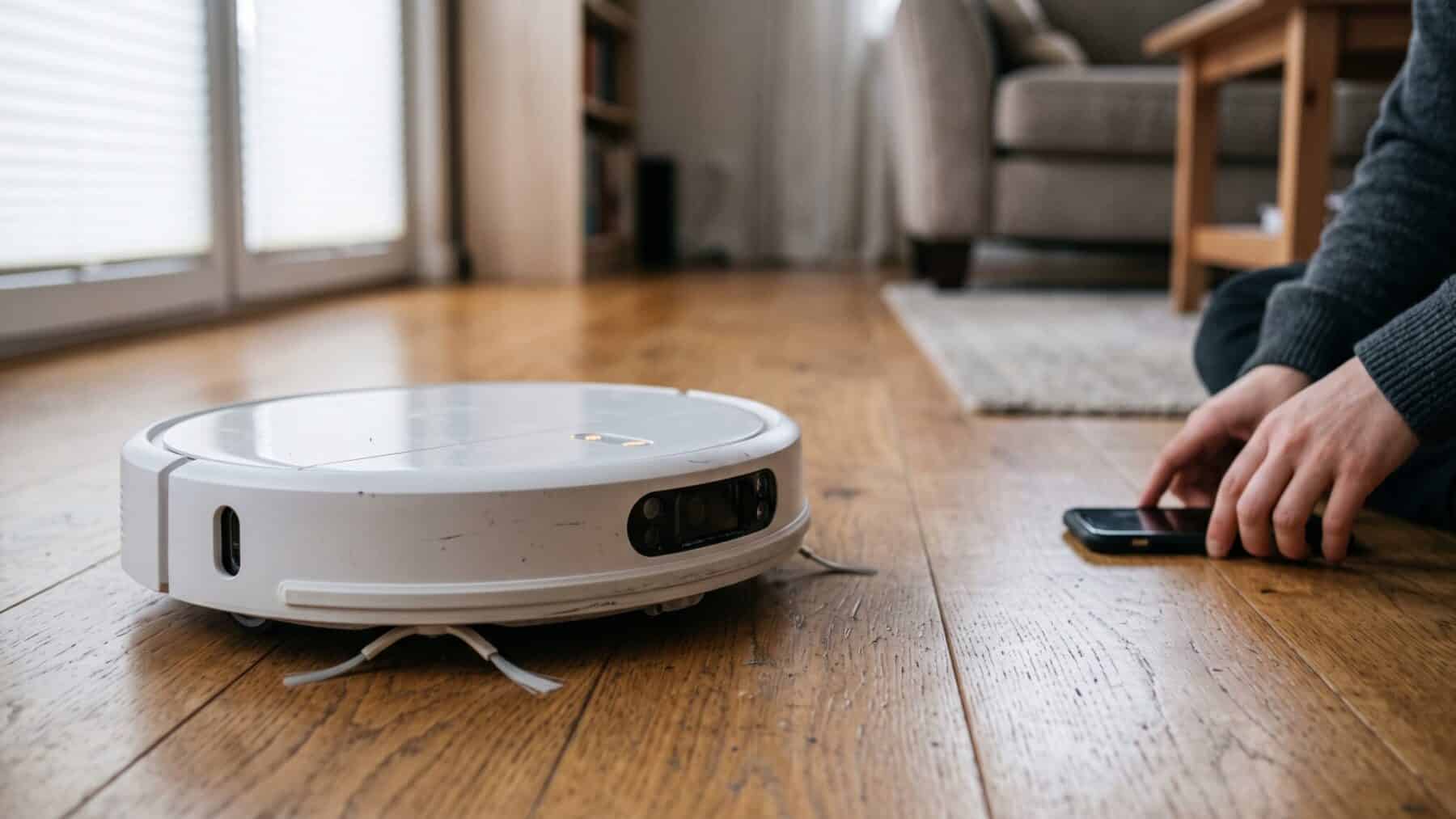
It sits in a corner, quietly charging, waiting for its next run.
You paid several hundred dollars for it. Maybe over a thousand.
It mapped every room, learned the furniture, dodged the dog’s bowl.
Then the monthly bill went unpaid, or you cancelled. And the machine that seemed to own your floors suddenly stopped knowing where it was.
What exactly cuts out, and why is the hardware powerless to stop it?
The app is the brain, and the cloud holds the keys
A robot vacuum’s headline abilities, AI obstacle detection, multi-floor mapping, geofenced room zones, and conditional scheduling, do not live inside the device itself. They run as licensed software services on company-owned servers, and the physical unit is simply a client that calls home to ask what it is allowed to do on each cleaning run.
Among major makers, several gate those features behind ongoing subscriptions, turning the hardware into a client terminal whose capabilities can shrink the moment payments stop. The vacuum does not malfunction. The licence does.
Advanced conditional scheduling and geofencing appear at paid tiers across multiple brands. So when a payment lapses, the robot reverts to a dumber version of itself: a bump-and-turn machine that cannot distinguish the kitchen from the hallway, or avoid the charging cable it navigated perfectly well last week.
What a $1,000-plus purchase actually buys by default
The smart home industry loves subscriptions, and robot vacuums are no exception. Some brands lock advanced features behind monthly fees, while others give you everything after the initial purchase. The packaging rarely spells out which camp the box in your hands belongs to.
That gap makes the upfront sticker price nearly meaningless as a long-run guide. A $600 robot on a $29-a-month plan costs more than $1,600 over three years before a single replacement brush is ordered. The math is not hidden; it is just not on the label.
One instructive, if extreme, case: iRobot’s Select program bundled a premium Roomba with a $29-a-month subscription, and if you stopped paying, iRobot would reach out and remotely deactivate the bot, rendering it useless. That program is now closed to new subscribers, but the principle it illustrated, that a company can reach into a device in your home and switch it off, remains a live concern across the category. Crucially, the Roomba in that program was a rental, not an outright purchase; the deactivation applied because iRobot owned the hardware throughout.
Some subscriptions also bundle warranty coverage and replacement parts with feature access, mixing the two in ways that make the monthly fee harder to object to. Paying for brushes feels reasonable. Paying for software you assumed you already owned does not.
How the pattern spread across the category
The shift was gradual enough that it drew little attention until it was widespread. Around 2022 and 2023, robot vacuums began gating advanced features behind subscriptions. By the time most buyers noticed, the practice had become an established part of several major brands’ business models rather than a single brand’s experiment.
By 2026, subscription tiers are structural across several leading brands, covering everything from cloud-sync and AI services to app-controlled cleaning modes on newer models. What was once a premium perk is now the price of admission to the features shown in the ad, at those brands, at least.
That timing matters. Robot vacuums crossed into the mainstream just as the subscription model was being quietly bolted on. Buyers who purchased five or six years ago got fully capable hardware for a one-time fee. Many who buy the same brand today do not.
Where the model breaks down for real users
The clearest problem is remote capability removal applied to hardware a consumer already owns outright. A television that lost its picture-in-picture feature the moment you cancelled a streaming plan would prompt immediate outrage. Some robot vacuum brands have achieved much the same result with far less public attention, partly because the robot still moves and suctions even after the smarter features vanish.
This mirrors the concern raised around misleading product naming in consumer tech: a device performs far below what its marketing implied, and the gap only becomes apparent after purchase. With robot vacuums, the shortfall is not in hardware specs but in software rights never truly transferred at the point of sale.
Cloud-dependent mapping adds a data dimension too. Every floor plan, room label, and cleaning schedule lives on company servers, not locally on the device. Cancel the plan and you may lose years of accumulated home data alongside the features.
What to check before the box is opened
The simplest filter is whether all documented features are available at purchase with no ongoing fee. Several major brands, including Roborock, Dreame, and Shark, explicitly advertise that AI object avoidance, mapping, and app control are all included at no additional cost, and have gained market share by using that fact as a selling point against subscription-heavy rivals.
Meanwhile, the broader consumer device market is navigating the same tension between upfront price and long-run cost as hardware makers chase recurring revenue. Reading the fine print on feature access before purchase is no longer optional; it is the only way to know what you are actually buying.
Competition is doing some of the work. As buyers grow more aware that a robot priced at $800 might quietly need another $348 a year to perform as advertised, the pressure on subscription-heavy models is only going to build.
