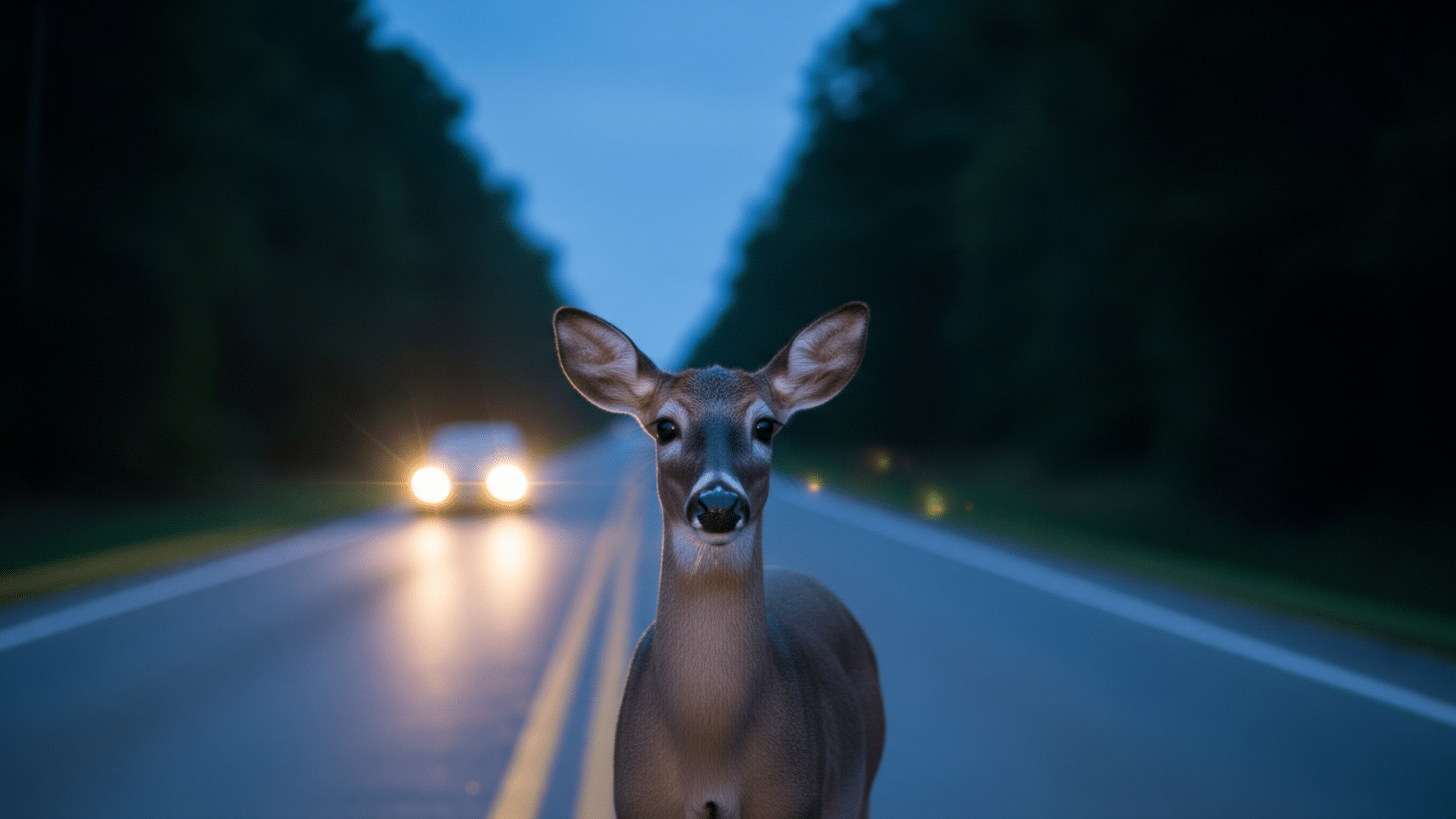
Every driver in America knows the feeling. You crest a hill at night, the headlights sweep the road, and there it is, a deer, perfectly still, staring straight back.
You brake. The deer does nothing. Then it either bolts or stays frozen until impact.
That moment has always felt random. Turns out it may not be random at all.
A real scientific study, published in April 2025, just revealed something about white-tailed deer that changes the way anyone should think about that split-second scenario, and it has direct implications for every vehicle on American roads today.
Why deer collisions keep getting more expensive despite better car safety technology
US drivers faced odds of 1-in-139 of being involved in an animal collision in the most recent reporting year, an improvement compared to the prior year’s 1-in-128 national average, but the numbers remain staggering.
According to State Farm data, US drivers filed an estimated 1.7 million animal collision insurance claims between July 2024 and June 2025. Deer-related incidents accounted for more than 1.1 million of those claims, well over half of every animal-collision report filed.
Beyond the insurance tallies, deer-vehicle collisions cause billions of dollars in damages and injure thousands of drivers every year in the United States, and few mitigation methods have proven effective.
Cars have gotten smarter. Automatic emergency braking, night-vision cameras, wildlife detection alerts, the technology is everywhere. And yet the collision numbers barely budge.
The question researchers kept coming back to was not what the car was doing in those final seconds. It was what the deer was doing, and why.
How a university team built a 95-meter collision simulator to watch deer decide
Carson Pakula, a doctoral graduate research assistant and lead author of the study, conducted 174 trials at the Whitehall Deer Research Facility in Athens, Georgia, through his work with the University of Georgia’s Savannah River Ecology Laboratory and Warnell School of Forestry and Natural Resources.
The team used a total of 23 female white-tailed deer, testing eight lighting combinations using an oncoming electric golf cart outfitted with halogen or LED headlights, set to high or low beam, with or without a rear-facing lightbar.
The study focused on short-range encounters, which ranged just 95 meters between the deer and the vehicle, designed to simulate the final seconds before a potential collision.
Using infrared cameras, researchers tracked alert behavior, when a deer stopped or reoriented in response to the vehicle, and flight behavior, when it made an apparent attempt to escape.
The headlight question was pressing for a specific reason. Most new vehicles are manufactured with LED headlights, which differ in total radiance and wavelength of light emitted compared to the previous industry standard of halogen headlights. Nobody knew if that mattered to a deer.
The part of the results that most people would get completely wrong
Common sense says brighter, whiter, more modern lights should give a deer more warning. More warning means more time to flee. Fewer collisions.
The data said something different.
Halogen high beams increased alert probability over LED high beam headlights, and also over halogen low beam headlights, meaning the modern LED systems now standard on nearly every new vehicle sold in America did not deliver the same alerting advantage.
Deer were less likely to notice and react to LED headlights compared with halogens, leading cart drivers to slam on the brakes to prevent head-on collisions with deer who ignored the danger.
And even when a deer did alert, what came next was the real puzzle.
This connects directly to a broader problem that engineers are still trying to solve, as GCN reported, researchers training an AI on 12,000 images of deer found the animal keeps defeating every car safety sensor designed to see it at night.
Deer have individual personalities, and that fact is what actually controls the crash
Here is the finding that no driver, and almost no automaker engineer, has fully reckoned with.
Some bolted; others froze long term in that infamous and deadly deer-in-headlights stance. Some choices seemed random; others appeared to follow personal patterns of usually fleeing or freezing, as if driven by their unique personalities, bold, shy, or cautious, and possibly past experiences with danger, the researchers say.
Across all behavioral responses, the researchers found large variations in responses among individual deer relative to lighting treatments, meaning an animal’s own personality swamped the effect of whatever headlights were on the car.
“It could be that by the time you’re in an imminent collision scenario, you’re kind of at the mercy of the deer,” says study co-author Travis DeVault.
The full study, Caught in headlights: Captive white-tailed deer responses to variations in vehicle lighting during imminent collision scenarios, was published in Applied Animal Behaviour Science in 2025 by Pakula, D’Angelo, Mowrer, Rhodes, and DeVault of the University of Georgia.
What drivers and automakers can actually do with this knowledge
The study does not end in helplessness. It ends in a clearer problem statement, and that clarity matters.
Future research should investigate how vehicle lighting treatments affect free-ranging, wild deer in a variety of real-world scenarios and at longer approach distances, which means the 95-meter chute was a starting line, not a finish.
Frontal vehicle illumination through rear-facing lighting has shown promise in enhancing deer responses to vehicles, and that specific technology is now a target for further testing.
For drivers right now, the practical answer is older than any headlight technology. Be most cautious during November, October, and December, especially in the two weeks surrounding the fall daylight saving time change, and remain alert between dusk and dawn.
And if you see one deer, expect more. Deer travel in groups, and during the rut, male deer become less cautious and may dart into roadways unexpectedly.
The bigger picture is that the auto industry has spent years engineering smarter sensors and tracking every mechanical fix at the federal level, while the most unpredictable variable on the road at night turns out to be a large wild animal with its own personality. That, researchers now say, is the problem worth solving next.
