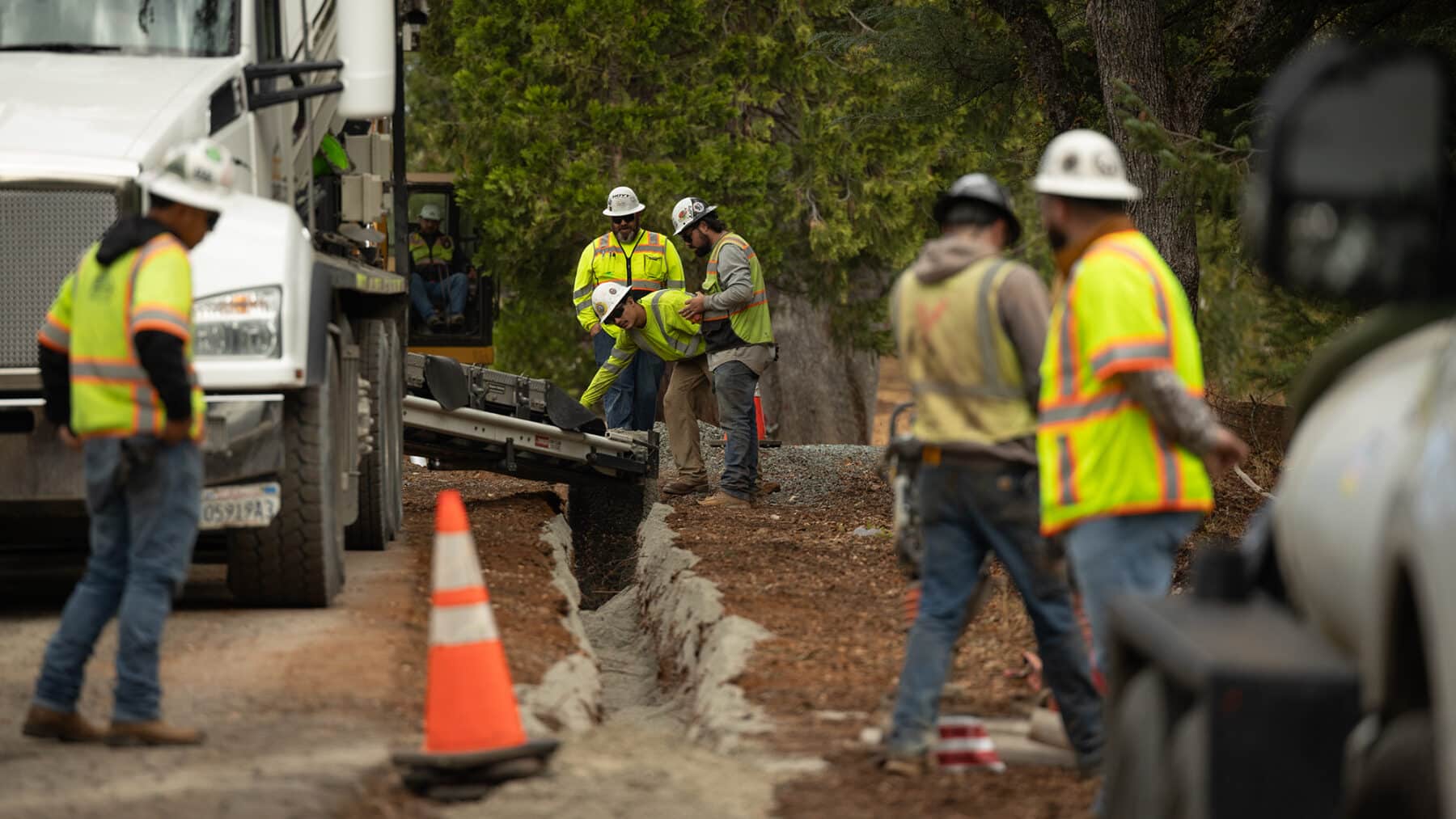
A trench cuts through a quiet roadside shoulder, wide enough to swallow a thick black cable and the crew kneeling beside it.
Nobody driving past gives the hole a second look.
But the wooden pole standing a few feet away is marked for removal, and so is the overhead wire it has carried for decades.
Replacing that ordinary pole with buried cable is one of the most expensive things a utility can do.
And regulators just put a hard number on who pays for it.
Why burying a power line costs so much more than stringing one overhead
Putting a line underground is not simply digging a ditch and dropping in cable. Crews have to cut a continuous trench, often through rock, roots or existing pipes, then install conduit, vaults and splice boxes rated to handle heat and groundwater for decades. That underground conversion work is slow, labor heavy and nearly impossible to speed up without more crews.
Overhead lines lean on a century of cheap, standardized construction instead: a wooden pole, a crossarm, bare wire strung between spans. Undergrounding swaps that for a sealed buried system built to survive being driven over, flooded and forgotten for decades without a single visual inspection.
That gap explains the price.
Wildfire investigators increasingly point to failed overhead equipment as an ignition source, so utilities in fire prone states keep leaning into undergrounding anyway, even at a steep premium, because regulators consider it one of the few fixes that is close to permanent.
Inside the price tag utilities are asking customers to carry
In California, the scale of that bet is no longer theoretical. One major utility has buried 800 miles of power lines since 2021, with each mile costing between $3 and $4 million, and state regulators have signed off on a plan to bury roughly 1,230 more miles through 2026.
So a modest residential street getting rewired underground can represent a multimillion dollar line item before a single new streetlight goes up.
Multiply that across hundreds of miles and a service territory, and the project stops looking like routine maintenance.
None of that spending stays with shareholders. It flows into the rate base, the pool of approved costs that regulators let a utility earn a return on and recover from customers over years, the same mechanism already fueling rate fights from Oklahoma to Wisconsin.
The confirmed dollar figure regulators just put behind it
The hardest number comes from the state’s own oversight filing. Between 2019 and 2024, the state’s three largest utilities had wildfire mitigation and liability costs authorized for recovery of approximately $40 billion, which works out to an equivalent revenue requirement over that period of about $27 billion, according to a report submitted to the state legislature.
That revenue requirement covers more than buried cable. It bundles vegetation trimming, pole hardening, insurance premiums and the wildfire fund surcharge into one distribution revenue requirement, and the same report finds the distribution revenue requirement has grown significantly over time, to more than double in 2025 what it was in 2016.
A state audit cited in that reporting found a verification gap still unresolved.
Regulators and consumer advocates still lack a reliable way to confirm whether utilities completed the work they billed customers for. So the $27 billion revenue requirement is confirmed as the state’s own figure, even as whether every mile funded was the cheapest way to cut fire risk remains an open question. That tension is not unique to California. Reporting on Pacific Northwest utilities found one company spending around $65 million a year on wildfire projects, including burying wires underground, a smaller version of the same bet now showing up in rate filings nationwide.
Where the math still breaks down for both sides
Even utilities that favor undergrounding admit it cannot be the whole answer. At $3 million to $4 million a mile, burying every at risk line in a sprawling service territory would take decades, and it would still leave substations, transformers and overhead feeder lines exposed above ground.
That is why most wildfire plans blend buried segments with cheaper fixes, including covered conductor and faster acting shutoff sensors. Some utilities are also experimenting with flexible grid connections, the same queue skipping approach described in this look at flexible EV charger connections.
Pushback is growing too.
Regulators in several states have challenged the returns utilities are allowed to earn on this spending, a dispute echoed in a challenge to one utility’s return. Ratepayer advocates increasingly ask whether every mile buried was the cheapest mile available, which makes the $27 billion a running total rather than a ceiling.
What the bill really buys, and what still has to be proven
For an ordinary customer, the practical effect is a wildfire charge embedded quietly inside a monthly bill, separate from the kilowatt hour rate most people assume is the whole story. Few households ever connect that line item to a specific trench a few counties away.
Yet the underlying logic holds up. Buried cable genuinely cannot be knocked down by wind, ice or a falling branch the way overhead wire can, and insurers and regulators alike treat that as real risk reduction worth paying for.
The open question is pace, not purpose.
Whether $27 billion in authorized spending measurably cuts ignitions over the next decade, or simply becomes the new baseline cost of keeping the lights on in fire country, is the test regulators and ratepayers are both still waiting to see settled.
