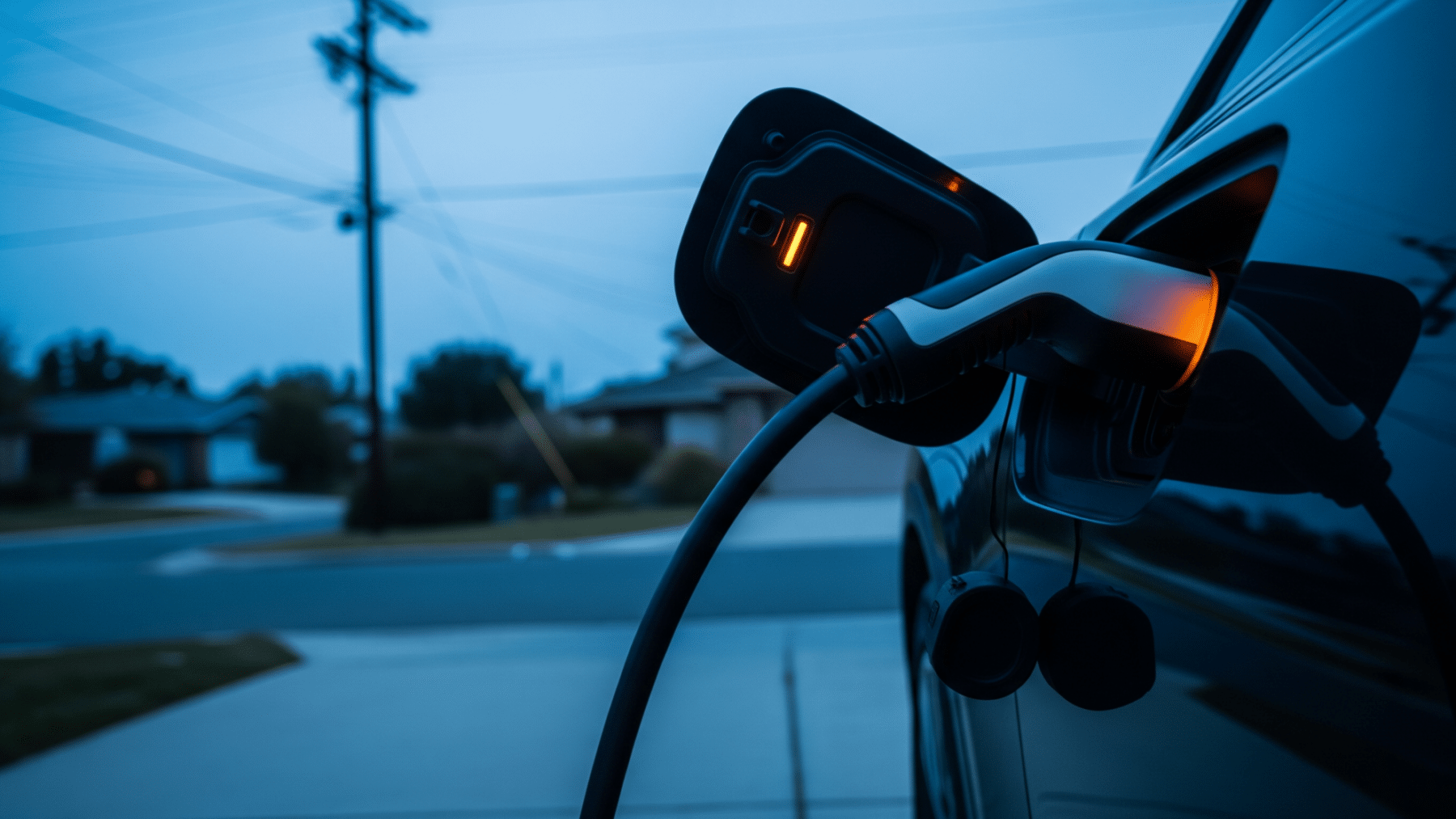
Every night, across millions of American driveways, the same thing happens. A driver gets home, plugs in, and walks away. Completely routine. Completely invisible.
But to a grid operator watching load curves, that moment is anything but invisible. It is the exact instant when demand spikes hardest and the system is already stretched from the day’s air-conditioning and industrial loads.
And the number attached to that routine action has just become impossible to ignore.
A peak-load forecast that grew more than six times over in three years
The five-year forecast of U.S. utility peak load growth has ballooned from 24 gigawatts in 2022 to 166 gigawatts in 2025, according to Grid Strategies.
That number is driven primarily by data centers, which Grid Strategies estimates will account for roughly 90 gigawatts of new peak demand growth based on utility filings, followed by manufacturing electrification and, contributing the remaining share, the evening surge of EVs all arriving at once.
That is not a gradual climb. That is a seismic revision to every infrastructure plan utilities built their capital budgets around.
Home charging pushes demand directly onto local distribution circuits that were never designed for it.
A single EV battery of 75 kilowatt-hours or more can draw seven to ten times the load of a typical household when recharged in just a few hours.
Grid engineers have a phrase for what happens when thousands of those loads hit the same feeder at 6 p.m. They call it coincident peak, and avoiding it is now the central challenge of U.S. energy infrastructure planning.
Why the timing of the plug-in matters more than the plug itself
About 83 percent of EV charging in the U.S. is done at home, according to the International Energy Agency, which can result in evening peak demands as individuals charge their cars after working hours.
That single behavioral fact is what makes the grid math so difficult. Nobody staggers it. Nearly everyone plugs in within the same two-hour window.
Exploiting the full potential of managed charging for reliability and cost savings will require standardized data-sharing protocols that have so far proven elusive for the industry.
The problem is not electrons. The problem is information and timing: who controls when the car charges, and whether that decision is made by the driver, the utility, or the software running between them.
Without active managed charging, off-peak price signals can cause large numbers of EVs to begin charging at the same time, potentially overloading local distribution infrastructure.
In other words, even a well-intentioned nudge toward off-peak hours can create a new, identical spike just two hours later.
The utility arms race to get inside your charging schedule
Managed charging, commonly referred to as V1G, indicating the one-way flow of energy from the grid to the vehicle, is already being used to shift load from peak demand hours.
Utilities across the country are now building or expanding programs that reach directly into enrolled vehicles and delay, slow or reschedule charging automatically, with the driver’s permission.
EV charging software firm ev.energy has published a managed charging playbook, with research support from The Brattle Group, examining the value of active V1G programs for utilities and grid planners, and similar analysis has been conducted for the New York State Energy Research and Development Authority.
Meanwhile, annual gasoline car operating costs in the United States have risen materially since 2020, while battery electric vehicle running costs have also climbed as average residential electricity prices have increased by more than 30 percent over the same period, according to U.S. Energy Information Administration data.
That electricity price climb is partly why every wasted peak kilowatt now carries a real dollar cost for every household on the circuit, not just the EV owner.
The $18 billion number California just put on the table
Here is the payoff that utilities are now racing toward. The Distribution Grid Electrification Model 2025 from California’s Public Advocates Office finds that shifting EV charging to reduce stress on local distribution circuits can provide between $5 billion and $18 billion in grid-cost savings by 2040 across California’s investor-owned utility territories.
That range is not a theoretical upper bound. The California Public Advocates Office, in its 2025 DGEM study, concluded that managed EV charging had a material impact on costs for all three investor-owned utilities in the state.
A California Energy Commission vehicle-grid integration report concluded that California’s EVs already represent an 18.5-gigawatt flexible asset, a figure that is only going to grow.
Rather than a burden on the national storage build-out, a well-managed EV fleet is emerging as a competitor to standalone storage, one that consumers have already paid for and parked in their garages.
Utilities can unlock up to $30 billion annually in savings by 2035 by embracing a managed charging approach, according to a report from EV charging software firm ev.energy, by shifting EV charging times to when electricity is cheapest and cleanest.
The record pace of U.S. battery storage additions is part of the same grid-modernization wave, but managed charging costs far less to deploy because the batteries are already on the road.
Who wins and who falls behind as utilities compete for control
The winners in this race are the utilities and third-party software firms that can enroll the most vehicles before unmanaged charging locks in a new, more expensive grid buildout.
Programs that have proven their case include California’s ChargeWise pilot, run by MCE and Silicon Valley Clean Energy (SVCE), which saw 98 percent of energy delivered off-peak and an average customer saving of $200 per year versus standard time-of-use rates alone, compared with 60 to 70 percent off-peak delivery under those standard rates.
The losers are utilities and states that move slowly.
Modeling of Massachusetts feeders found that up to 11 percent could overload in the near term from transportation electrification, rising to 23 percent by 2030.
About 10 percent of substations could overload in 2030 and 28 percent in 2035 if charging is left unmanaged.
The arithmetic is unusually clear for an infrastructure debate. Manage the timing, save tens of billions. Miss the window, rebuild the grid. The car is already in the driveway. The question is who gets to decide exactly when it starts charging.
