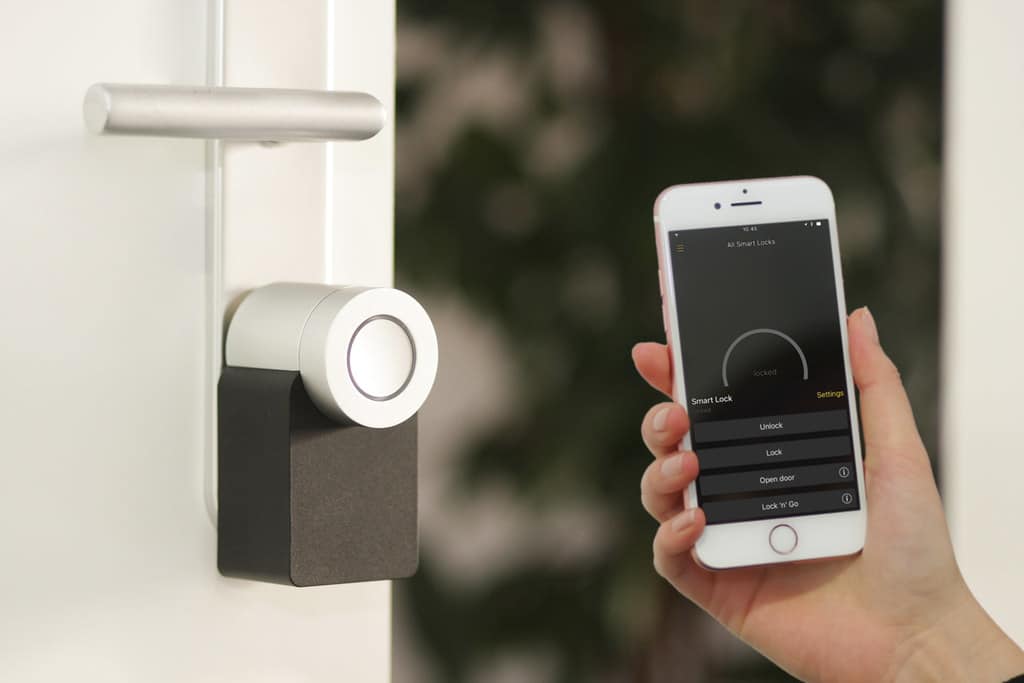
A front door clicks open the instant its owner’s phone drifts close enough to notice, no key, no tap, no code.
That walk up convenience is the entire sales pitch for modern smart locks.
It is also, researchers found, the same gap a stranger standing on the porch can use.
No keypad gets touched, no app gets opened, and no alert gets sent.
So how does a lock built to recognize one phone end up answering to anyone nearby?
How the lock’s own convenience feature became the opening
Smart locks like the ones made by Austrian manufacturer Nuki work by talking to a paired phone over Bluetooth Low Energy, a short range wireless standard built for small, battery sipping devices. The lock and the phone exchange encrypted messages, and when the phone is close enough and authorized, the lock’s small motor turns.
That exchange is supposed to run through a strict permission check, confirming the device sending a command actually has the right to send it. Researchers at NCC Group found that Nuki’s implementation of the Bluetooth Low Energy (BLE) API lacked proper access controls, allowing an attacker to send high-privileged commands they should not have permissions to send.
The result, catalogued as CVE-2022-32507, meant the lock’s Bluetooth system accepted commands from devices that had never proven they were authorized. A device that had never proven who it was could still reach the lock’s motor directly, sending high privileged commands it should never have touched.
What that looks like at an actual front door
Picture a porch, a delivery bag, and a phone in someone’s pocket that never left airplane mode near the lock. Nuki offers smart lock products, Nuki Smart Lock and Nuki Bridge, that allow users to unlock their doors with their smartphones by simply walking in range , which is exactly the feature that made it popular with renters and homeowners trying to ditch physical keys. That same walk up range turns a nearby stranger into a plausible attacker rather than a distant one.
No breach of a cloud account was required. No phishing email had to land first. The vulnerable exchange happened over the air, within normal Bluetooth range of the door, invisible to anyone watching from inside.
Most buyers judge a lock the way they would a deadbolt, by feel and app polish. The real attack surface is a radio handshake nobody can inspect before buying, a pattern around default trust that keeps resurfacing in consumer hardware.
How researchers actually proved the door would open
NCC Group’s engagement was a structured security assessment of the lock maker’s full product line, not a single bug report, and security researchers with NCC Group documented 11 vulnerabilities impacting Nuki smart lock products, including issues that could allow attackers to open doors . Beyond the Bluetooth gap, the same review found both Nuki Smart Lock and Nuki Bridge were found to lack SSL/TLS certificate validation, allowing an attacker to perform a man-in-the-middle attack and intercept network traffic . That gave attackers two separate routes into the same lock.
Researchers also opened the hardware itself and found exposed debug interfaces on both devices, along with crafted packets that could trigger denial of service conditions. An exposed debug interface lets anyone with a screwdriver and brief physical access read or rewrite the chip’s memory directly.
Disclosure followed standard timing. Nuki was informed about the vulnerabilities found during the research on April 20 2022, provided information to NCC Group about the fixes progress and potential release dates on May 6 2022, and released the vulnerability patches for all submitted vulnerabilities on June 9 2022 . ” Some of the vulnerabilities result in a fully compromised device, including capabilities to open and close the door without the owner noticing, ” NCC researchers Guillermo del Valle Gil and Daniel Romero told the outlet that first reported the findings.
Where the fix holds and where it does not
Patches close the specific flaws researchers catalogued, but they do not retroactively audit every lock already screwed into a door frame. Anyone running older firmware stays exposed to the same Bluetooth gap, because updates on IoT hardware depend entirely on the owner checking for them rather than arriving automatically.
That is the quieter catch behind smart lock marketing. A product sold on seamless convenience also depends on an update process most buyers never confirm is current, the same trust gap that has shown up across unrelated software ecosystems for years.
Nor is this brand unique. Independent researchers have documented other weak points in Bluetooth based smart lock designs more broadly, including relay attacks that extend a phone’s signal to trick a lock into unlocking from farther away than intended. So the limit here is scope, not severity, documented and patched flaws in one product line, not proof every smart lock is exploitable today.
What buyers can actually do about it
None of this means smart locks are a bad idea, only that the convenience they sell comes with homework attached. Checking that firmware and the companion app are current takes a couple of minutes inside the same app used to unlock the door.
Shoppers can also look for whether a manufacturer publishes a public update history rather than staying silent about past patches, since a company willing to document its own flaws is at least showing the audit trail exists. The broader lesson lines up with research on account recovery, where small overlooked steps carry outsized risk.
A lock is only as strong as the handshake nobody sees. For now, the fix is simple and already shipped. The harder part is making sure every lock still running old firmware actually gets it.
