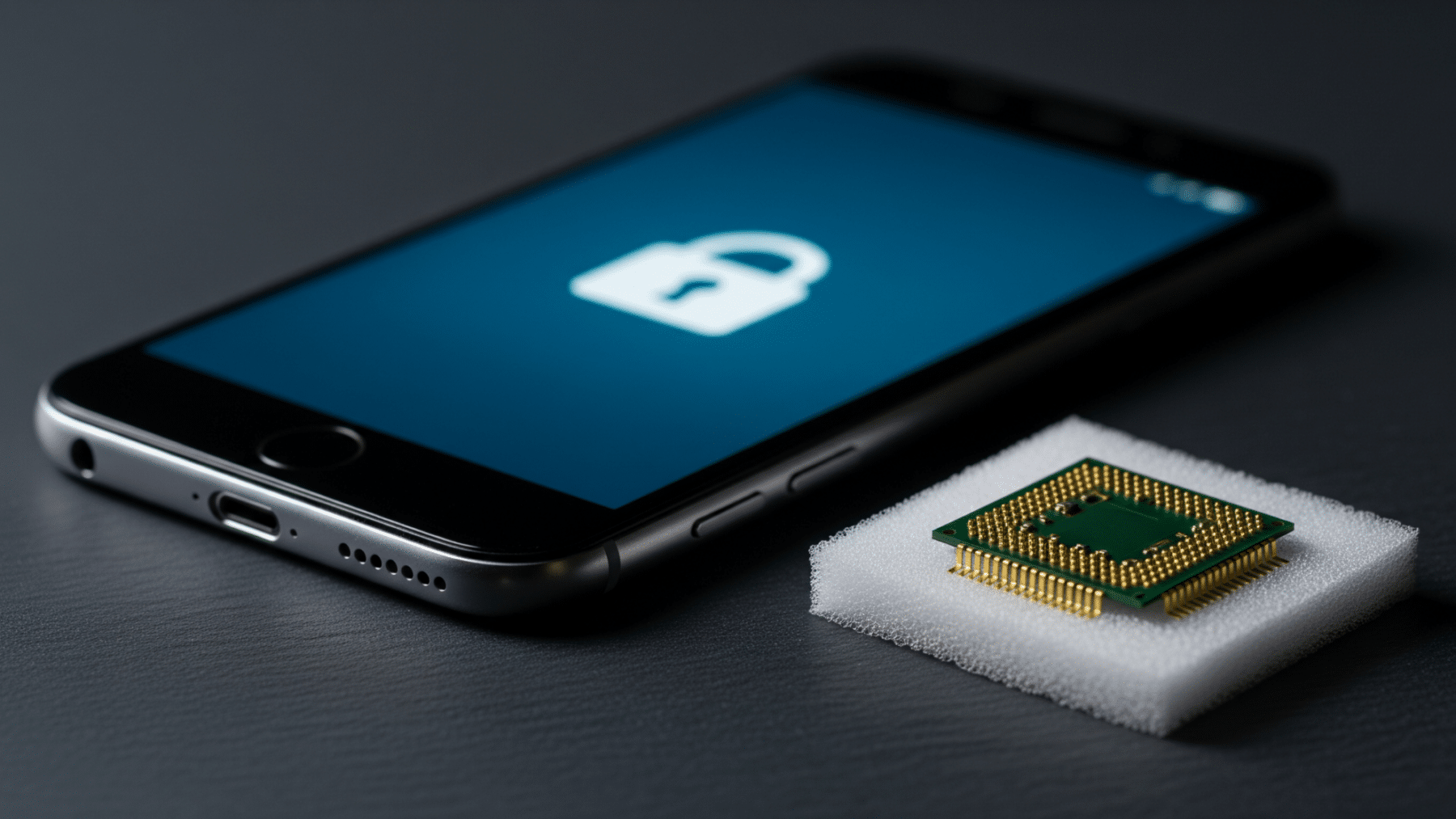
Your phone has a chip inside it, and the company that sold it described that chip with a word that used to belong exclusively to physicists working in sealed, cryogenic laboratories.
The word is “quantum.”
It is printed on the box, featured in the press release, and repeated in every carrier store display that wants you to feel your banking app is genuinely, impossibly safe.
Most buyers never ask what it actually certifies. The answer turns out to be more complicated than the marketing ever hints.
The phone feature that sounds like science fiction, explained in plain language
A quantum random number generator, or QRNG, is a real piece of hardware.
It uses quantum mechanical processes to produce truly random numbers, relying on unpredictable quantum events as a source of entropy.
Unlike algorithmic generators that only simulate randomness, a QRNG measures it directly from physical phenomena that cannot be predicted or repeated.
That distinction matters enormously for security. Randomness is what prevents encrypted systems from being predictable or reversible, and every modern encryption system depends on it.
So far, so genuinely impressive. The physics is real.
How a quantum chip ended up inside a phone you can buy at the mall
The world’s first mass-market application of quantum technology in a smartphone laid the foundation for affordable high-security key generation in mobile devices.
Following that success, successive versions appeared each year. The Galaxy Quantum 6 is Samsung’s latest generation of quantum-secure mobile devices, combining ID Quantique’s quantum technology with Samsung Knox, Samsung’s powerful security platform, and equipped with even more QRNG-based encryption applications.
The new Galaxy Quantum 6 integrates what ID Quantique describes as “the world’s smallest” QRNG chipset, measuring 2.5 mm × 2.5 mm, enabling trusted authentication and encryption of information.
That gave the marketing teams something real to point at: a physical, quantum-physics-based component soldered into a consumer device.
And then the rest of the industry noticed.
The part of the story that the press releases skip over entirely
The quantum random number generator market has entered its gold rush phase, with market reports now counting over 120 companies in the space. Market forecasts range from $500 million to over $600 million for 2026, depending on how broadly the segment is defined.
Investment capital is flowing, vendors are racing to differentiate, and when the underlying physics offers limited room for differentiation, marketing departments fill the gap.
Vendor announcements have leaned into the superlatives: one chip maker promoted what it called “the world’s smallest” QRNG chipset, measured at 2.5 mm × 2.5 mm. Others have reached further still, coining names that lean heavily on the aura of the exotic rather than on certified physics.
Whether any given product deserves the word “quantum” in its marketing materials is, as one analysis put it, “a more complicated question.”
That complicated question is exactly the one consumers never get to ask at the point of purchase.
The real catch that no spec sheet lists next to the quantum label
Here is what the box does not tell you: the word “quantum” on a chip or a smartphone carries no binding standard that a buyer can independently verify before purchase.
NIST, in collaboration with the University of Colorado Boulder, has established the Colorado University Randomness Beacon (CURBy), the first publicly accessible random number generator underpinned by quantum entanglement, leveraging the inherent randomness of quantum mechanics to produce verifiable and demonstrably unbiased numbers, broadcast freely as a public resource.
CURBy is, in NIST researcher Krister Shalm’s words, “one of the first publicly available services that operates with a provable quantum advantage.” “The quality and origin of these random bits can be directly certified in a way that conventional random number generators are unable to.”
CURBy produces random numbers automatically and broadcasts them daily through a website for anyone to use. Notably, NIST performed one of the first complete experimental Bell tests in 2015, which firmly established that quantum mechanics is truly random, and in 2018 pioneered methods to use those Bell tests to build the world’s first sources of true randomness, but turning that laboratory breakthrough into a continuously operating, publicly accessible service took until CURBy, and that gap tells you something important: before it existed, there was no universally accepted, publicly accessible reference point against which to test vendor claims.
CURBy matters precisely because it provides a reference point against which vendor claims of “self-certifying” or “device-independent” randomness can finally be measured.
Other devices that exploit quantum mechanical phenomena still depend on classical hardware like detectors, which can be biased by things like temperature or radiation fluctuations. In contrast, the Bell test is device-independent, it can provide mathematical guarantees of randomness even if the underlying hardware is in some way compromised. The chip in your phone may be a genuine quantum device, a classical chip with a quantum-sounding name, or somewhere in between, and nobody outside a specialist lab can easily tell the difference from the outside.
That gap between the label and the reality is the hidden cost: not money, but misplaced trust in a security guarantee that the industry has not yet standardized.
What buyers can actually do while the standards catch up
Independent accreditation does exist: NIST ESV on the IID track, FIPS 140-3 validation at Level 2 or above, BSI AIS 31 P2, and Common Criteria at EAL4-plus are the recognized certifications in roughly descending order of rigor.
Those are the credentials worth looking for, not the word “quantum” printed large on a box.
The broader quantum industry is moving fast enough that genuine, standardized, consumer-verifiable quantum security is a real destination. The timeline is just measured in regulatory cycles, not product launches.
In the meantime, NIST’s CURBy project is the one to watch: it represents a significant milestone, delivering a “provable quantum advantage” in the realm of data generation and establishing a new standard for trust and transparency in random number services.
That makes it a fixed reference point against which every future “quantum secure” phone claim can be checked.
That is a genuinely good outcome. And unlike the “quantum” label on the box, it already ships, broadcasting numbers daily through a public website for anyone to use.
