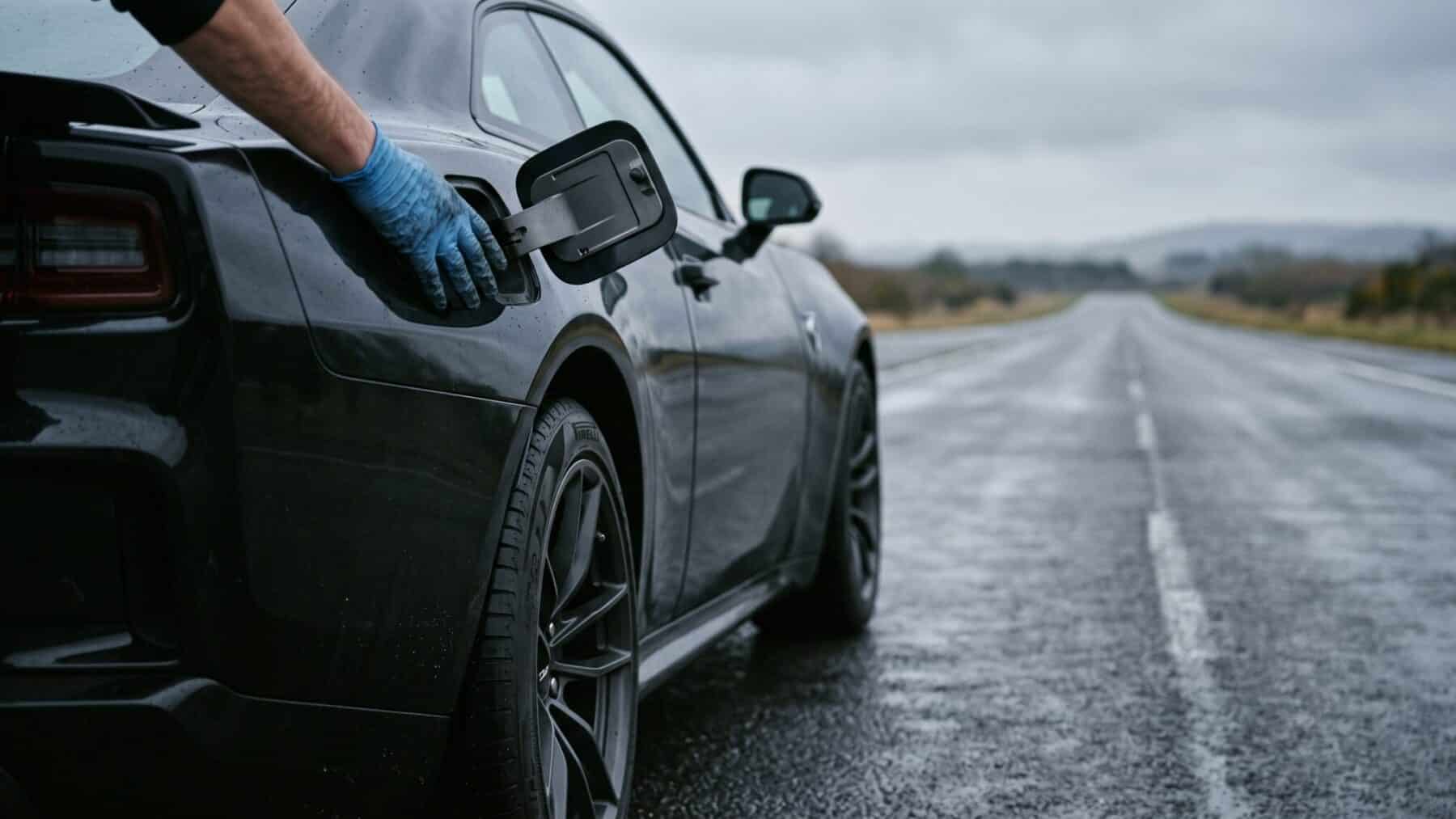
Picture a Dodge Charger Daytona rolling out of a test facility on a grey summer morning.
Inside its battery pack, there is almost no conventional liquid electrolyte. The cells are dense and largely dry, unlike anything in a production electric car sold anywhere today. Engineers have spent years arguing about whether this chemistry could survive a real road. This summer, it did.
Why a near-solid cell holds so much more energy than the liquid packs you know
Every lithium-ion battery in every electric car on sale today uses a liquid electrolyte to carry charged particles between the electrodes. That liquid is a core reason packs are heavy, a reason they can overheat, and a reason energy density has a ceiling.
Replace the liquid with a solid or near-solid material and you can eliminate much of the volume the fluid occupied, tighten the gap between anode and cathode, and allow the use of a lithium-metal anode that stores far more charge in the same space. The validated cells reach 375 watt-hours per kilogram, demonstrated over 600 cycles progressing toward automotive qualification. That compares with roughly 250 to 270 for the premium lithium-ion packs in today’s EVs.
That gap is not incremental. It is the kind of jump that either lets a car travel farther on the same weight or hold its range on a smaller, lighter pack.
So the engineering trade-off shifts completely. Heavier packs cost more and eat into the weight budget that determines how a car handles. A denser cell that does more with less mass breaks that constraint in both directions at once.
The test car, the cell chemistry, and what the Charger carries under its floor
Stellantis and Factorial reached a milestone this June: the integration of Factorial’s FEST solid-state battery technology into a Dodge Charger Daytona development vehicle and the launch of a road-testing program to verify performance, safety and reliability. It marks the first integration of solid-state cells into a Stellantis vehicle.
FEST cells demonstrated an energy density of 375 Wh/kg, ultra-fast charging from 15% to 90% in just 18 minutes and robust reliability from minus 30°C to 45°C. That temperature window covers the coldest Minnesota winter and the hottest Phoenix summer, which is exactly the range that prior solid-state prototypes consistently failed to hold.
Cold starts and charge heat have killed more promising battery chemistries than any laboratory problem ever has.
The cells were integrated into the existing battery pack using an innovative, patented new mechanical architecture developed by Stellantis to bring out the best of solid-state cell performance. That detail matters because it signals the technology does not demand a completely new platform. Stellantis selected the STLA Large platform as the basis for the development car.
The numbers behind the validation and where the data comes from
Stellantis and Factorial validated a 77 amp-hour cell at 375 watt-hours per kilogram, with over 600 cycles progressing toward automotive qualification. The cell validation was announced in Stellantis’s April 2025 press release, with the road-testing milestone confirmed on June 11, 2026.
The cells deliver high power output with discharge rates of up to 4C , meaning the battery can be fully discharged in as little as 15 minutes. That rate is well above what standard EV packs manage, and it is precisely why the Charger Daytona was chosen. A performance car pushes harder on its cells than a crossover, making it a severe real-world test environment.
Factorial holds partnerships with Mercedes-Benz, Stellantis, Hyundai and Kia. A validated cell that multiple large automakers have already contracted around carries very different weight from a startup’s press release. That breadth of commitment also lands at a moment when the fast-charging race is intensifying across the whole industry.
Where this technology does not yet deliver, and the gap between a test car and a showroom
Moving a cell from a lab into a car is the step where most battery promises fall apart. Bench numbers come under controlled temperatures and clean charge cycles. A road car faces cold starts, fast-charge heat, vibration and years of wear.
Even in the best-case scenario, the new battery would still need to be implemented in a production EV and manufactured at volume, a process that adds several more years. Stellantis has not announced a production timeline for solid-state battery-equipped vehicles, though the company has hinted that 2028 would be a target. As Factorial’s chief executive Siyu Huang has said, what the two companies built together, “from cell chemistry to pack architecture to enable real-world road testing,” is the kind of deep collaboration solid-state has always required. The road-testing phase is where the industry finds out whether the lab numbers hold under conditions no laboratory can fully replicate.
Commercial timelines for new chemistries have a long history of slipping by two or three years even after promising road tests. The Charger Daytona program is a proof of integration, not a production commitment.
For buyers weighing a new EV purchase today, the short-term reality is that current lithium-ion cars are the only option at the dealership. The test-to-showroom gap is still measured in years, not months.
What changes if the road test holds, and the shift it signals for the whole EV battery market
A battery that adds range without adding weight, or keeps the range while cutting the cost, is the exact lever the sector has been missing. Right now, automakers largely compete on pack size. Bigger packs mean more range but higher costs and heavier vehicles.
A cell with roughly 40 percent more energy per kilogram than today’s best lithium-ion packs breaks that equation. It lets a mid-size sedan compete on range with a much larger vehicle, and it does so without demanding a heavier platform to carry the load.
The 18-minute charge window, from 15 to 90 percent, is particularly significant at highway speeds. At that pace, a charging stop becomes comparable to a gas station visit rather than a meal-length wait.
None of that is guaranteed by a single development vehicle. But with the battery pack now complete, Stellantis and Factorial have integrated FEST solid-state battery cells into a Dodge Charger Daytona development vehicle, the first such automotive integration in North America, and a road-testing and calibration program is now underway. That is the step every prior announcement in this space failed to reach. The road test settles nothing by itself, but it starts the phase that decides whether any of these numbers ever reach a window sticker.
