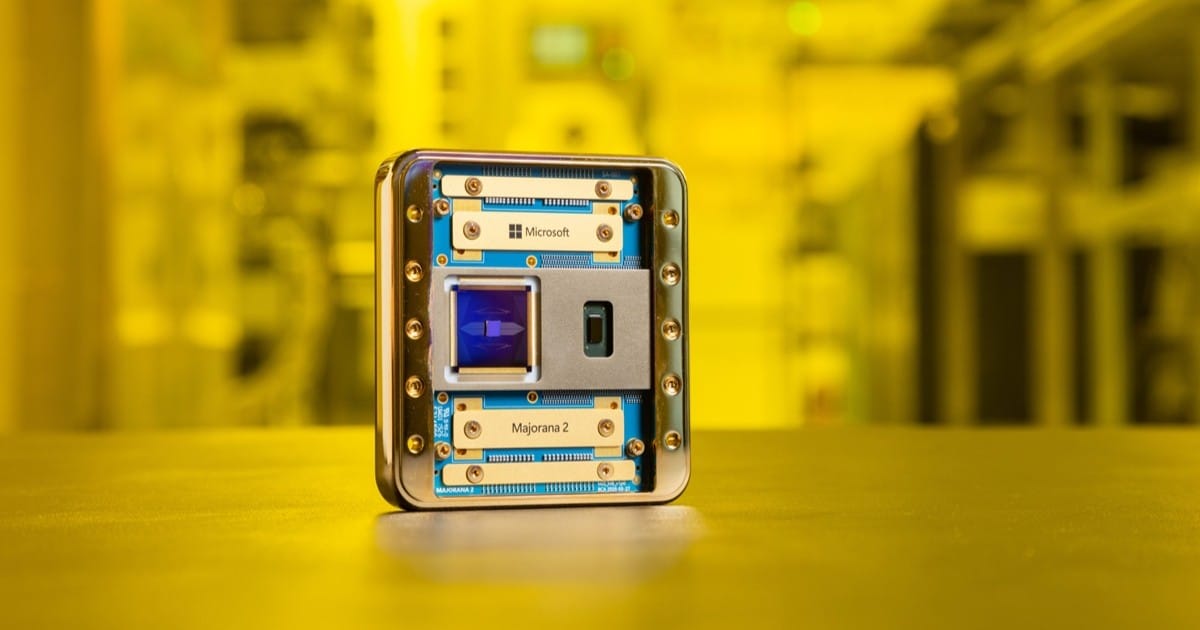
A chip smaller than a thumbnail sits at the center of one of the biggest bets in computing.
It runs near absolute zero, inside a refrigerator the size of a chandelier. The quantum information it holds used to vanish in milliseconds. Then researchers swapped one metal for another, and everything changed.
How does a single material substitution stretch a qubit’s life by a factor of 1,000?
Why lead does what aluminum never could inside a quantum wire
Each qubit in the chip is built from a structure called a tetron: two superconducting nanowires arranged in a parallel pair, with Majorana Zero Modes sitting at their ends. Those exotic quasiparticles store quantum information through parity, the evenness or oddness of the number of electrons inside each wire.
The trick is that the information is not trapped at one point. By encoding data nonlocally across spatially separated states, the stored information becomes inherently more resistant to localized disturbances.
The most significant change in the new chip is the replacement of aluminum with lead as the superconducting material. Lead provides a substantially larger superconducting gap than aluminum, making it far harder for environmental disturbances to generate unwanted excitations. Think of the gap as a moat around the qubit: the wider the moat, the harder it is for thermal noise to scramble a calculation.
The chip also updates the semiconductor active region to indium arsenide antimonide (InAsSb), a compound that sits sandwiched against the lead. The resulting topological gap is significantly wider than that of the previous processor. Together, the two changes transform the chip’s behavior class entirely.
What the chip looks like and how it fits inside a real machine
Each qubit is constructed from two parallel nanowire segments arranged in an H-shaped geometry, creating four Majorana Zero Modes. That H-shape is the tetron, and a working processor links many tetrons into a grid.
The entire assembly operates at temperatures close to absolute zero, where the lead layer becomes a true superconductor. The new material stack creates qubits with lifetimes averaging 20 seconds, with some lasting as long as one minute. That is roughly the time it takes to read this sentence aloud, an eternity by quantum computing standards.
Most competing superconducting qubits decohere in microseconds to low milliseconds. The gap is not incremental.
Topological qubits are also uniquely suited to scaling because of their inherently low error rates, small size, and digital control. A future chip can pack more of them into the same cryogenic volume than conventional designs allow, a quiet engineering advantage that drives nearly every cost and complexity projection in the field.
The hard numbers behind the 1,000-fold jump
The new materials stack delivers Z-parity lifetimes exceeding 20 seconds, representing an improvement of more than three orders of magnitude over the 1 to 12 milliseconds measured in aluminum-based devices. Majorana 2 has a mean qubit lifetime of 20 seconds, with some instances lasting up to one minute, compared with one to 12 milliseconds in Majorana 1. These figures come from a technical paper filed at arXiv under identifier 2606.03884 and posted June 3, 2026, for independent review.
That is a jump of three orders of magnitude in a single hardware revision, not an incremental step. The chip was developed with the help of Microsoft Discovery, an agentic AI platform designed to accelerate scientific research.
Across the broader quantum field, leading platforms have pushed two-qubit gate error rates below one percent, making quantum error correction viable. Yet the topological approach aims further, preventing errors at the hardware level rather than patching them afterward. That structural difference is what makes the material swap so consequential. Progress in underlying chip performance is visible in our coverage of how global chip sales surpassed any previous full-year record in just seven months.
Where the approach still faces friction
The chip is an updated version of a highly controversial predecessor, and whether Microsoft has actually built a topological qubit, or is instead measuring something else entirely, remains one of the most contentious questions in condensed-matter physics. The central dispute is whether the Majorana Zero Modes in the device are genuine topological quasiparticles or subtler electronic artifacts that mimic their signature.
Engineering constraints further complicate progress. Lead is softer and more reactive than aluminum, which means the manufacturing process must be rebuilt from scratch. Cleanliness inside the deposition chamber becomes critical in a way it simply was not before.
There is also the question of scale. The current device is a research processor, not a commercial product, and moving from a handful of reliable topological qubits to the thousands needed for a fault-tolerant machine is the unsolved engineering step the 2029 target implicitly requires. That challenge mirrors the infrastructure scaling questions covered in our look at how one startup splits a single AI job across completely different chips at the same time.
What a 2029 fault-tolerant target actually means for computing
Microsoft has cut its timeline for achieving a scalable quantum computer from 2033 to 2029, a four-year compression that the company attributes to the material stack change and the agentic AI development work that supported it.
Chetan Nayak, Microsoft’s technical fellow and corporate vice president of quantum hardware, said: “We need to make improvements each year that will get us closer to delivering a computer that we believe will have massive commercial and societal value. We’ve got to keep marching to that roadmap to accomplish that, but where are we relative to last year? We’re 1,000 times better.”
A fault-tolerant quantum machine could tackle intractable problems in global health, food supply, sustainability and energy production. A processor that keeps its qubits alive for a full minute transforms what is simulatable and at what depth.
The most significant trend in the field right now is the quiet movement of quantum applications from academic papers into corporate pilots. That transition depends entirely on the hardware reliability the new chip claims to demonstrate. Whether or not 2029 holds, the proof that a single material swap can extend qubit parity lifetime by a factor of 1,000 resets the baseline every competing team now has to beat.
