
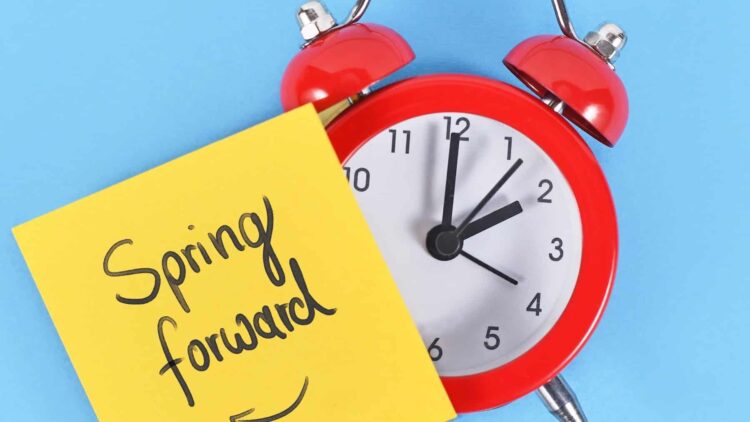
January is nearing its end and with it, slowly goes the icy winter days and with the passing of the winter solstice, comes shorter nights followed by longer days. Once the snow melts, it will, yet again, be time to “spring ahead” and adjust your clocks to enjoy an extra hour of daylight.
What is Daylight Saving Time?
Clocks across the country have to be adjusted twice a year to change from standard time to daylight saving time. This occurs once during the summer months when we “spring forward” and again during the winter months when we “fall back” to standard time.
NSIT has reported that “in the United States, this has the effect of creating more hours of sunlight in the evening during the months when the weather is warmest. In 2025, 2 a.m. on Sunday, March 9 will mark the end of standard time and the beginning of Daylight Saving Time. At that time, clocks will jump forward one hour, from 2 a.m. to 3 a.m. This will continue until Sunday, November 2, when clocks will jump back from 2 a.m. to 1 a.m.
What is the history of this phenomenon?
The National Institute of Standards and Technology has determined that DST lasts for 238 days, or about 65% of the year. The phenomenon was first introduced in the USA in 1918 under the name “Fast Time”. It was repealed less than a year later, but its use continued in cities such as Boston, Pittsburgh, and New York.
In 1942, during the administration of President Franklin D. Roosevelt, the idea was soon reintroduced, now under the name “War Time”. This lasted until 1945. However, it was not until 1966 that uniform rules for changing time were officially established in the United States. This became known as the Uniform Time Act.
What is the relation between Americans and the time change in the present day?
“Springing ahead” and “falling back” has been something of a struggle for Americans for years. According to the National Conferences of State Legislatures, 2023 alone recorded at least 75 pieces of legislation filed across 29 states. To the nation’s dismay, none of the legislations became law that year.
In more recent developments, newly re-elected President Donald Trump made an announcement regarding this matter on social media platform, X. He proclaimed that the Republican Party will “use its best efforts to eliminate Daylight Saving Time,” and that it “has a small but strong constituency, but shouldn’t!”
He reaffirmed that, “Daylight Saving Time is inconvenient, and very costly to our Nation.”
Trump’s claims may be bold, but they are not unique and a stance against this tradition has been taken in the past. A bipartisan group of legislators, including U.S. Sen. Ed Markey, D-Mass. first rolled out a legislation that would make daylight saving time permanent across the country. This was known as the Sunshine Protection Act.
A 2021 release reports, “The bill would simply negate the need for Americans to change their clocks twice a year”, and while the bill did manage to pass the Senate in March 2022, it did not clear the U.S house.
Frustration is evident in a statement made by Markey, wherein he says, “this head-spinning ritual of falling back and springing forward has gone on long enough, it isn’t just a nuisance — changing our clocks also has a very real impact on our economy, our health, and our happiness.”
Dressing up the notion of daylight saving time with cute puns like “springing ahead” and “falling back” is not enough to mask people’s annoyance with the transition. Whether attempts are made to make Daylight Saving Time permanent or to eliminate it, one sentiment is for certain — everyone is over it.