
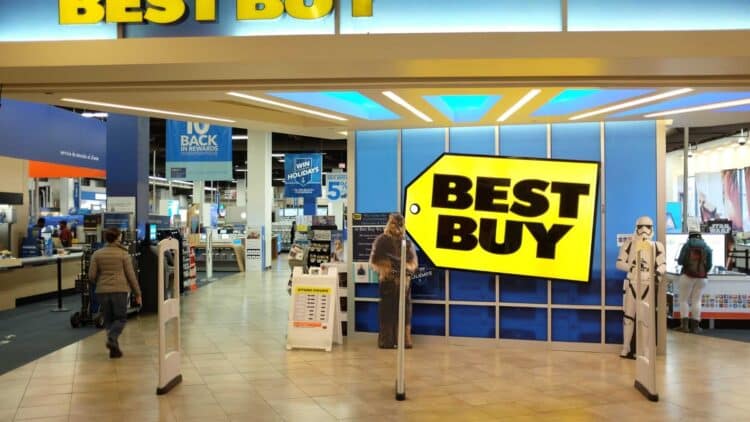
Best Buy, the retail chain specializing in electronics, may be suffering a potential blow amidst tariff regulation changes set forth by the newly re-elected president, Donald Trump. The electronics giant had previously been facing some setbacks in recent months that ultimately led to the decision to re-evaluate the number of physical stores it will keep running. Best Buy has already closed the doors of 24 of its locations, with the closure of 10 to 15 more slated for the near future.
President Trump has introduced a higher tariff rate for products sourced outside of the United States of America, and as a result, the already struggling electronics retailer will have to re-evaluate its current trade processes.
Tariff Talk
In his sequel presidency, decisions made by Donald Trump in his early days in office have resulted in a massive inflation of tariff rates. Goods entering the country from Mexico and Canada will now incur a 25% tariff and good from China will have a 10% tariff. It is also alleged that the European Union will be the next target of inflated tariffs. The president claims to have enacted these increased tariffs, in part, to combat the prohibited entrance of fentanyl into the States.
Consumer’s are not as detached from these tariff hikes as they would like to be. Granted, they do not have to pay tariff fees themselves, but if a retailer has to pay increased tariffs, the price of the goods they sell will likely face an increase as well. The irony of the situation — that was perhaps overlooked by the president when he enacted the increase — is that if prices increases, consumers will buy less.
It should be noted that at present, the 25% tariff rates on Canada and Mexico have been put on a temporary pause. China’s 10% tariff remains in effect through this pause, however.
How will Best Buy continue to buy the best?
These raised tariffs could have a lasting impact on the popular electronics retailer and the company is currently assessing the situation and potential resolutions.
When asked by MRP News about the company’s position regarding these tariff tensions, Corie Barry, a chief executive at Best Buy, said, “What we’re trying to do is support the administration’s goals. So you’re trying to understand, like, what are we really trying to accomplish here, but also to educate on what that means for the American consumer.” This statement was shared at the First Tuesday speaker series at the University of Minnesota’s Carlson School of Management.
The changes to import tariffs means that now the increased 10% fee will be paid by the entity importing goods from China, rather than the foreign exporter. Barry has also cautioned consumers that this tariff increase will cause a domino effect that could potentially result in a higher price point for items in store.
The company will presumably make efforts to source its production from alternative, cost-effective vendors, however, Barry further noted that, “We’ll work with vendor partners, but at the end of the day, these really do become costs that get passed on to the American consumer. They flow through that entire supply chain, and they become part of the baseline cost.”
Barry also shared that a new goal for the company is to expand production away from China to aid this issue. Unfortunately, diversifying a supply chain on such a large scale will, of course, take a lot of time and effort. The fallout of this means that there is a possibility that customers will be stuck with increased cost until the matter is resolved.
“About 60 percent of our cost of sales flows through China in some way, shape or form. And that’s actually been pretty consistent, even with everything that’s happened over the last five years,” Barry added.
The almost obvious solution of rehoming production to America is not particularly feasible and it is actually quite difficult to build in the U.S., according to Barry who also noted that “these aren’t supply chains that are easy to build here. And in fact, many companies that have tried to build supply chains here in the U.S. have not been successful because they’re so complex, because of the quantities of labor and technical expertise that you need.”