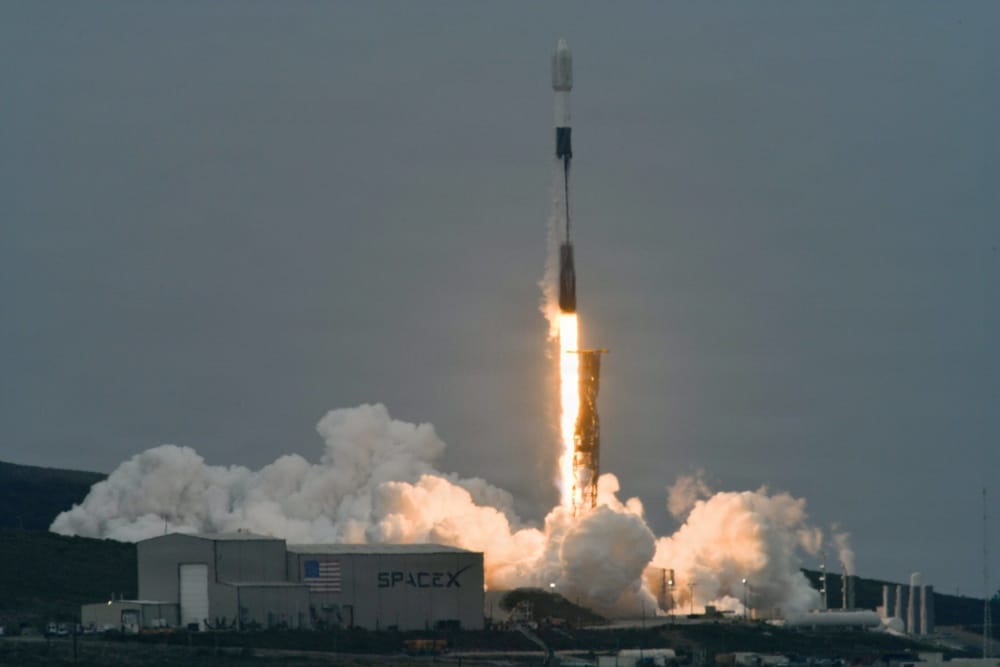
A rocket lifts off from a foggy California coastline before sunrise, carrying two dozen flat satellites stacked like dinner plates inside its nose cone.
Within an hour, those satellites separate and begin spreading their solar wings against the black of space.
Nothing about the scene looks historic.
But the fleet those satellites just joined quietly became the largest machine humans have ever put into orbit.
So what actually lets one company keep stacking thousands of spacecraft into the sky without the system collapsing under its own traffic?
How one network keeps adding thousands of satellites without jamming the sky
The trick is not just launching more hardware, it is getting the satellites to talk to each other instead of relying on the ground. Newer spacecraft in the fleet carry onboard laser terminals that link neighboring satellites directly in orbit, bouncing data from one spacecraft to the next rather than sending every signal down to a tower first.
Each Starlink satellite contains three space lasers operating at up to 200Gbps, together forming a global internet mesh that can connect customers anywhere in the world. One typically links to the satellite ahead, one to the satellite behind, and one to a neighboring orbital plane. That arrangement means a user’s data can hop satellite to satellite across an ocean before it ever reaches a ground station.
Because of that mesh, the constellation does not need a ground antenna within sight of every customer. A connection from a ship in the middle of the Atlantic or a village above the Arctic Circle can ride the laser mesh to whichever ground gateway happens to be reachable. That flexibility is part of why the operator keeps adding satellites to polar and high latitude shells specifically.
What the sky actually looks like with 11,000 working satellites up there
Picture the orbital shells as several stacked highway systems circling the planet at different altitudes, most sitting a few hundred miles up. Independent trackers that watch these shells report the constellation crossed 11,000 satellites this past summer, with the operational count near 10,000 as of late October, since the total in orbit and the number actively working are counted separately.
Compared with its rivals, SpaceX’s lead is overwhelming. SpaceX has more than 11,000 Starlink satellites in orbit, while OneWeb trails with several hundred, and Amazon Leo, which started launching production satellites in 2025, has about 392 in orbit as of October 2026. That shortfall is one we detailed in our coverage of the broadband fleet’s missed deadline.
Meanwhile two Chinese state-backed projects are still building toward their own ten-thousand-satellite ambitions. As of late October 2026, tracker data put combined deployment at roughly 480 satellites, still well under 3% of the two programs’ stated long-term ambitions of roughly 13,000 and 15,000-plus satellites, respectively. So one network alone accounts for the overwhelming majority of everything humming overhead right now.
The tracking numbers behind the two-thirds claim
The two-thirds figure is not a marketing line, it comes from independent catalogs that log every object circling the planet. As of October 27, 2026, there are 16,822 active satellites in Earth orbit, counting every satellite in CelesTrak’s active catalog, and 11,160 of the active ones (66%) are SpaceX Starlink satellites.
Orbital Radar tracking data separately recorded 9,996 active Starlink satellites out of 15,887 active satellites total as of 28 October 2026, putting the share in the same neighborhood even though the two catalogs count slightly different things. Trackers caution that none of these counts agree to the decimal point, since satellites are constantly climbing toward working altitude or sinking toward reentry at any given moment.
But every independent tracker lands in the same neighborhood, which is itself a kind of confirmation. SpaceX has launched about 13,000 all-time, and roughly 1,864 units have already reentered or left the active catalog, a built-in retirement cycle that keeps debris from piling up indefinitely.
Where the dominance runs into real limits
Even a fleet this large has edges. A further 961 satellites were raising their orbits and 178 were deorbiting, illustrating why launched spacecraft and operational satellites are different measures.
So the headline total and the working total are never quite the same number, and trackers are careful to separate them. That distinction matters for anyone trying to judge the network’s true size on a given day rather than its lifetime launch count.
There is also a policy question hanging over all of it. With one operator controlling such a dominant orbital share, decisions about altitude, collision avoidance and brightness made by a single company now shape how crowded low orbit becomes for every rival still racing to catch up.
What this milestone means for the years ahead
The practical upshot for ordinary customers is faster, steadier broadband reaching places fiber lines and cell towers never will, from fishing boats to rural households. That real world payoff is the whole reason the laser mesh and the relentless launch pace exist in the first place.
Competition is still coming, just slower than planned. Rival constellations measured in the hundreds and low thousands of satellites remain years from matching this scale, even as regulators keep adjusting deadlines and spectrum rules to keep the race honest.
For now, the two-thirds figure stands as a genuine first in spaceflight history. A single commercial network now outnumbers every government and competitor combined.
Whether that balance holds as Chinese megaconstellations ramp up by the end of the decade is the open question every tracker is now watching closely.
