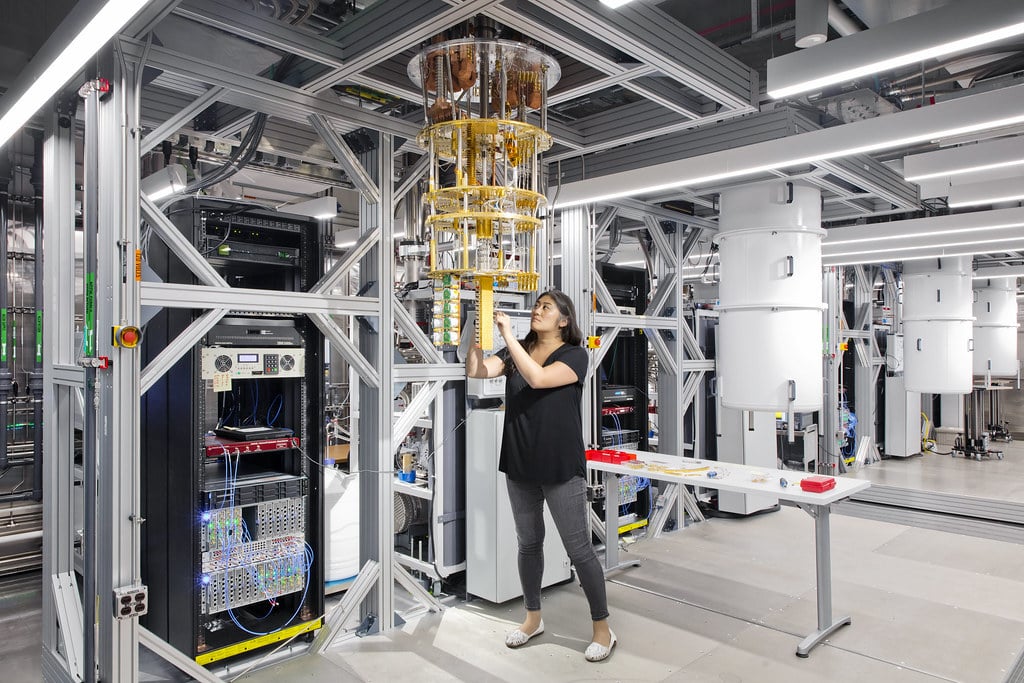
A vacuum chamber the size of a shoebox hums behind gold plated hardware in a Colorado lab.
Inside it, charged atoms hover in near perfect stillness, held by crisscrossing beams of laser light. Technicians outside the chamber run the same tiny calculation again and again, checking for slip ups. Out of one million of those checks, only five actually failed.
How do you get a computer this reliable
The trick is not a single flawless qubit. It is dozens of imperfect ones working as a team, a technique called a logical qubit encoding that spreads one unit of quantum information across many physical atoms at once. If one atom wobbles or gets hit by stray light, the rest of the group can detect the slip and quietly correct it before it spreads.
Quantinuum built this particular setup using something called a color code, a decades old mathematical pattern for arranging qubits so that errors show up as a kind of checkerboard signature. Engineers can read that signature in real time and fix the mistake mid calculation rather than after the fact.
So the heavier the protection, the fewer the mistakes. That sounds obvious, but in practice it rarely holds, because adding more fragile atoms to a system usually adds more ways for things to break. Here the opposite happened: in experiments using color codes of distance 3, 5 and 7, Helios reduced the logical failure rate by an average factor of 12 each time the code distance increased , a pattern that kept repeating as the protection scaled up.
That exponential pattern is the real headline inside the headline. It means the errors are shrinking faster than the extra hardware needed to fight them, which is the mathematical signature of a system actually headed toward fault tolerant computing rather than one that is simply getting lucky.
Picture the machine behind the number
The computer doing this work is called Helios, a 98 qubit trapped ion processor that Quantinuum runs out of its Broomfield, Colorado facility, a 98-qubit trapped-ion quantum processor based on the quantum charge-coupled device architecture . Unlike the chip based machines most people picture, it has no silicon wafer at its core, just a sliver of barium ions suspended in an electromagnetic trap.
Lasers do almost everything here. They cool the ions down to near stillness, they read out their quantum states, and they perform the logic gates that make the computation move forward, which is why each ion behaves as a naturally identical atom rather than a manufactured circuit. That uniformity gives the physical qubits a head start over anything etched onto silicon.
That uniformity is expensive in another way. The color code used as many as 37 physical qubits per logical qubit, compared with 10 for the company’s Helix code , far less. Similar tradeoffs between speed and precision already show up elsewhere in computing, the same way a single slim power connector can trade simplicity for strain.
So Helios effectively ran two different experiments on the same hardware within weeks of each other, one favoring efficiency and one favoring raw accuracy, letting engineers measure the real cost of pushing error rates lower.
Where the five in a million number actually comes from
The result was announced on October 19, when Quantinuum announced a world-record quantum error-correction result, achieving a logical fidelity of 99.9995% on its Helios commercial computer using the company’s error-correction architecture .
Researchers tested the color code at three different code distances, three, five and seven, essentially three sizes of the same error correcting pattern. They measured how often a single logical qubit still failed per operation cycle, repeating each configuration enough times to separate real signal from noise.
Logical fidelity reached 99.9995% in October, within Apollo’s target range, with an error rate ten times lower than September’s record and 100 times lower than the best published result across other hardware modalities . That comparison matters because it is not Quantinuum grading its own homework. Independent outside scientists have weighed in too, calling the result a milestone the field has chased for years, and even skeptics who publish weekly rundowns of hype versus substance conceded that “the measured suppression factor of 12 with each increase in code distance provides evidence of exponential error reduction rather than a single optimized demonstration.”
What still holds this back from everyday use
None of this means a usable quantum computer shipped last month. The test ran a single, carefully chosen operation under lab conditions, not a long real world calculation stitched together from thousands of steps involving routing and measurement.
That distinction is not a technicality. A five errors per million figure measured on one operation is not the same as a rate maintained across a large algorithm with routing, measurement, reset, decoding, and classical control all running in the loop at once. Stack enough of those steps together and small gaps add up fast.
There is also a blunt resource problem. Using up to 37 real atoms just to protect one unit of usable information is a steep price. The Helix code used only 10 physical qubits per logical qubit, compared with up to 37 for the color code, though the color code delivered lower logical error rates , and scaling either ratio to the thousands of logical qubits a truly useful machine would need remains an open engineering fight.
Even so, the tradeoff itself is valuable information. The two demonstrations illustrate how Quantinuum can rapidly prototype different error-correction codes within the same architecture to optimize for relative strengths in accuracy, efficiency, and speed , which is the kind of concrete tuning knob that other error correction efforts are racing to match.
What this milestone opens up next
Quantinuum frames all of this as a waypoint, not a finish line. The company is targeting a fully fault tolerant machine it calls Apollo, planned for 2029, and says this fidelity result falls inside the accuracy window that roadmap requires.
That is a promise, not a delivered product, and quantum computing has a long history of ambitious target years slipping. Still, the underlying trend, errors falling exponentially rather than just linearly as protection increases, is exactly the behavior theorists said would be needed before fault tolerant machines become realistic.
Because the test ran on commercially available hardware rather than a one off lab prototype, outside researchers and paying customers can eventually run their own versions of this same check, the kind of scrutiny already applied to other open tools reaching wide release.
For now, the honest takeaway is narrower than the headline number suggests but still genuinely significant. A trapped ion machine proved that piling on more redundancy does not just incrementally help, it compounds, and that is the exact signal the field has been waiting to see confirmed outside a whiteboard.
