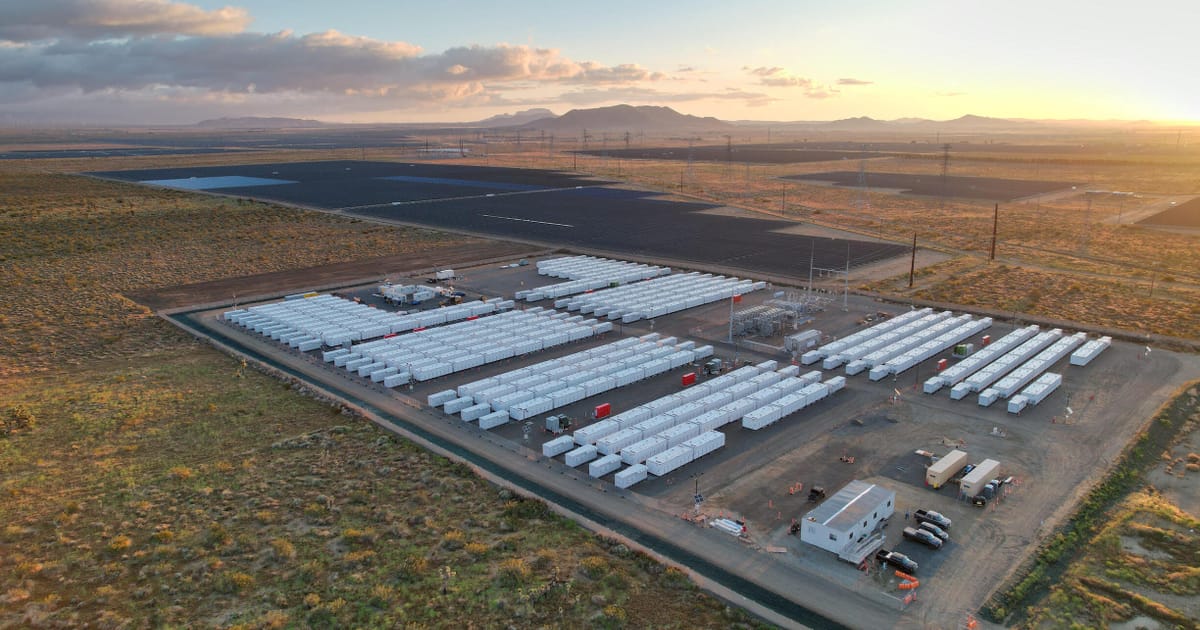
Rows of white steel containers sit on a gravel pad outside Rosamond, each one packed with battery racks instead of cargo.
By late afternoon the containers begin pulling in sunlight that arrived hours earlier as electricity.
They will not let it go until well after dark.
That single design choice just rewrote what a grid battery in California is built to do.
So what actually changed inside the box, and why does eight hours matter so much more than four?
How a battery doubles its discharge window without changing its chemistry
The trick behind the Tumbleweed project is not a new kind of battery chemistry at all. It is simple multiplication: more battery boxes sitting side by side on the same patch of land, all wired to discharge through the same connection to the grid. A standard grid battery today is built for a four-hour run, charging at midday and draining fast once demand climbs after sunset.
Tumbleweed’s developer, REV Renewables, took that same basic unit and doubled the hardware on site rather than inventing a denser cell. The company’s storage development lead, Cody Hill, told Canary Media that the team “literally doubled the number of battery boxes on the site,” and added “Technology-wise, the differences are pretty trivial.”
Because the batteries are lithium-ion, the jump to eight hours is mostly an exercise in scale and land. The Kern County parcel was too small for solar but fit a dense battery footprint, and that tradeoff let engineers absorb a full afternoon of surplus solar instead of just shaving the sharpest edge of the evening spike.
A patch of old oil country now anchors the overnight grid
The ground beneath Tumbleweed used to produce oil, not electrons. Kern County’s arid, scrubby terrain that once hosted oil extraction has become a hot spot for wind, solar, and batteries , though the site still looks almost unremarkable from the road, just shipping-container-sized boxes behind a chain-link fence.
Inside, racks of cells feed inverters that convert stored direct current into the alternating current that moves through transmission lines. The output is not small. The plant is rated at 125 megawatts of power and roughly 1,000 megawatt hours of stored energy, enough to discharge at full strength for the entire eight-hour window it was built around.
That stretch runs roughly from 6 p.m. to 2 a.m., filling up on strong solar generation from around 8 a.m. to 6 p.m. before pushing it back out overnight.
Those are the hours when solar has vanished but air conditioning and lighting have not, precisely the gap that shorter batteries and gas peakers have historically filled.
Regulators confirm the record and the mandate behind it
The California Public Utilities Commission confirmed the plant came online as the first eight-hour battery built under its integrated resource planning process, a requirement written specifically to push the market past the four-hour standard that dominates the fleet today.
The project was developed with Northern California community choice aggregators, including Ava Community Energy and California Community Power, whose contract satisfies a share of a state mandate for long-duration storage. CPUC Executive Director Leuwam Tesfai said at the commissioning that “as the first eight-hour long duration energy storage project developed under the California Public Utilities Commission’s Integrated Resource Plan procurement requirements, Tumbleweed demonstrates how forward-looking policy can most affordably accelerate deployment of the next generation of grid infrastructure.”
Independent trade coverage from Energy-Storage.news matched the same commissioning date and capacity figures. That gives the milestone two separate confirmations beyond the developer’s own announcement, and it explains why this battery was engineered from its first sketch to run twice as long as the rest of the fleet.
Where eight-hour storage still falls short
Even an eight-hour battery has a ceiling on endurance. It drains completely if demand stretches past the early morning hours, or if a heat wave keeps air conditioners running long after sunset across several days in a row.
Because the technology is still lithium-ion, Tumbleweed shares the same degradation curve as every other grid battery, losing a slice of capacity with every cycle. A battery built to run eight hours today may run somewhat less years from now.
That gap matters.
It is one reason iron-based and flow batteries, built for far longer discharge windows, are still being tested elsewhere for multi-day storage, while the broader fleet of four-hour batteries keeps expanding fast, increasingly paired directly with solar farms in a shift EIA data confirm is accelerating nationwide.
What the milestone signals for the grid ahead
So the real significance of Tumbleweed is not its size alone. It is proof that a familiar battery chemistry can be stretched further simply by building more of it in one place, a far cheaper path than waiting on an entirely new chemistry to mature.
Regulators now have a working example to point to as they push other developers toward similar long-duration contracts, and the same aggregators involved here have signaled interest in further projects now that this one proved the model works on schedule.
Demand-side programs are shifting too.
Efforts like the fleet charging depots adding load across four cities show every piece of the grid nudging toward running more of its day on stored sunlight. None of this guarantees eight-hour batteries become the new standard overnight, but one dusty former oil patch in Kern County has shown regulators, and every developer watching, that the next battery nearby can simply be built bigger rather than reinvented from scratch.
