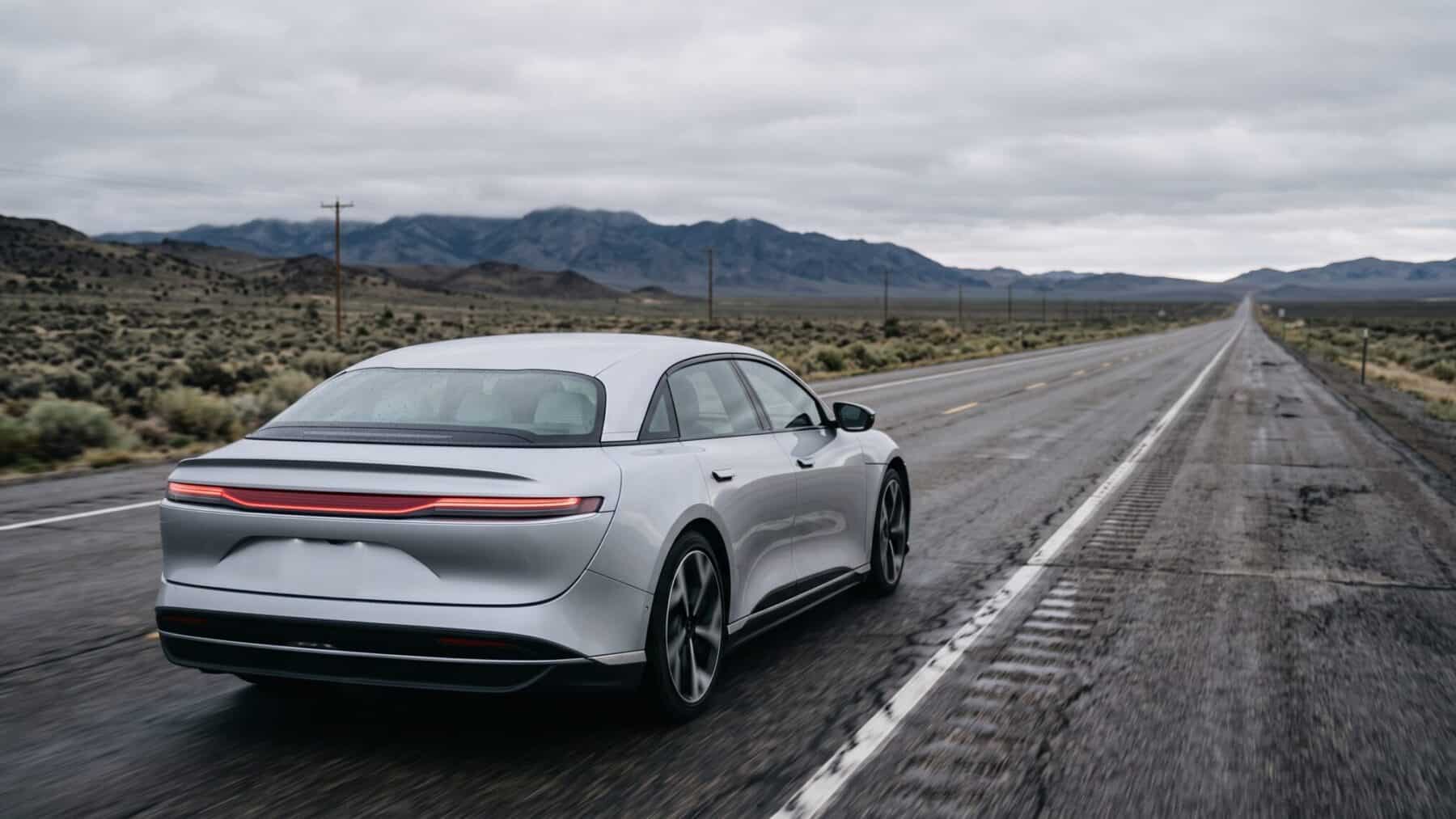
Pull up to a fast charger with a full 512 miles on the dash.
Drive from Chicago to St. Louis and back without stopping for power. Never stop for a charge on a Los Angeles-to-San Francisco run. That is the arithmetic behind the longest EPA-rated range of any production electric car sold in the United States right now. And the machine doing it is not a truck with a battery the size of a shipping pallet.
How the same miles cost fewer kilowatt-hours than anything else on the road
The Lucid Air Grand Touring delivers a US EPA-estimated range of up to 512 miles without relying on the enormous battery packs used by long-range electric trucks and SUVs. The secret is in how little energy the car burns per mile, not how many kilowatt-hours it can store. Its EPA-rated efficiency of 128 MPGe combined, equivalent to 4.3 miles per kilowatt-hour, is what separates it from large-format electric pickups covering the same distance.
Aerodynamics do most of the work. The body carries a drag coefficient among the lowest of any production sedan on sale, and every fraction of drag saved compounds across hundreds of highway miles.
The sedan also produces 819 horsepower and accelerates from zero to 60 mph in three seconds. On a compatible 350 kW DC fast charger, it can recover approximately 248 miles of range in around 16 minutes. So the longest-range EV in America is also a rapid charger and a genuine performance machine.
What 512 miles of range looks like in a real American drive
Picture the car at a full charge in downtown Dallas. A commute running 30 miles each way burns only a fraction of the pack, leaving well over 200 miles of capacity for weekend trips. For most US drivers, a weekly charge is enough.
The Air is the only production EV capable of exceeding 500 miles on a single charge, placing it in a category of one. Every other electric car or truck on the US market today sits at least 19 miles below that mark. Six 2026 models exceed 400 miles on the EPA cycle: the Air at 512, the Silverado EV at 493, the Escalade IQ at 465 (a Cadillac manufacturer estimate rather than a formal EPA label), the Sierra EV at 460, the Lucid Gravity at 450, and the R1T at 420 miles.
But the gap in how that range is built is just as striking as the numbers. The trucks and SUVs on that list carry battery packs close to 200 kilowatt-hours, while the sedan’s pack is 117 kilowatt-hours. Less mass to move means less energy burned each mile, and the advantage compounds across every kilometer of every trip.
The verified record behind the EPA number
The Air’s 512-mile EPA figure is independently tested, not a manufacturer estimate, which matters when comparing it with rivals whose long-range claims carry only an in-house testing stamp. It went through the same independent test cycle used for every other EPA-rated vehicle on American roads.
The automaker also holds a Guinness World Record for the longest journey by an electric car on a single charge: an Air Grand Touring covered approximately 749 miles on one charge, traveling from St. Moritz, Switzerland, to Munich, Germany. That hypermiling result is nearly 50 percent above the already-record EPA rating. Founder and former CEO Peter Rawlinson has long argued that it is Lucid’s in-house motor and inverter technology, rather than raw battery size, that separates the Air from competitors.
A decade and a half ago the average battery-electric vehicle could cover around 100 miles before needing to stop. The progression to a 512-mile intercity sedan required sustained advances in battery chemistry, motor design, and power electronics across roughly 15 years of development.
Where the record does not hold and what real-world driving costs
The EPA number is measured in a controlled lab environment at moderate speeds and mild temperatures. Real highways tell a different story. Independent testers have repeatedly pushed the Air Grand Touring deep into 400-plus-mile territory at highway speeds, though results vary with pace, temperature, and terrain. One widely cited 70 mph loop exceeded 510 miles, while drivers cruising faster or in warmer cabin conditions can expect meaningfully less.
Cold weather is the harder penalty. Range can drop 20 to 35 percent in freezing conditions because the battery loses efficiency and the cabin heater draws serious power, though preconditioning and heat pumps cut the penalty significantly. Winter in Minneapolis or Denver will meaningfully compress that 512-mile figure.
Cost is the other wall. Every model exceeding 400 miles of EPA range costs over $55,000, and most sit well above $70,000. The range record and the fast-charging network it pairs with are not yet a mainstream proposition. If you want to top up on the road, fast-charging stalls at grocery-anchored centers are expanding the practical reach of long-range EVs for everyday drivers.
What the 512-mile benchmark means for the cars being built right now
The range record shapes what engineers at rival automakers put on their drawing boards. The benchmark for a respectable maximum range has settled around 300 miles, and the field of electric vehicle models competing to exceed it continues to grow. Five years ago, a 200-mile range was often considered sufficient for a premium EV.
Electric vehicles are on course to represent a significantly larger share of car sales worldwide than they did five years ago. As volumes grow, the pressure to close the range gap intensifies. New electric assembly lines are being engineered from the ground up with longer-range targets baked into the design brief.
The Air’s lead will eventually be caught as battery chemistry and manufacturing scale keep improving. But the 512-mile mark will remain the number that forced every EV maker to treat highway range as a first-order engineering goal rather than a footnote. For now, no production car sold in America goes further on a single charge.
