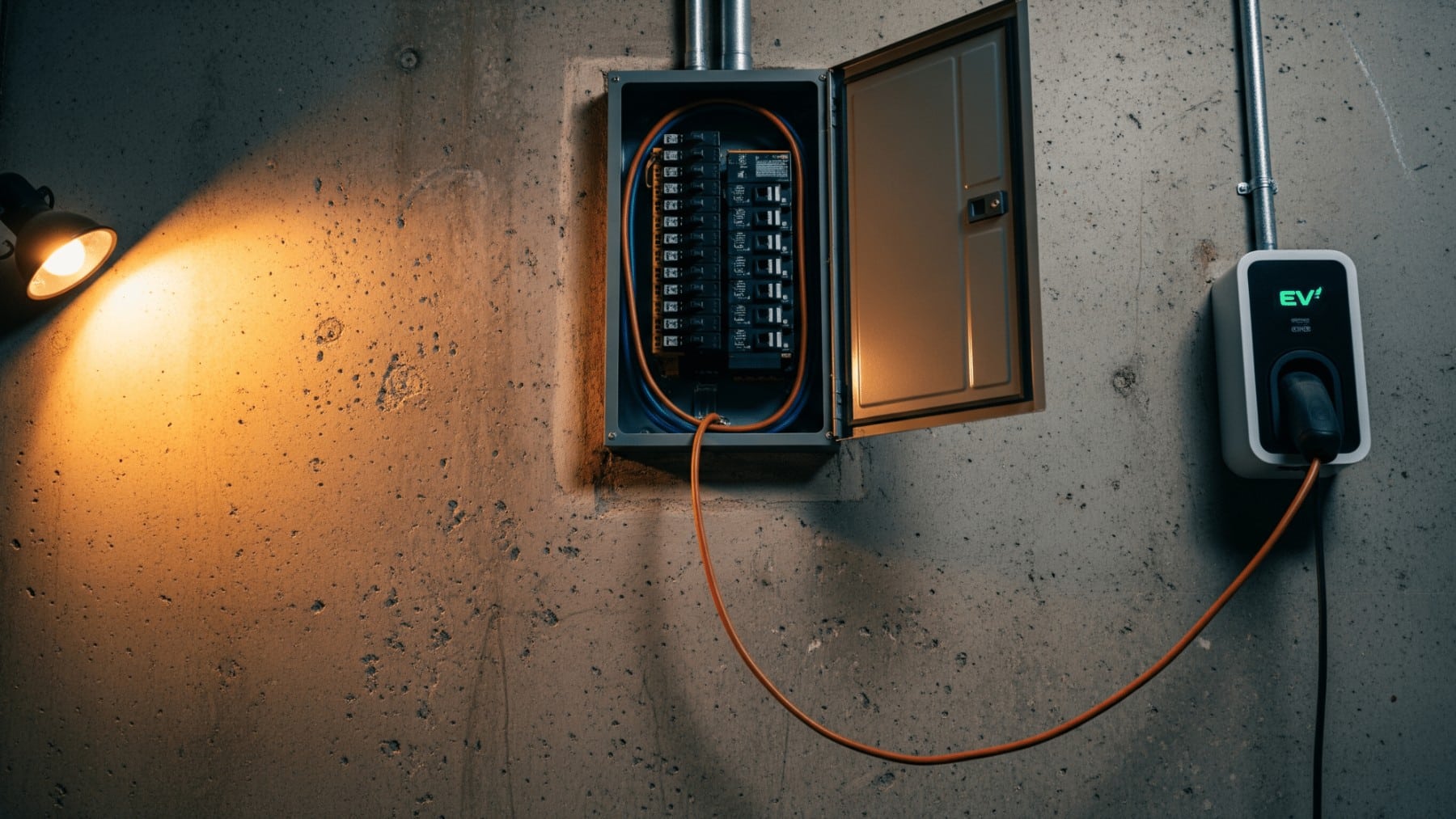
It sounds like the dream upgrade: buy an electric vehicle, hire an electrician for a Saturday, and wake up every morning to a full charge in the garage. No gas station. No range anxiety. Just plug in and go.
Millions of Americans are doing exactly that, and millions more are expected to follow.
But there is a box on the wall of almost every home in the country that nobody thinks about until something goes wrong. Right now, that box is becoming the real bottleneck in America’s electric future.
The appliance that changed how America thinks about home electricity
A Level 2 EV charger runs on 240 volts, the same circuit as a clothes dryer, and can restore most electric vehicle batteries overnight.
Most units require a dedicated 40-amp circuit; the National Electrical Code mandates the breaker be sized at 125% of the charger’s continuous draw. A dryer uses similar power. A central air conditioner does too.
The difference is frequency. An EV charger is not a weekends-only appliance. It is always waiting to draw a large, sustained load, potentially every single night.
And it needs a dedicated 240-volt run straight from the main panel or an approved sub-panel; sharing a circuit with other high-draw appliances is not an option under code.
What an electrician sees when they open the garage door
When an installer arrives at an older home, the first thing they check is not the garage wall. It is the breaker box.
Older homes without central AC may only have a 100-amp panel. Newer homes typically have 200-amp panels with room to spare.
A 100-amp panel was never designed with electric vehicles in mind.
In a home already running central air, an electric dryer, an electric range, and an electric water heater, that panel may already be near its limit.
Homes built after 2000 skewed heavily toward 200-amp service, but a large share of older housing stock remains where capacity is tight.
A number that sounds small until you do the math
Most modern homes with a 200-amp panel handle charger installation without drama. But about 20% of homes need additional electrical work beyond basic installation, according to data from Qmerit.
Twenty percent sounds manageable at the household level. Multiply it by the scale of EV adoption and it becomes something else entirely.
The National Renewable Energy Laboratory estimates that sufficient grid energy may be needed to support 33 million EVs on the road by 2030. An estimated 64% of all EV charging is expected to take place at single-family homes using Level 1 and Level 2 charging.
If even a fraction of those homes require electrical work, the ripple moves outward.
Each upgraded panel draws more peak power from the distribution network feeding the neighborhood, and those neighborhoods feed the grid.
The real catch: what a $3,000 surprise does when it happens on every street
Here is the hidden cost that the charger box in the store never mentions.
When a home panel cannot safely handle a Level 2 charger, costs escalate fast.
A simple circuit addition runs $500 to $1,500. A sub-panel adds $800 to $2,000. A full panel replacement costs $1,500 to $4,000. A complete service upgrade can reach $5,000 or more.
A full upgrade from 100 to 200 amps means replacing the meter socket and service entrance cables, then coordinating with the local utility to disconnect and reconnect power.
That last step is where the grid enters the picture. The Department of Energy’s EVGrid Assist data projects that home Level 1 and Level 2 chargers will handle 80% of all EV charging by 2030, meaning the neighborhood distribution transformer is where most of America’s EV energy will actually flow.
That transformer was sized for televisions, refrigerators, and the occasional dryer. It was not sized for two dozen chargers running from 10 p.m. to 6 a.m.
As the grid capacity race being fought at the data-center level has a less visible twin playing out on every residential cul-de-sac, total U.S. electricity demand is already climbing, and residential electrification is a growing driver.
What happens when the grid catches up to the garage
The panel problem is real, but it is not a dead end.
Federal help existed in recent years: the 30C Alternative Fuel Vehicle Refueling Property Credit offered a 30% tax credit, up to $1,000, on home EV charger installation costs in eligible census tracts, though it expired June 30, 2026, after the One Big Beautiful Bill Act moved the sunset date forward from 2032. State, utility, and local programs continue to offset a portion of costs in many areas. Homeowners should verify current incentives with their utility or the DSIRE database.
Smart load management is changing the picture further. Modern tools watch total home consumption and automatically throttle the charger when the oven and dryer are running, then ramp back up once those loads drop.
A clear trend toward 200-amp panels in homes built after 2000 suggests the housing stock is slowly catching up to the demand.
The garage charger was always going to be more than a gadget. It turns out it is also a small, humming test of whether the electrical infrastructure laid down decades ago can carry the country into the next era of energy, one home panel, and one street transformer, at a time.
